 Maya MacDonald
Four women withdrew from the 2026 Strasbourg Open before a single competitive ball was struck. Madison Keys, Marta Kostyuk, Hailey Baptiste, and Elisabetta Cocciaretto all pulled out of the WTA 500 clay-court event at the Tennis Club de Strasbourg (May 17-23, 2026), each replaced by players further down the entry list. Among the replacements: Emma Raducanu, returning to competition after more than two months away following a post-viral infection. Meanwhile, two Canadians — top seed Victoria Mboko (ranked 9th in the world) and seventh seed Leylah Fernandez (ranked 23rd) — remain in the draw heading into the crucial Roland Garros warm-up week.
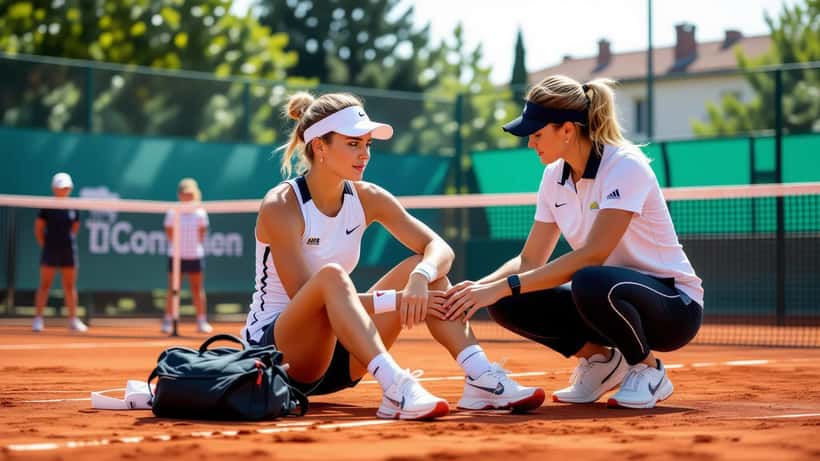
The four withdrawals at Strasbourg are not unusual in isolation, but together they illustrate something Canadian amateur athletes often learn the hard way: knowing when an injury requires you to stop — and when a sports medicine professional should make that call for you — is as important as knowing how to train.
Medical disclaimer: This article provides general health information. It does not replace professional medical advice. If you are experiencing pain or injury, consult a qualified sports medicine physician.
A Clay Season Taking Its Toll
The physical demands of clay-court tennis are distinct from those of hard or grass surfaces. Slower, heavier balls produce longer baseline rallies and sharper lateral movements. Topspin-heavy play increases stress on the knees, hips, and shoulder rotator cuffs. Recovery time between points is shorter than it appears on television.
By the time the Strasbourg draw was set, both Ekaterina Alexandrova (ranked 14th) and Clara Tauson (18th) had played only a handful of clay-court matches this season due to physical complaints. The cumulative load of a ten-month professional calendar — with minimal off-season — means that players arriving at the final pre-Roland Garros event in Strasbourg may already be managing borderline conditions rather than playing at full health.
For Raducanu, the calculus was different: a post-viral infection kept the British former U.S. Open champion out of competition for more than two months. Her entry into Strasbourg as a late replacement reflects the tension between competitive urgency and physiological readiness that athletes at every level must navigate.
Canada's Stakes
Victoria Mboko has had one of the more physically consistent seasons among young WTA players in 2026. At 20 years old and ranked 9th globally, the Toronto-born Canadian enters Strasbourg as the top seed — a milestone in what has been a rapid ascent through the rankings. Her durability has been central to that rise.
Leylah Fernandez brings a different kind of resilience: the 23-year-old has built her career on fighting through adversity, most famously at the 2021 U.S. Open where she defeated three top-five players in succession. At Strasbourg, Fernandez's seventh seed places her in the same tier as players who have had uneven physical preparation this clay season.
Both Canadians' presence in the draw, at a tournament that saw four peers withdraw before play, is a reminder that injury management is not merely a problem for the elite. The same structural and physiological principles apply to the thousands of Canadians who play recreational tennis — in community clubs, school programs, and municipal leagues — every week.
Three Zones: How Sports Medicine Physicians Classify Athletic Pain
Sports medicine physicians in Canada classify athletic pain into three management zones. Knowing them helps recreational athletes decide when to play through discomfort — and when to stop.
Green zone — continue: Generalized muscle fatigue, mild DOMS 24-48 hours after exertion, minor irritation. Expected byproducts of training. No rest required beyond standard recovery.
Yellow zone — modify and monitor: Joint pain that warms up and eases with movement; localized tendon tenderness at 3-4 out of 10; swelling that resolves within 24 hours. Athletes in this zone can often continue with modified intensity and physiotherapy support — but should be under clinical supervision. Without it, yellow-zone conditions accelerate to red.
Red zone — stop immediately: Sharp or sudden joint pain; pain that worsens through a session; acute joint swelling; numbness or tingling in a limb; any pain that forces you to change your serve motion, footwork, or grip. These signal that continued play risks converting a manageable injury into a structural one.
Raducanu's situation adds a fourth consideration: post-viral return. Respiratory infections and systemic illnesses can cause myocarditis, profound fatigue, and immune suppression well beyond the acute phase. Returning to high-intensity competition without medical clearance after significant illness carries real cardiovascular risk.
For Canadian sports medicine practitioners and professional standards, the Canadian Academy of Sport and Exercise Medicine maintains a practitioner directory and athlete education resources.
When to Stop Pushing Through
The four Strasbourg withdrawals represent athletes who, presumably with medical guidance, chose not to compete. For recreational players without that professional backstop, the decision is harder — and the consequences of getting it wrong are often underestimated.
Common scenarios that warrant a sports medicine consultation rather than self-management:
- Joint pain lasting more than 72 hours after the triggering match or session, even if it is mild
- Pain that changes your technique — if you are unconsciously modifying your serve motion, grip, or footwork to protect a body part, the body is already compensating for something that deserves clinical attention
- Recurring pain at the same location that returns each time you play, even if it feels manageable in isolation. Tendons and cartilage do not communicate pain proportionally to the damage occurring; persistent localized symptoms often signal structural load problems that worsen progressively
- Return to sport after illness — a minimum of 10 days of complete rest after a fever-producing illness is a general guideline; for any illness involving chest symptoms, medical clearance before returning to vigorous exercise is advisable
The Rybakina leg injury saga documented earlier this clay season — analysed in detail here: Elena Rybakina's Stuttgart win and its hidden injury concerns — illustrates how even elite players can be caught between competitive obligation and physical reality. And the health performance questions surrounding Anastasia Potapova's recent clay results (covered here) show how injury and output are linked at every level of the game.
The Competitive Pressure Trap
Professional athletes face powerful incentives to underreport pain: ranking points, prize money, and sponsorship visibility all reward match play over rest. These pressures are real.
Recreational athletes face analogous ones: pre-paid league schedules, non-refundable tournament entries, and the social discomfort of withdrawing. None of these are physiologically sound reasons to play through a red-zone signal.
The players who stay healthy enough to compete in the second and third weeks of major tournaments are, almost always, the ones who were most conservative with their bodies in the first week.
What Comes Next at Strasbourg
The 2026 Strasbourg Open continues through May 23. Mboko and Fernandez are the names Canadian fans will be tracking closely. But the more lasting lesson from the tournament's chaotic opening draw may be this: four top professionals made medically guided decisions to withdraw. Each of those decisions, unpopular as any voluntary withdrawal from competition feels in the moment, was also a bet on the future.
A sports medicine consultation is how recreational athletes make the same kind of bet — with professional guidance rather than guesswork.
