 David Kelly
Mercedes-Benz owners in Australia pay some of the highest servicing costs in the world — but not all of that money needs to go to a dealership. Here's what the official service centres won't tell you about maintaining your Mercedes-Benz without compromising your warranty or vehicle reliability.
Mercedes-Benz Dealership vs. Independent Specialist: The Real Cost Comparison
The choice between an authorised Mercedes-Benz dealership and an independent specialist is the most financially significant decision Mercedes owners make. In Australia, the price difference can be substantial — but so can the differences in equipment, warranty implications, and expertise.
Source: Australian Consumer Automotive Survey 2025, NRMA Vehicle Servicing Cost Index 2025
What the dealership offers that independents typically don't:
- Access to Mercedes-Benz XENTRY diagnostic software (OEM-only system)
- Direct access to factory technical bulletins and software updates
- Warranty-complaint recall management (required for new vehicles under warranty)
- MBFS (Mercedes-Benz Financial Services) stamped service history (relevant for resale value)
What quality independent specialists offer:
- Genuine or OEM-equivalent parts at lower cost
- Faster turnaround times (no backlog of warranty work)
- More personal service and direct communication with the mechanic working on your car
- Flexible scheduling and often more honest diagnostic conversations
Your Warranty Rights as a Mercedes-Benz Owner in Australia
One of the most persistent myths in Australian automotive servicing is that you must use an authorised dealership for all servicing to maintain your new car warranty. This is false — and it was clarified definitively by the Australian Competition and Consumer Commission (ACCC) in guidance updated in 2024.
Under the Australian Consumer Law (ACL), specifically Schedule 2 of the Competition and Consumer Act 2010, manufacturers cannot void your statutory warranty simply because you chose to have servicing performed at an independent repairer, provided:
- The servicing was performed competently
- The parts used were of acceptable quality
- The work was documented in the vehicle's logbook
This principle was reinforced by the Federal Court ruling in ACCC v Ford Motor Company of Australia [2018], which established that warranty exclusions cannot circumvent consumers' statutory rights. The Motor Trades Association of Australia (MTAA) confirms that independent repairers have the legal right to perform warranty-compliant servicing [MTAA Consumer Guide, 2025].
However, there are important exceptions:
- During the first 3 months or 5,000 km of a new Mercedes-Benz, first service at a dealer is recommended to establish service history for resale purposes
- Recall repairs and software updates (Over-the-Air or XENTRY) must be performed at authorised dealers
- Powertrain warranty claims may be complicated if independent service records are incomplete
"Australian car owners have strong statutory rights that many dealerships are reluctant to remind you of. The Australian Consumer Law protects you whether you service at a dealer or an independent specialist."
— David Blackhall, CEO of the Motor Traders' Association of Queensland
Most Common Mercedes-Benz Repairs in Australia: What to Expect
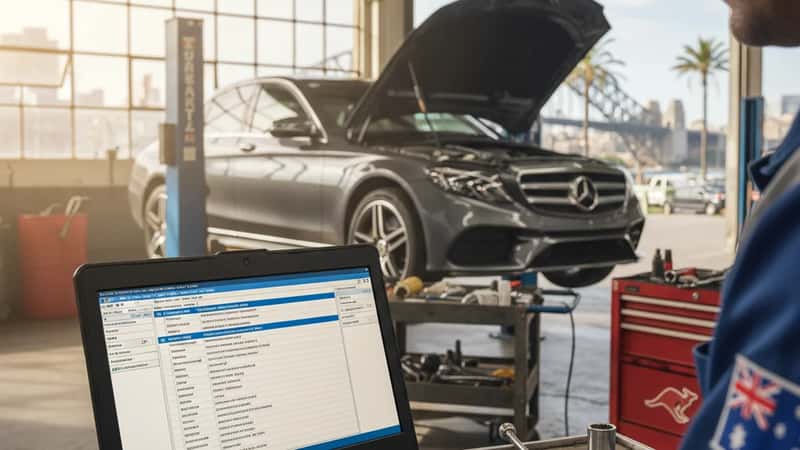
Mercedes-Benz vehicles are engineered to high standards, but certain models and components have known recurring issues in Australian conditions. Understanding these helps you plan maintenance proactively rather than reactively.
Most frequently reported repairs in Australian Mercedes-Benz vehicles:
| Issue | Affected Models | Average Cost AUD | Urgency |
|---|---|---|---|
| Airmatic suspension failure | E-Class, S-Class, ML/GLE | $2,500-$5,000 | High |
| SBC (Sensotronic) brake system failure | Pre-2005 E-Class, SL | $1,800-$3,500 | Critical |
| Oil leaks (camshaft adjuster seals) | OM642 diesel V6 | $800-$1,500 | Medium |
| Coolant system leaks | C-Class, E-Class | $600-$1,200 | High |
| 7G-Tronic transmission service (neglected) | Most post-2005 models | $900-$2,500 | Medium |
| Catalytic converter failure | Diesel BlueTEC models | $2,000-$4,500 | High |
| Panoramic roof seal replacement | CLA, GLA, C-Class | $400-$800 | Low-Medium |
| AdBlue system faults | Post-2014 diesel models | $500-$1,500 | High |
Source: RAA Vehicle Reliability Data 2025, NRMA Reliability Survey 2024
Australia-specific concerns:
Australian road conditions impose particular stresses on Mercedes-Benz vehicles. Airmatic air suspension — common in higher-end models — struggles with the corrugated dirt roads common in rural Queensland, WA, and NT. Air spring failures on these roads can be complete failures rather than gradual degradation, leaving drivers stranded.
Diesel-powered Mercedes models (particularly OM642 and OM651 engines) are very popular in Australia for their towing capacity, but the AdBlue (DEF fluid) system requires regular top-up in hot climates where consumption increases. Running out of AdBlue triggers a limited-start counter that eventually prevents the vehicle from starting entirely.
How to Find a Qualified Mercedes-Benz Specialist in Australia
Not all independent mechanics have the equipment, training, or experience to work on modern Mercedes-Benz vehicles. The wrong choice can result in poorly diagnosed faults, incorrect parts, and voided warranty claims.
What to look for in a Mercedes-Benz specialist:
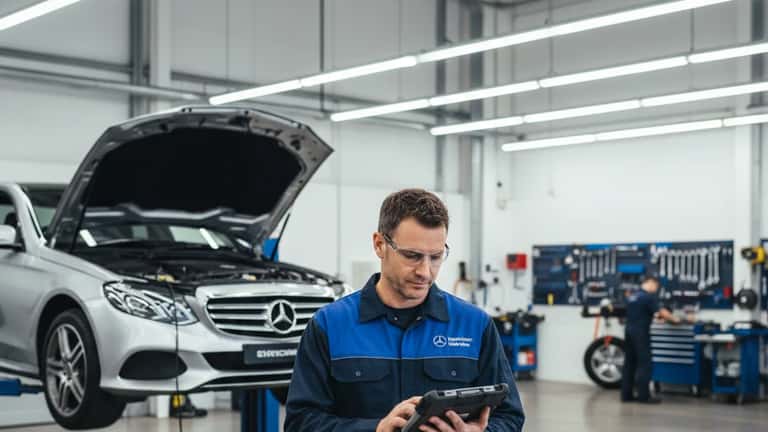
Diagnostic equipment — Modern Mercedes-Benz vehicles (W205 C-Class onwards) require XENTRY or equivalent OEM-level diagnostic software to read fault codes, perform adaptations after parts replacement, and code new components. Ask directly: "Do you have XENTRY or iCarsoft MB II diagnostic capability?" A mechanic who relies on a generic OBD-II reader cannot properly service a current-generation Mercedes.
Manufacturer training — Some independent workshops employ mechanics who trained at Mercedes-Benz or completed the AMG Performance Training program. These technicians bring factory-level knowledge without the dealership price premium.
Parts sourcing — Reputable specialists use either genuine Mercedes-Benz parts (MBAG OEM) or high-quality OEM-equivalent parts from manufacturers like Bosch, Brembo, or Meyle (all of whom supply parts directly to Mercedes-Benz assembly lines). Avoid workshops that source from unknown discount suppliers.
Local Mercedes-Benz owner communities are your best resource for finding tested specialists. Forums like MBClub Australia, German Cars For Sale Australia Facebook groups, and the Mercedes-Benz Owners Association of Australia (MBOAA) maintain member-recommended workshop lists updated with real owner experiences.
A reliable way to find verified automotive specialists with Mercedes-Benz expertise is through professional platforms where mechanics list their qualifications and receive client reviews — allowing you to compare specialists before committing.
Mercedes-Benz Service Intervals: What Your Logbook Actually Requires

Mercedes-Benz uses an adaptive service indicator called ASSYST Plus (or MBSA — Mercedes-Benz Service Assist) that calculates service intervals based on actual driving conditions rather than fixed kilometre intervals. This is a significant advantage for Australian drivers who cover variable terrain.
Standard service intervals for Mercedes-Benz in Australia:
- Service A (minor): Occurs first at approximately 10,000 km or 12 months, then every 20,000 km or 2 years. Includes synthetic oil and filter change, fluid checks, brake inspection, and tyre check.
- Service B (major): Occurs at approximately 20,000 km or 24 months after the last Service B. Includes all Service A items plus cabin air filter, brake fluid change, and comprehensive safety check.
- Transmission fluid: Mercedes-Benz lists the 7G-Tronic transmission fluid as "lifetime fill" — but independent specialists and most experienced mechanics recommend changing it every 60,000-80,000 km in Australian conditions to prevent premature wear. Neglected transmission fluid is the most common cause of 7G-Tronic failures.
- AdBlue (diesel only): Top up approximately every 10,000-15,000 km. Cost: $10-$15 AUD per litre at Supercheap Auto, Repco, or service stations.
The synthetic oil debate:
Mercedes-Benz specifies full synthetic oil meeting MB 229.5, 229.51, or 229.52 specifications for most petrol engines, and MB 228.51 for diesels. Using the wrong grade can void powertrain warranty claims and accelerate engine wear. In Australia's heat, never substitute with conventional or semi-synthetic oil — the thermal stability of full synthetic is critical in summer temperatures above 35°C.
DIY Maintenance: What Mercedes-Benz Owners Can Do Themselves
Not all Mercedes-Benz maintenance requires a workshop. Several tasks are legal, safe, and cost-effective to perform at home — saving hundreds of dollars per year without affecting your warranty status under Australian Consumer Law.
Safe DIY tasks for Mercedes-Benz owners:
- Windscreen washer fluid top-up — Use a diluted screenwash suitable for Australian conditions (add anti-insect agent for outback driving)
- Tyre pressure monitoring and inflation — Check monthly and before long trips. Mercedes TPMS systems alert at 25% below recommended pressure, which is already in the danger zone.
- Cabin air filter replacement — On most W204/W205/W212/W213 models, the cabin filter is accessible without tools. A new Mahle or Mann filter costs $25-$45 AUD versus $80-$120 AUD at a dealer.
- Battery terminal cleaning — White corrosion on battery terminals reduces starting reliability, especially in humid coastal areas (Brisbane, Sydney). Clean with a mixture of baking soda and water, rinse, and apply dielectric grease.
- AdBlue fluid top-up — Pour directly into the AdBlue filler (blue cap, typically in the boot near the spare tyre on Australian-spec diesel models). Do NOT use general water or urea — only ISO 22241-certified AdBlue.
What you should NOT DIY on a modern Mercedes:
- Any work requiring XENTRY coding or adaptation (gearbox, steering angle sensor, key programming)
- Brake system bleeding on SBC-equipped models (requires special tool)
- Airbag system work (legal prohibition for non-licensed technicians in Australia)
- Any work inside the cabin that involves disconnecting SRS airbag components
Mercedes-Benz Electric and Hybrid Models: New Repair Realities
The rise of EQ-series electric and EQ Boost hybrid vehicles in Australia's Mercedes-Benz lineup introduces new servicing requirements that many traditional mechanics are not equipped to handle.
EQ and hybrid-specific considerations in Australia:
High-voltage safety — EQA, EQB, EQC, EQE, and EQS models operate at 400V+ systems. Work on these requires mechanics certified as high-voltage first responders under Australian electrical safety legislation. Unauthorised work on HV systems is illegal under state workplace safety laws and creates serious injury risk.
Battery warranty — Mercedes-Benz EQ vehicles sold in Australia include an 8-year/160,000 km battery warranty that guarantees at least 70% of original capacity. This warranty requires all software updates and battery conditioning to be performed at authorised service points — one area where dealership servicing remains mandatory.
Brake system maintenance — EQ vehicles use regenerative braking that significantly reduces brake wear. Australian Mercedes-Benz EQ owners typically need brake pad replacement only every 80,000-120,000 km versus 40,000-60,000 km for conventional vehicles. However, brake discs can corrode faster if the vehicle sits unused, as the regenerative system rarely applies physical brakes in slow traffic.
Charging infrastructure costs — Wallbox home chargers (7.4 kW AC) cost $900-$1,500 AUD installed in Australia. Public DC fast charging (up to 150 kW for EQE/EQS) adds approximately $0.35-$0.60/kWh at Chargefox or Evie Networks stations [ARENA Australian EV Infrastructure Report, 2025]. For the EQS 450+, this equates to approximately $35-$55 AUD for a full charge via fast charger.
The transition to electric servicing is creating a skills gap in the Australian automotive industry. Independent workshops that invest in EV training and certification now will have a significant advantage as Mercedes-Benz's Australian model mix shifts toward electrification — with a commitment to 25% EV sales by 2027 [Mercedes-Benz Australia media release, 2025].