 David Kelly
Car air conditioning failures peak in Australian summers when temperatures top 40°C across most of the continent. Getting your car AC repaired quickly and correctly matters both for comfort and driver safety — heat fatigue significantly increases accident risk on long drives. This guide walks you through diagnosing the problem, understanding the repair process, knowing what to pay, and finding a trustworthy mechanic near you.
How Car Air Conditioning Systems Work
A car's air conditioning system is a closed-loop refrigeration circuit. It does not generate cold air — it removes heat from the cabin air and expels it outside. Understanding the core components helps you communicate clearly with a mechanic and understand why certain repairs cost more than others.
The five main components are:
- Compressor: Pressurises the refrigerant gas. Driven by the engine via a belt. The most expensive component to replace.
- Condenser: Mounted at the front of the car behind the grille. Converts pressurised refrigerant from gas to liquid by releasing heat to the outside air.
- Expansion valve: Controls refrigerant flow from high-pressure to low-pressure side.
- Evaporator: Located inside the dashboard. Absorbs heat from cabin air as refrigerant expands, cooling the air blown into the cabin.
- Receiver-dryer or accumulator: Filters and stores refrigerant, removes moisture.
Australian cars manufactured after 2000 use R-134a refrigerant. Most new vehicles (2020+) use R-1234yf, which has a lower global warming potential. These refrigerants are not interchangeable — your mechanic must use the type specified on the underbonnet label.
The system loses approximately 10–15% of its refrigerant charge annually through normal permeation — not a leak, just natural diffusion through hoses and seals. This is why a regas every 2–3 years is normal preventive maintenance in Australia's climate.
Signs Your Car AC Needs Repair
Catching problems early is cheaper than waiting until the system fails completely. These are the clearest indicators that your car AC requires attention from a mechanic.
Blowing warm or lukewarm air: The most obvious symptom. If the system blows warm air on the coldest setting, the most common cause is low refrigerant — indicating a leak somewhere in the circuit.
Weak airflow from vents: If the temperature is cold but the volume of air is low, the blower motor or cabin air filter is typically at fault. A clogged cabin air filter is a cheap fix most drivers overlook — in dusty Australian conditions, it should be replaced every 10,000–15,000 km.
Clicking, rattling, or grinding noises when AC is switched on: These sounds during AC engagement often point to compressor clutch failure or debris caught in the compressor. Don't ignore these — a seized compressor can destroy the serpentine belt and cause broader engine damage.
Musty or mouldy smell: Bacterial and fungal growth on the evaporator core is extremely common in humid Australian climates (Brisbane, Darwin, Sydney). An AC deodorising treatment (around AUD $80–$120 from most mechanics) kills the growth. If the smell persists, the evaporator may need chemical flushing.
Refrigerant oil stains: Oily residue on AC hose fittings or near the condenser at the front of the car indicates a refrigerant leak. Because modern refrigerant is nearly odourless, you may not smell a leak — look for the oily residue instead.
AC only works when moving, not when stationary: This typically indicates a condenser fan failure. The condenser requires active airflow when the car isn't moving. At highway speeds, ram air substitutes for the fan — which is why the symptom is speed-dependent.
Approximate breakdown of car AC complaint causes [Australian Automotive Service & Repair Association (AASR), 2024]
The Car AC Repair Process: What Happens at the Workshop
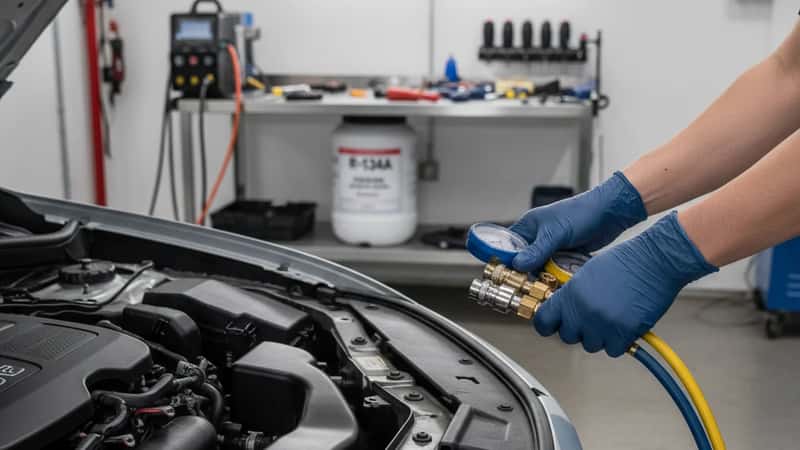
Understanding the repair sequence helps you evaluate whether a mechanic's quote is thorough or cutting corners. A reputable car AC repair follows these steps:
Step 1: Diagnosis and Pressure Testing
The technician connects gauge manifolds to the high and low pressure service ports to check system pressures. Low pressure on both sides typically confirms low refrigerant. Abnormal pressure differentials indicate blockages, compressor faults, or expansion valve issues. This diagnostic step should take 20–30 minutes and should be quoted as a separate line item.
Step 2: Leak Detection
If low refrigerant is found, the source must be identified before recharging. Simply topping up refrigerant without finding the leak wastes money — the charge will leak out again, often within weeks. Leak detection methods used by Australian mechanics include:
- UV dye test: Inject fluorescent dye, run the system, then scan with a UV light to identify dye-stained leak points.
- Electronic leak detector: A probe sniffs for refrigerant gas concentration around fittings, hoses, and components.
- Nitrogen pressure test: For suspected large leaks, nitrogen is used to pressurise the system — being non-flammable and inexpensive compared to refrigerant.
Step 3: Refrigerant Recovery
Before any work on the AC system, the existing refrigerant must be recovered using a refrigerant recovery machine — required by Australian environmental law under the Ozone Protection and Synthetic Greenhouse Gas Management Act 1989 (OPSGGA). Releasing refrigerant to atmosphere is illegal and attracts significant fines.
Step 4: Component Repair or Replacement
Depending on findings, the mechanic replaces faulty components:
- Hose or O-ring seal: Low cost, $50–$200 parts and labour
- Condenser: $300–$600 parts and labour
- Compressor: $800–$1,800 parts and labour (highest labour cost — requires refrigerant recovery, component access, and recharge)
- Evaporator: $600–$1,400 parts and labour (most labour-intensive — requires dashboard disassembly)
Step 5: System Evacuation, Recharge, and Testing
After repairs, the system is evacuated (vacuumed) for a minimum of 30 minutes to remove all air and moisture. Moisture in the AC circuit causes acid formation and component corrosion. The system is then recharged with the correct refrigerant type and weight-measured quantity as specified by the vehicle manufacturer.
Final testing verifies outlet temperature (should reach 2–7°C on a warm day), checks for leaks post-recharge, and confirms pressures are within spec.
À retenir: A full car AC regas in Australia (refrigerant recovery + evacuation + recharge, no major repairs) costs AUD $120–$250. If a mechanic quotes a regas for under $80, they are likely skipping the recovery step — which is both illegal and a sign of cut-corner practices.
Car AC Repair Costs in Australia: What to Expect
Car AC repair costs vary significantly based on the fault, vehicle type, and location. Here is a realistic guide to what you should expect to pay at an Australian workshop in 2026.
| Service | Typical AU cost (AUD) |
|---|---|
| Diagnostic inspection | $60–$120 |
| Cabin air filter replacement | $40–$100 (parts + labour) |
| Refrigerant regas (no major leak) | $120–$250 |
| Leak detection (UV dye or electronic) | $80–$150 |
| Condenser replacement | $350–$700 |
| Compressor replacement | $900–$2,000 |
| Evaporator replacement | $700–$1,500 |
| AC deodorising / sanitising | $80–$130 |
Prices vary by vehicle make, model, and workshop location. European luxury vehicles typically sit at the higher end of each range.
Scenario: A Toyota Corolla owner in Brisbane noticed the AC blowing warm after two summers. The mechanic found a slow refrigerant leak at a condenser fitting O-ring, recovered the refrigerant, replaced the O-ring, evacuated and recharged the system. Total cost: AUD $310 — far less than replacing the condenser, which would have been the wrong solution without proper leak diagnosis.
A few factors push costs higher in Australia specifically:
- R-1234yf refrigerant (used in most cars made after 2017) costs approximately 4× more than R-134a. A regas for a new car costs significantly more than for an older model.
- Rural workshop rates are generally lower than capital city rates, but part sourcing can add delays and costs.
- Labour rates in Sydney and Melbourne average $120–$150/hour. Brisbane, Perth, and Adelaide average $100–$130/hour.
How to Find a Reliable Car AC Mechanic Near You
Finding trustworthy car AC repair near you in Australia takes a bit more than a Google search. Here's a practical approach.
Look for ARC-Ticketed Technicians
In Australia, technicians who work with refrigerants must hold a Refrigerant Handling Licence issued under the Australian Refrigeration Council (ARC). Ask the workshop: "Are your AC technicians ARC-ticketed?" If they hesitate or say no, the repair won't be legally compliant. ARC licence holders are legally certified to purchase, handle, and recover automotive refrigerants.
Check Google Reviews Specifically for AC Work
Search "[suburb] car ac repair" and look at Google Maps reviews. Filter for reviews mentioning air conditioning, AC, or regas. Specific reviews about AC work ("fixed my AC properly the first time", "correctly diagnosed a condenser leak") are more valuable than generic "great service" ratings.
Get a Written Quote Before Work Starts
Australian Consumer Law (ACL) requires that where a consumer asks for a quote, the final bill cannot exceed the quoted amount without the consumer's prior consent. Always ask for a written quote before authorising work beyond the diagnostic inspection.
A trustworthy quote will separately itemise:
- Diagnostic fee
- Refrigerant recovery
- Parts (with part numbers or descriptions)
- Labour hours and rate
- Refrigerant recharge (including refrigerant quantity and type)
Ask About Warranty on Repairs
A reputable workshop warrants both parts and labour. Standard Australian warranty expectations for AC repairs: 12 months or 20,000 km on parts and labour. Some dealers and specialist AC workshops offer 24-month warranties. Always ask what's included before signing off.
Specialist AC Workshops vs. General Mechanics
Specialist automotive air conditioning workshops typically invest in better diagnostic equipment and have more experience with complex faults (evaporator leaks, hybrid AC systems). For a simple regas, any ARC-ticketed general mechanic is fine. For a suspected compressor or evaporator fault, a specialist AC workshop is worth the slight premium for their diagnostic accuracy.
Maintaining Your Car AC to Avoid Expensive Repairs
Prevention is significantly cheaper than repair for automotive AC systems. These habits keep the system healthy between services.
Run the AC every fortnight, year-round. Even in winter, running the air conditioning for 10 minutes keeps seals lubricated and prevents refrigerant oil from separating. Many Australian drivers turn off AC entirely in cooler months and find the system has degraded significantly by the following summer.
Use the AC on "fresh air" mode occasionally. Recirculation mode reduces ambient particulates but can increase moisture buildup on the evaporator. Switch to fresh-air mode for 5–10 minutes weekly to dry out the evaporator core.
Replace the cabin air filter every 15,000 km or annually, whichever comes first. In dusty regions (outback, mining areas, rural Queensland), every 10,000 km. A blocked filter restricts airflow, strains the blower motor, and allows particulates to accumulate on the evaporator.
Annual AC service inspection. A professional check of refrigerant pressure, belt condition, and leak inspection once per year costs $60–$120 and catches developing problems before they become expensive faults. Book it at the same time as your annual service.
Turn the AC off 2–3 minutes before you stop the engine. Switch to fan-only while the engine is still running to dry out the evaporator surface before the system sits idle. This reduces mould growth significantly — particularly important in coastal and tropical Australian climates.
Important note: Car AC work involving refrigerant must only be performed by ARC-ticketed technicians in Australia. DIY refrigerant "top-up" cans sold at automotive stores do not fix leaks and often cause system damage by overcharging. They are also technically non-compliant with the Ozone Protection and Synthetic Greenhouse Gas Management Act 1989 when used incorrectly.