 David Kelly
Can a flat tyre be repaired, or does it always need replacing? The answer depends on where the damage is, how big it is, and how the tyre has been stored since it went flat. Most drivers don't know the limits — and end up either spending needlessly on a new tyre or, worse, driving on a tyre that should have been replaced.
This guide answers the questions Australian drivers actually ask about tyre repair: what's fixable, what isn't, what it costs, and when to trust a plug versus a patch.
Can My Tyre Be Repaired? The Repairability Rules
Tyre repair has strict industry rules, not because tyre shops want to upsell replacements, but because a failed tyre at highway speed causes accidents. The Australian Tyre Industry Council (ATIC) follows international standards set by the British Standard BS AU 159f and the European Tyre and Rim Technical Organisation (ETRTO), which define exactly what is and isn't repairable.
Repairable damage meets ALL of these criteria:
- Located in the central tread area (within the central 75% of tread width — not the shoulder)
- Puncture diameter no greater than 6mm (approximately the diameter of a standard nail)
- No structural damage to the tyre's casing or bead
- The tyre has not been run flat (driven on while deflated)
- No previous repair within 25mm of the new damage
Non-repairable damage includes:
- Any damage to the sidewall or shoulder
- Punctures larger than 6mm
- Cuts, slashes, or impact damage of any kind
- Run-flat damage (even if the tyre looks undamaged externally, internal casing damage may be invisible)
- Any separation of the tread from the casing
- Visible cords or ply showing through the tyre surface
- Damage from age (cracking, perishing) — these tyres need replacement regardless of puncture size
If a tyre has been driven flat — even for 50 metres to reach a safe stopping point — the sidewall may have been crushed sufficiently to cause internal casing damage. A competent tyre shop will demount the tyre from the rim and inspect the inside before deciding whether repair is safe.
What's the Difference Between a Tyre Plug and a Tyre Patch?
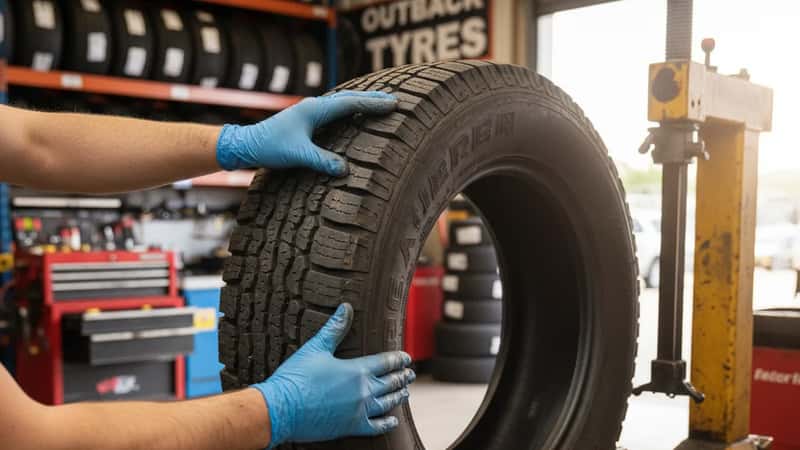
Many drivers use the terms interchangeably, but they describe different methods with very different safety outcomes. Understanding the distinction matters when evaluating what a tyre shop is offering to do.
Tyre Plug (External-Only Method)
A tyre plug is inserted from outside the tyre without removing it from the rim. A rubber-coated plug is threaded through the puncture hole using a insertion tool, then trimmed flush with the tread. The procedure takes 5–10 minutes and can be done roadside.
The problem with plugs alone: An external plug only seals the outer portion of the puncture. It does not seal the inner liner, and it does not allow inspection of the inner casing for damage. Most tyre industry standards, including ATIC guidelines, classify a standalone plug as a temporary emergency fix — not a permanent repair.
When a plug is acceptable: As a temporary measure to get to a tyre shop within 50–80 km at reduced speed (under 80 km/h). Not acceptable for sustained highway driving.
Tyre Patch (Internal Method)
An internal patch is applied to the inside of the tyre after the tyre is demounted from the rim. The area around the puncture is buffed, cleaned, and a vulcanising patch is bonded to the inner liner. This seals the inner liner but does not fill the puncture channel through the tread.
Combination Patch-Plug (Industry-Standard Method)
The combination patch-plug — also called a mushroom plug or uni-seal — is the only repair method endorsed by ATIC and major tyre manufacturers for permanent repair. It consists of a rubber stem that fills the puncture channel from the inside and a bonded patch that seals the inner liner. This addresses both the outer tread channel and the inner liner simultaneously.
| Repair method | Inner liner sealed? | Puncture channel filled? | Safe for highway? | Permanent? |
|---|---|---|---|---|
| Plug (external) | No | Partially | No | No |
| Patch (internal) | Yes | No | Limited | No |
| Patch-plug (mushroom) | Yes | Yes | Yes | Yes |
À retenir: If a tyre shop offers to "plug" your tyre for $15–$25 without removing it from the rim, this is a temporary fix only. A permanent patch-plug repair requires tyre demounting and costs $30–$60 — this is the correct and safe option.
How Much Does Tyre Repair Cost in Australia?
Tyre repair is one of the most cost-effective automotive services available. The cost is almost entirely labour — materials are minimal.
| Service | Typical AU cost (AUD) |
|---|---|
| Temporary plug (external, roadside) | $15–$30 |
| Permanent patch-plug repair | $30–$65 |
| Tyre demounting and remounting (for inspection) | $15–$25 per tyre |
| Wheel balancing (after repair) | $20–$35 per wheel |
| Valve stem replacement | $10–$20 |
| Full repair + balance | $50–$100 total |
Prices vary between capital cities and regional areas. Many tyre retailers include balancing in the repair price — ask explicitly.
For context, replacing a standard passenger tyre in Australia costs AUD $90–$250 depending on brand and size. A $50 repair versus a $180 replacement is an obvious financial reason to repair where it's safe — but only where it's genuinely safe. A false economy on an unrepairable tyre is not worth the risk.
Scenario: A Melbourne tradie driving a Hilux picked up a screw in the rear tyre on a Friday afternoon. The tyre had 8mm of tread remaining and the screw was squarely in the central tread area. The tyre shop demounted the tyre, confirmed no run-flat damage, and performed a combination patch-plug repair including rebalancing for AUD $75. The tyre went on to travel another 35,000 km without issue. Replacement would have cost $220.
Should I Use a Tyre Repair Kit or a Sealant Spray?
Most new Australian cars no longer include a spare tyre — they come with either a tyre repair kit (inflator + sealant can) or a space-saver spare. Understanding the limitations of these kits prevents them from being misused.
Tyre Inflation + Sealant Kits (OEM Kits)
Sealant kits (like those supplied by Toyota, Hyundai, and Volkswagen as OEM equipment) inject liquid latex sealant through the valve stem while simultaneously inflating the tyre. The sealant coats the inner liner and may temporarily seal very small punctures (under 4mm) in the tread area.
Critical limitations:
- Only works for small tread punctures — completely ineffective for sidewall damage or punctures over 4mm
- The sealant contaminates the Tyre Pressure Monitoring System (TPMS) sensor inside the wheel, which typically requires replacement (AUD $50–$150 per sensor)
- The tyre must be permanently replaced after sealant use — it cannot be properly patched once sealant has been applied
- Maximum driving speed after sealant application is typically 80 km/h; maximum distance is 80–200 km to reach a repair facility
These kits are emergency equipment — they get you to a tyre shop, they do not solve the problem. Disclose to the tyre shop that sealant has been used before any repair or replacement work.
Aftermarket Puncture Prevention Products
Products that fill tyres with foam or gel (sold as "never flat" solutions) are not approved by any major tyre manufacturer and void tyre warranties. They also damage valve stems and TPMS sensors and make subsequent tyre servicing extremely difficult. Avoid them.
When You Need a Spare, Not a Repair
Some punctures and damage cannot wait for a tyre shop. Blowouts, sidewall damage, and large tread cuts require a spare tyre or roadside assistance call. Australian states offer varying levels of roadside assistance through NRMA, RAA, RACV, RAC, and RACQ — membership costs approximately $100–$180 annually and covers tyre-related callouts.
When Should I Replace Instead of Repair?
Repair is not always the right answer, even when the damage meets repairability criteria. Consider replacement when any of the following apply.
Low tread depth: Australian law requires a minimum tread depth of 1.5mm across the central three-quarters of the tread width, and around the entire circumference. However, safety experts recommend replacing tyres at 3mm or less — wet-weather braking distances increase significantly below this threshold. If your tyre has less than 3mm of tread remaining, replacement is better value than repair.
Tyre age: Rubber degrades with time regardless of use. Most tyre manufacturers recommend replacing tyres over 5 years old, and state that tyres over 10 years old should never be used regardless of appearance. The manufacture date is encoded in the tyre sidewall as a four-digit DOT code (e.g., "2319" = 23rd week of 2019). An older tyre with a new repair can still be structurally compromised.
Multiple repairs on one tyre: ATIC guidelines allow a maximum of two patch-plug repairs on a single tyre, provided the repairs are at least 50mm apart. A third puncture on the same tyre warrants replacement.
Premium tyres under warranty: Some premium tyre brands (Michelin, Bridgestone, Continental) offer road hazard warranties that cover replacement of damaged tyres in the first 3 years of purchase. Check your purchase documentation before paying for a repair — replacement may be free.
The practical test: If the repair cost exceeds 25% of a new replacement tyre's price, given the tyre's remaining tread life, replacement is often better value. A repair on a tyre with 2mm of tread remaining has limited remaining utility regardless of repair quality.
Frequently Asked Questions About Tyre Repair in Australia
How long does a professional tyre repair last?
A properly executed combination patch-plug repair on an eligible tyre lasts the remaining safe service life of the tyre — often tens of thousands of kilometres. The repair itself does not wear differently from the surrounding tyre material. The tyre's remaining useful life is determined by tread depth and age, not the repair.
Can run-flat tyres be repaired?
In most cases, no. Run-flat tyres have reinforced sidewalls that allow driving at reduced speed for up to 80 km after puncture. However, this reinforcement makes it difficult or impossible to visually inspect internal casing damage after a run-flat event. Most tyre manufacturers and ATIC recommend replacing run-flat tyres rather than repairing them after they have been driven in the deflated condition.
My TPMS warning light is on after a tyre repair — is that normal?
If the tyre was repaired with a patch-plug and properly reinflated, the TPMS light should extinguish once the system reads correct pressure. If it remains on, drive for a few kilometres — some TPMS sensors need time to recalibrate. If it persists, ask the tyre shop to check and reset the TPMS. If a sealant kit was used, the TPMS sensor may be contaminated and require replacement.
Is it legal to drive on a repaired tyre in Australia?
Yes, provided the repair meets Australian tyre industry standards (ATIC guidelines), the tyre has adequate remaining tread depth (minimum 1.5mm by law, 3mm recommended), and the tyre is properly inflated. A correctly performed patch-plug repair does not compromise the tyre's roadworthiness.
What's the tyre repair age limit in Australia?
There is no specific law limiting tyre repairs by age, but Australian consumer rights require products to be safe and fit for purpose. A professional tyre shop should refuse to repair any tyre over 10 years old, or any tyre showing sidewall cracking, ozone checking, or tread compound degradation — regardless of puncture size.