 David Kelly
Searching "mobile mechanic near me" returns dozens of operators — but how do you know this service is worth it? A driveway visit can cut your servicing bill by 20–40 % compared with a bricks-and-mortar workshop, and you never lose half a day in a waiting room. Below are seven concrete reasons Australian car owners are switching, a pricing snapshot for common jobs, and a checklist so you can tell a qualified operator from a backyard hack.
1. No Travel Time, No Waiting Room
The service comes to wherever your car already sits — at home, at the office, or even at a shopping-centre car park. The Australian Automobile Association (AAA) estimates that the average Australian spends roughly 4.5 hours per year on vehicle-related errands. A mobile service eliminates the drop-off trip, the taxi or rideshare home, and the return pick-up. For parents juggling school runs or shift workers with limited windows, that time saving alone justifies the call.
2. Lower Overheads Mean Lower Prices
Workshop owners pay commercial rent, front-desk staff, and equipment leases. An operator working from a fitted-out van skips those overheads, so a larger share of your payment goes toward parts and labour rather than fixed costs. The table below shows typical price ranges for routine jobs across major Australian cities.
| Service | Workshop estimate | Mobile mechanic estimate | Saving |
|---|---|---|---|
| Logbook service (4-cyl) | $280–$380 | $180–$280 | ~25 % |
| Brake pad replacement (front) | $300–$450 | $220–$350 | ~20 % |
| Battery replacement | $200–$320 | $150–$250 | ~25 % |
| Oil and filter change | $150–$220 | $100–$160 | ~30 % |
Estimates based on 2025 national averages from AutoGuru and Lube Mobile price guides. Actual costs vary by vehicle make and location.
3. You Watch Every Step of the Repair
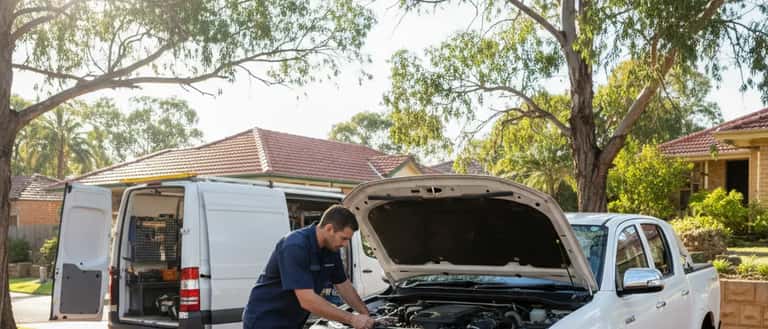
Transparency is built into the on-site model. The technician works in your driveway, so you can observe the diagnosis, ask questions mid-job, and see the old parts before they go in the bin. In a traditional workshop, the car disappears behind a roller door and you rely on a phone call to approve extra work. Seeing the process first-hand builds trust and helps you learn basic maintenance habits — like checking brake-fluid colour or spotting a cracked serpentine belt before it snaps.
4. Flexible Scheduling — Including Weekends
Most mobile mechanics offer evening and Saturday appointments because they do not depend on workshop opening hours. Some operators, including national franchises like Jim's Mobile Mechanics, run seven-day rosters. If your car develops a fault on Friday night and you need it for a Monday commute, an on-call operator can often fit you in over the weekend without the emergency surcharge a 24-hour workshop might apply.
5. Ideal for Fleet Owners and Small Businesses
A tradesperson whose ute is the business cannot afford to leave it at a workshop for a full day. On-site servicing keeps fleets productive — often outside business hours — so no vehicle sits idle. According to the Australian Bureau of Statistics (ABS), there were 4.4 million registered light commercial vehicles in Australia in 2024. Fleet operators who switch to mobile servicing commonly report 15–20 % fewer hours of vehicle downtime per quarter, because the mechanic comes to the depot instead of each driver taking a separate trip.
6. Regional and Rural Coverage Where Workshops Are Scarce
Outside capital cities, the nearest workshop can be 30 km or more away. Mobile mechanics fill that gap. Operators on platforms like Airtasker and AutoGuru now cover regional hubs from Ballarat to Bundaberg. If you live on a rural property and your vehicle cannot be safely driven, a travelling technician is often the only realistic option short of an expensive tow.
"About 60 % of my bookings come from customers who would otherwise need a tow truck just to reach the nearest garage." — independent mobile mechanic, Sunshine Coast [interview, 2025]
7. Straightforward Quoting with Less Upselling Pressure
In a workshop environment, it is common to receive a phone call mid-service recommending extra work you had not planned for. A visiting technician quotes on the spot, shows you the issue in person, and lets you decide without the social pressure of a busy service counter. Consumer advocacy group CHOICE recommends always getting a written quote before approving work — a step that feels more natural when the mechanic is standing beside you in your own driveway.
When a Workshop Is the Smarter Choice
This service is not the right call for every repair. Jobs that require a hoist — such as transmission rebuilds, exhaust-system replacement, or wheel alignments — need a fully equipped workshop. The same applies to work that demands specialist diagnostic rigs (e.g., air-conditioning re-gas under the Australian Refrigerant Handling Licence) or a controlled paint environment. As a rule of thumb, if the repair involves heavy components suspended beneath the vehicle or refrigerant gases, book a workshop.
A quick decision guide:
- Mobile mechanic: logbook services, brake pads, batteries, alternators, diagnostic scans, minor electrical faults, pre-purchase inspections.
- Workshop: transmission overhauls, exhaust fitting, wheel alignments, air-conditioning re-gas, panel and paint work.
How to Vet a Mobile Mechanic Before You Book
Not every operator advertising on social media is qualified. Run through this checklist before handing over your keys:
- Verify their trade certificate. In Australia, a mechanic must hold a Certificate III in Light Vehicle Mechanical Technology (AUR30620) or equivalent. Ask for the certificate number.
- Check their ABN. A legitimate operator runs as a registered business. Search the Australian Business Register (ABR) at abr.business.gov.au to confirm the ABN is active and matches the business name.
- Ask about insurance. Public liability insurance (minimum $5 million) protects you if something goes wrong on your property. Motor-trade insurance covers damage to your vehicle during repair.
- Read recent reviews. Platforms like Google Business, AutoGuru, and Airtasker display verified reviews. Look for consistent feedback over at least six months rather than a handful of five-star ratings posted in one week.
- Request a written quote. Under Australian Consumer Law (Competition and Consumer Act 2010, Schedule 2), you have the right to a written estimate before work begins. If a mechanic refuses, walk away.
- Confirm warranty terms. Reputable mobile mechanics offer a minimum 12-month or 20 000 km warranty on parts and labour. Get it in writing.
Key takeaway: A qualified operator will happily show their trade certificate, ABN, and insurance documents. If any of these are missing, find another operator.
The Bottom Line
For routine servicing, brake work, batteries, and diagnostics, a mobile mechanic near you in Australia delivers genuine savings — in money and time. The model works best when the job can be done safely without a hoist and when you value transparency over the convenience of a one-stop workshop. Use the vetting checklist above, get a written quote, and you will have a reliable mechanic on speed-dial for years to come.
Disclaimer: The information on this page is provided for general guidance only and does not constitute professional mechanical or legal advice. Always consult a qualified mechanic for your specific vehicle and situation.