 Evelyn Carter
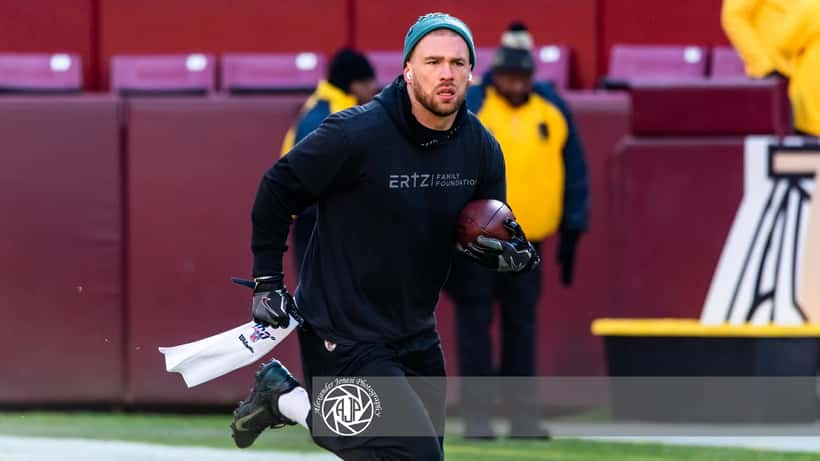
Zach Ertz rejoined the Philadelphia Eagles this September — less than nine months after tearing his ACL in a Week 14 loss to the Minnesota Vikings. For NFL fans, it is a compelling comeback story. For the roughly 200,000 Americans who tear their ACL every year, it raises a question that matters more than any fantasy football roster move: what should my recovery timeline actually look like?
Disclaimer: This article addresses medical topics for informational purposes only. Always consult a qualified healthcare professional before making any diagnosis or treatment decision.
The Injury That Could Have Ended His Career
On December 7, 2025, Ertz went down in a non-contact play during Washington's Week 14 game against Minnesota. He had been one of the more productive tight ends in the league that season — 50 catches for 504 yards and a touchdown in 13 games — when the injury cut his year short. He was 35 years old. His one-year contract with the Commanders was expiring. Most observers expected retirement.
Instead, Ertz committed to the rehabilitation process, declared by April 2026 that his recovery was ahead of schedule, and eventually re-signed with the Eagles — the franchise where he became a three-time Pro Bowler — returning to their practice squad just before Week 1. He was expected to be cleared for game action approximately nine months after surgery, and was placed in a position to dress for Monday night football against the Chicago Bears in Week 3.
Nine months from ACL reconstruction to NFL game action is at the aggressive end of the recovery spectrum, even for elite professional athletes with daily access to team physicians, advanced imaging, and biomarker monitoring. For recreational athletes managing similar injuries without those resources, Ertz's timeline can create a dangerously misleading benchmark.
What the Science Actually Says About ACL Recovery After 35
The anterior cruciate ligament is one of the four primary stabilizers of the knee joint. When it tears — particularly in a non-contact mechanism like Ertz experienced — surgical reconstruction typically involves grafting tissue from the patellar tendon or hamstring to replace the damaged structure. According to the National Institute of Arthritis and Musculoskeletal and Skin Diseases (NIAMS), return-to-sport timelines should be based on functional testing outcomes, not fixed calendar milestones.
A 2024 meta-analysis found that athletes who returned to cutting and pivoting sports before achieving 90% quadriceps symmetry between their injured and non-injured leg had a 15-23% re-tear rate within 24 months — compared to under 3% for those who met symmetry benchmarks first. That is a five-to-eight-fold difference in risk, driven by a single measurable variable.
Age further complicates the picture. After 35, muscle mass rebuilds more slowly, bone density affects surgical anchor strength, and the ligamentization process — the biological remodeling that transforms a graft into a functioning ligament — takes the same 12-24 months regardless of fitness level. Research consistently shows that athletes over 35 face a 20-25% higher rate of graft complications compared to those under 25.
What Ertz has is a full professional medical infrastructure tracking every element of this process. What most patients have is a single follow-up appointment six weeks after surgery, at which a physician's assistant checks the incision and says "it looks good."
The Recovery Phase Most Patients Have Never Heard Of
There is a specific window in ACL graft healing that sports medicine specialists refer to as the ligamentization phase — roughly months three through six post-surgery. During this period, the new graft undergoes vascular remodeling and collagen restructuring that is essential to its long-term integrity. Paradoxically, the graft is at its mechanically weakest point during the phase when patients often feel the best they have since the injury.
Patients who feel 80% recovered, stop formal physical therapy, and return to recreational sport during this window — without a functional movement assessment — are statistically the highest-risk group for re-tear. This is counterintuitive. It is also not routinely communicated during standard orthopedic follow-ups, which tend to focus on surgical outcomes rather than return-to-sport readiness.
Sports medicine specialists recommend functional assessments at months three, six, and nine following ACL reconstruction for any active adult. Most patients see only their surgeon at a post-operative check at four to six weeks. The gap between what evidence-based care recommends and what standard care delivers is where re-injuries happen.
A Concrete Case: What Jamie's ACL Tear Actually Costs Without a Specialist
Consider Jamie, a 39-year-old project manager in suburban Philadelphia who tears their ACL playing recreational soccer on a Friday evening in November 2025. Jamie has good employer health insurance with a $2,800 annual deductible, is reasonably fit, and wants to return to the spring league — roughly six months away.
Following the standard pathway — GP referral, orthopedic surgeon consultation, ACL reconstruction, six weeks of supervised physical therapy, surgical clearance at month five — Jamie returns to the soccer field with reasonable confidence. The knee feels stable. The swelling resolved months ago.
What Jamie does not know: at month five without rigorous daily rehabilitation, most patients in this demographic test at approximately 65-75% quadriceps symmetry on a single-leg strength assessment. The ligamentization window is not fully closed. The statistical re-tear probability for a patient returning to soccer at this stage is approximately 18%.
If Jamie had added one or two sports medicine specialist consultations — averaging $275 per visit, partially covered by insurance — those visits would have included a functional movement screen, a quadriceps output comparison, and a six-week targeted strength protocol. With that protocol completed, Jamie retests at month eight at 91% symmetry, passes functional movement screening, and returns to soccer with a re-tear probability under 3%.
The arithmetic is stark. Two consultations costing roughly $550 out of pocket reduce the probability of a second ACL surgery by approximately 15 percentage points. A second reconstruction typically costs $25,000-$45,000 in the US even with insurance, requires 12-18 months of additional recovery, and correlates strongly with accelerated onset of knee osteoarthritis before age 55. The investment in a specialist consultation is not a luxury. It is a basic risk-management calculation.
Four Signs You Need More Than a Surgeon's Clearance
Not every ACL patient requires extensive additional specialist involvement. But these situations consistently benefit from a dedicated sports medicine consultation:
You are over 35 and want to return to pivoting or cutting sports. Basketball, soccer, tennis, skiing, and recreational flag football all involve the lateral loading patterns that put reconstructed ACLs under most stress. Your return-to-sport clearance should be based on quadriceps symmetry data, not how the knee feels.
Your ACL tore without contact. Non-contact tears frequently indicate underlying biomechanical risk factors — hip abductor weakness, knee valgus under load, or landing mechanics — that, if uncorrected, dramatically increase re-tear risk after reconstruction. A sports medicine physician can identify these through a functional screen and prescribe targeted programming.
You are still experiencing instability or swelling at month six. These are not normal recovery residuals at the six-month mark. They are clinical signals that warrant imaging and specialist review before any return to sport.
Your rehabilitation has been primarily home-based. Without periodic objective testing, there is no data to confirm where you are in your actual recovery arc. Feeling strong is not a functional assessment. It is a feeling.
For a related look at how young athletes navigating ACL and hamstring histories manage return-to-sport risk, see the earlier Expert Zoom analysis of Jordyn Tyson's injury history and what it reveals about pre-draft medical evaluations.
What to Do If You Are Managing an ACL Injury Right Now
Zach Ertz's return to professional football is a story about elite preparation, elite resources, and a body that responded to nine months of evidence-based care. It is not a standard to measure yourself against. His clearance was based on daily functional testing, advanced imaging, and medical team consensus. Yours should be based on the same principles — scaled to your circumstances.
If you tore your ACL in the last 12 months and have not had a sports medicine specialist assess your quadriceps symmetry, request one. If you are approaching or past month six and still relying only on your surgeon's surgical clearance, that is incomplete information for a return-to-sport decision.
ExpertZoom connects patients with licensed health professionals who provide ACL recovery consultations, functional readiness assessments, and second opinions on injury timelines — without the referral delays of traditional channels. The goal is not to scare you away from returning to the activities you love. It is to make sure the data supports your readiness before you get back on the field.
Zach Ertz played football at the highest level for 14 years because he treated expert guidance as a standard, not an upgrade. The same principle applies to your knee.
