 Emily Wang
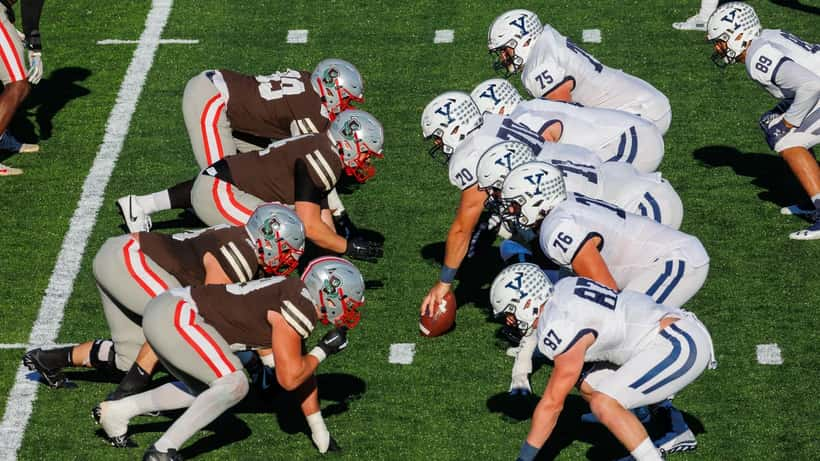
Yale was voted the 2026 Ivy League Football preseason favorite in August — but while the Bulldogs chase another championship, their players navigate one of college football's most legally complex NIL landscapes. Unlike Power 4 athletes who can now receive direct school payments, Yale football players operate under a conference-wide ban on university-to-athlete compensation, forcing them to rely entirely on third-party deals with no institutional safety net.
The $2.8 Billion Decision That Changed Everything for Ivy Athletes
In early 2026, the Ivy League made a headline-grabbing move: it opted out of the NCAA's historic $2.8 billion House v. NCAA settlement — the agreement that allowed Power 4 conferences to directly pay athletes from school revenues. Harvard, Yale, Princeton, and the other five Ivy schools remain firmly in a pre-settlement legal framework.
The consequences for Yale football players are significant. While a Clemson or Ohio State athlete can receive direct "revenue sharing" payments from their athletic department — a right confirmed by the House settlement — a Yale wide receiver cannot receive a single dollar directly from Yale Athletics. This isn't a historical relic; it is the Ivy League's deliberate 2026 position, reaffirmed by all eight schools.
The opt-out doesn't eliminate NIL rights. Since 2021, all NCAA athletes — including Ivy League players — have been permitted to profit from their name, image, and likeness through third-party deals. What changed in 2025 and 2026 is the compliance infrastructure around those deals, adding a layer of legal documentation that many student-athletes are unprepared to navigate alone.
What Yale Players Can Actually Earn — and the Paper Trail Required
Third-party NIL deals remain fully legal for Yale football players. A starting linebacker can sign a deal with a New Haven restaurant, endorse athletic wear on Instagram, or license their likeness for a local car dealership. None of that requires Ivy League pre-approval.
But since September 2025, the eight Ivy athletic departments began requiring signed "attestations of independence" for any NIL payments exceeding $2,000 from outside donors or collectives. This attestation — a formal signed document — certifies that the deal was not brokered or facilitated by the university's own athletic department. The Ivy League's unique stance effectively means Yale's compliance office must maintain documented distance from every deal it knows about.
This creates a clear legal demarcation: Yale can provide NIL education resources, but cannot be a party to arranging deals. A Yale booster who approaches a player to offer $3,000 for a social media campaign must ensure the university's hand is nowhere in the negotiation. Under the right of publicity — the legal principle that enables athlete NIL deals — any NCAA athlete retains the right to control how their identity is used commercially. If a business uses a Yale player's image without consent, that player has a clear legal claim for NIL rights violation.
When a Yale Linebacker Lands a $5,000 Deal: A Concrete Scenario
Consider this realistic 2026 situation: Marcus is a starting Yale linebacker with 12,000 Instagram followers. A New Haven fitness supplement brand approaches him, offering $5,000 for three Instagram posts over eight weeks, each tagging the brand's products.
If the deal is handled correctly: Marcus negotiates independently, signs a standard NIL licensing agreement, and receives payment. Because the amount exceeds $2,000, the transaction requires an attestation of independence — no Yale Athletics involvement in brokering the deal. Marcus reports the $5,000 as ordinary income on his taxes. His eligibility is unaffected, and because Yale offers no athletic scholarships, there is no scholarship impact to manage.
If the deal goes sideways: The brand posts the first two campaign images but refuses to pay, claiming Marcus "didn't hit engagement metrics" specified in a vague contract clause. Without a clearly drafted licensing agreement specifying payment milestones, payment deadlines, and performance definitions, Marcus has limited legal leverage. He could pursue breach of contract — but without a lawyer reviewing the deal upfront, the language may not protect him.
The critical numbers: A $5,000 NIL deal crosses every threshold simultaneously. It exceeds the $2,000 Ivy attestation trigger. It exceeds the $600 IRS 1099 reporting threshold (per IRS Publication 525 on miscellaneous income). And it represents real financial exposure if a dispute arises. An attorney reviewing a standard NIL licensing agreement typically charges $300–$800 — a small fraction of the $5,000 contract value that could protect the entire amount.
If the deal violates right of publicity: A New Haven business that runs a billboard featuring Marcus's jersey number and likeness without a signed agreement has committed a right of publicity violation. In Connecticut, Marcus could send a cease-and-desist letter, demand retroactive licensing fees, and pursue damages under state publicity statutes. These protections exist regardless of whether Marcus attends Yale or Alabama — but without knowing they exist, most athletes don't act on them.
Your Legal Rights as an Ivy League Football Player in 2026
Several legal protections apply specifically to Ivy League NIL athletes, and many Yale players remain unaware of how broadly these rights extend:
Contract enforceability: NIL agreements are standard commercial contracts, fully enforceable under state contract law. NCAA membership rules do not override state contract protections. A player can sue a brand for breach of contract, seek injunctions, and claim consequential damages if a failed deal caused reputational harm.
No-school-interference protection: Because Ivy League schools must maintain attestation of independence, a Yale player has a potential legal argument if they can show Yale Athletics facilitated a specific deal — creating an eligibility issue the university itself would be responsible for. This means players have some negotiating leverage in disputes about whether a deal was school-directed.
Tax exposure on all income: NIL income is fully taxable as self-employment or ordinary income, regardless of conference. Yale players receiving more than $400 in NIL income in a year may need to file quarterly estimated tax payments with the IRS to avoid underpayment penalties. Unlike athletic scholarships (which may be tax-exempt), NIL income is never exempt.
Collective and booster group deals: Payments that appear as NIL but are contingent on athletic performance — playing in the starting lineup, winning a specific game — remain prohibited under Ivy League rules and could trigger eligibility investigation. The distinction between a legitimate NIL deal and impermissible pay-for-play is a legal question that depends on the precise contract language.
Social media ownership: A Yale athlete's social media accounts and the audience they've built are their own intellectual property. No school, conference, or sponsor can compel specific posts without a signed agreement. If a booster pressures an athlete to post endorsements without compensation, that pressure may create claims around unpaid commercial use.
When to Talk to a Lawyer
For Yale football players navigating NIL in 2026 without the institutional support structures available at Power 4 schools, three situations clearly warrant professional legal review:
Before signing any deal over $2,000. The attestation requirement means the paperwork is already more complex than a handshake deal. A sports attorney or general contract attorney can review a standard NIL licensing agreement in under an hour, identifying vague performance clauses or missing payment schedules before they become disputes.
If a deal goes unpaid or a brand uses your likeness without permission. These are actionable legal claims. A cease-and-desist letter drafted by an attorney costs far less than the value typically at stake, and most brands will respond quickly to formal legal notice.
Before filing taxes that include NIL income. A tax professional familiar with self-employment income can set up a proper structure for quarterly payments and identify legitimate deductions — a phone used for content creation, for example, may be partially deductible as a business expense.
Yale's position as the 2026 Ivy League preseason favorite means more visibility, more followers, and more inbound NIL opportunities for its players than in most recent seasons. The same right of publicity that protects a top NFL prospect at Alabama applies to a Yale tight end trending on social media after a big win. The difference is that Yale players navigate those rights without the formal agent connections and institutional deal pipelines that Power 4 programs offer. Knowing your legal position before you sign is not a luxury — it's the minimum due diligence every Ivy League athlete should exercise in 2026.
This article provides general informational content about NIL legal principles and should not be construed as legal advice. Consult a qualified attorney for guidance specific to your situation.
Looking to consult a sports or contract lawyer about NIL deals? Find expert attorneys on Expert Zoom who can review your agreements and protect your rights.
Related: Eastern Illinois vs Minnesota: What the NIL Era Means for College Football Contracts | Miami vs. Stanford NIL Contract Traps Every Athlete Should Know
