 Joseph Wallace
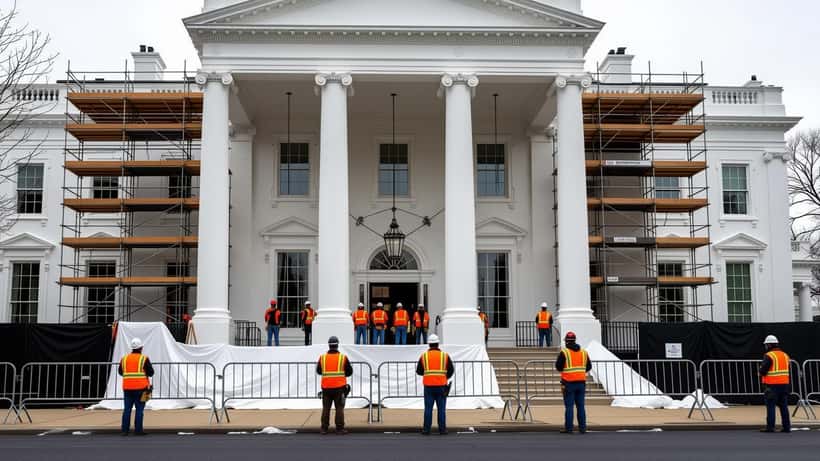
The White House began fortifying its North Portico front door this month at President Donald Trump's direct request, replacing a decades-old entrance with hardened, security-focused materials that the US Secret Service has quietly pushed for years. The work, first reported by CNN and Forbes on July 10, 2026, is expected to be finished by roughly mid-September — and it carries a lesson for ordinary homeowners: the front door is almost always a building's weakest point.
For most American families, that lesson lands close to home. Roughly 66% of residential break-ins happen through a door, and about 56% involve a "kick-in" attack that defeats the frame rather than the lock, according to security-industry data compiled by SafeWise. When the most protected residence in the country decides its front door needs reinforcing, it is worth asking whether yours does too.
What is happening at the White House
Unlike the cosmetic renovations Trump has ordered around the grounds, the North Portico project is strictly about security, CNN reported. Workers are repairing the exterior columns and hardening the entrance itself, with tarps currently hanging over the facade during construction.
The door work is one piece of a larger perimeter plan. On July 10, the Secret Service, the Executive Office of the President and the Department of the Interior submitted a lengthy proposal to the US Commission of Fine Arts to enclose Lafayette Park, on the north side of the White House, with new permanent fencing. According to CBS News, "phased implementation" of that fence could begin as soon as 2027, pending review by the US Commission of Fine Arts, the federal body that must sign off on design changes to the nation's most symbolic address.
The urgency has a grim backdrop. Trump has been the target of multiple attempts on his life, including an incident tied to the White House Correspondents' Dinner at the Washington Hilton in April 2026 and an alleged plot last month against a UFC event staged on the South Lawn. Layered security — a hardened door, a reinforced frame, a controlled perimeter — is the professional response to exactly that kind of threat.
Why your front door is the real weak point
Homeowners tend to invest in cameras and smart doorbells while leaving the door itself — the thing an intruder actually has to get through — untouched. That is backwards, security professionals say. A camera records a break-in; a reinforced door prevents one.
The numbers explain why. Grade 1 deadbolts, the highest residential rating, must withstand 10 strikes from a 75-pound force without failing, and they deliver roughly 85% break-in resistance when installed correctly, per industry testing cited by SafeWise. But a deadbolt is only as strong as the frame it anchors into. Most kick-in burglaries succeed because the strike plate is screwed into a thin, hollow jamb, not because the lock breaks.
That is why the White House is hardening the structure around its door, not just the lock — and it is the single upgrade most homes are missing.
Five upgrades experts recommend
A qualified home-improvement or security-installation professional will usually prioritize the following, roughly in order of impact per dollar:
- A solid-core or steel/fiberglass door. Hollow-core doors offer almost no impact resistance. Steel and fiberglass provide genuine protection against kick-ins.
- A reinforced frame and strike plate. Reinforcement kits typically add $200 to $400 over a standard install but achieve around 90% effectiveness against the kick-in attacks that cause the majority of forced entries.
- A Grade 1 deadbolt with three-inch screws. The screws matter as much as the lock — short screws bite only the trim, not the structural stud.
- Multi-point locking. Common in Europe, multi-point locks secure the door at several points along the frame. They add roughly $300 to $500 to installation but push break-in prevention to about 95%, versus 85% for a deadbolt alone.
- A layered perimeter. Just as the Secret Service pairs a hardened door with fencing, homeowners get the most protection by combining a strong door with lighting, sightlines and, only then, cameras.
When to call an expert
Installing a reinforced door is not always a weekend job. Load-bearing frames, older masonry openings, fire-code requirements and multi-point hardware all reward professional installation — a poorly hung security door can jam, sag or fail to seal, defeating the whole point.
A licensed home-improvement contractor or security-door installer can assess your specific entry: whether the existing frame can be reinforced or must be replaced, which lock grade suits your door, and how to stay compliant with local building and egress codes. On a consultation platform like Expert Zoom, homeowners can put those questions to a vetted professional before spending on hardware that may not fit their door or their risk level.
The White House is spending months and, eventually, taxpayer millions to close the gap at its front entrance. The average homeowner can meaningfully harden theirs for a few hundred dollars — but only if they start, as the Secret Service did, with the door itself.
This article is for general information only and does not constitute professional security, construction or legal advice. Consult a qualified specialist before undertaking structural or security modifications to your home.
