 William Reed
More than 200 million Americans are living under an extreme heat dome this week, and the same weather that is draining people is quietly punishing their vehicles. As of mid-July 2026, forecasters at the National Weather Service report daytime highs in the upper 90s to low 100s across the South, Plains and East, with cities like Houston stringing together a ninth straight day at or above 100°F. Sudden afternoon thunderstorms and flash flooding are landing on top of that heat, creating the exact temperature swings that mechanics see wreck batteries, tires and cooling systems every summer.
Why this week's weather matters for your car
Heat is one of the hardest conditions a passenger vehicle faces. When pavement temperatures climb well past the air temperature, the heat radiating into your engine bay and tires is far higher than the number on your dashboard. According to weather.com, some regions this week are seeing triple-digit heat indices with overnight lows that never drop below the mid-80s — meaning your car never gets the cool nighttime recovery it normally would.
That matters because most summer breakdowns are not random. They are the predictable result of components that were already worn being pushed past their limit during a heat wave. A battery that would have survived until fall dies in a parking lot at 104°F. A tire with low tread and low pressure blows out on hot asphalt. Understanding the mechanism helps you act before the tow truck.
The battery is the first casualty
Counterintuitively, summer heat kills more batteries than winter cold. High temperatures accelerate the chemical reactions inside a lead-acid battery and speed up the evaporation of the internal fluid, degrading the plates. The damage is invisible until a cooler morning when the weakened battery finally fails to start the engine.
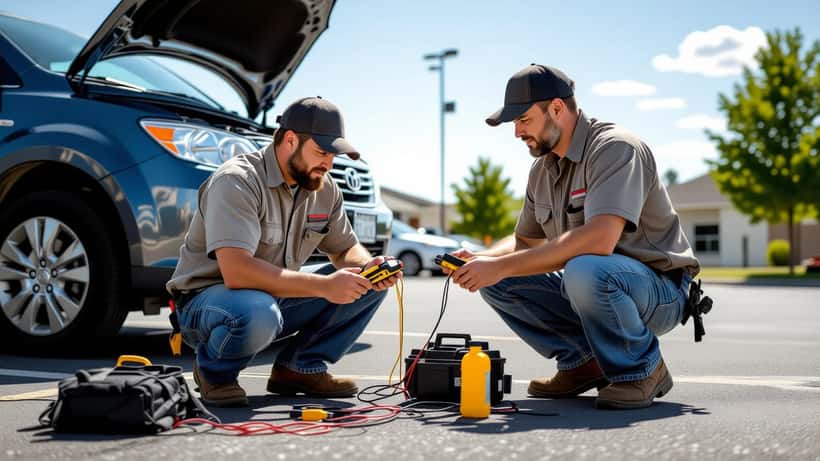
If your battery is more than three years old and you are in one of this week's heat-dome states, that is worth a five-minute check. A mechanic can load-test a battery to see how it performs under demand, not just whether it reads a healthy voltage at rest. Corroded terminals — that white or bluish crust — also spike resistance and should be cleaned.
Tires: pressure, heat and blowouts
Air expands as it heats, so tire pressure rises on a hot day and climbs further as friction warms the rubber at highway speed. That sounds harmless, but a tire that is already underinflated flexes more, builds heat faster and is far more likely to fail. The U.S. Department of Transportation has long identified summer as peak season for blowouts for exactly this reason.
Check your pressure when the tires are cold — before you drive — and match the figure on the door-jamb sticker, not the maximum stamped on the sidewall. Inspect the tread and the sidewalls for cracking, which the sun's UV and ozone accelerate. A tire that looks fine but is six years old may be one pothole away from letting go.
Cooling systems and the flash-flood risk
The engine's cooling system is the component actually designed to fight heat, which is why a marginal one chooses a heat wave to fail. Low coolant, a tired water pump, a clogged radiator or a weak cooling fan can all tip an engine into overheating when the ambient temperature is already extreme. If your temperature gauge starts creeping up in traffic, that is a signal to pull over — not to push on.
This week's forecast adds a second hazard: the same systems delivering record heat are also spinning up violent thunderstorms and flash flooding, as the National Weather Service and NBC News have flagged. Never drive into standing water. As little as a foot of moving water can float a car, and water pulled into the engine's air intake causes catastrophic, usually uninsured-as-neglect damage. If your vehicle has been submerged even briefly, have it inspected before restarting it.
A six-point heat-wave checklist
Before your next drive this week, a mechanic would run through these — the same routine maintenance discipline that keeps any modern vehicle reliable:
- Battery — load-test if it is over three years old; clean corroded terminals.
- Coolant — check the level in the reservoir when the engine is cold and look for leaks or a sweet smell.
- Tires — set cold pressure to the door-sticker spec; scan for cracks and low tread.
- Oil — top up and confirm you are on schedule; heat thins oil and stresses the engine.
- Belts and hoses — squeeze hoses for soft or brittle spots and look for cracked belts.
- A/C — weak cooling often means low refrigerant or a failing compressor, worth diagnosing early.
The U.S. Department of Energy's vehicle maintenance guidance is a useful official reference for keeping a car running efficiently in extreme conditions, and it reinforces that proper tire pressure and cooling upkeep also protect your fuel economy.
When to call a professional
Some of this is DIY. A tire-pressure check and a coolant top-up take minutes. But a battery that keeps dying, a temperature gauge that climbs, a whiff of coolant, or any exposure to flood water are all signs to stop guessing and get a qualified mechanic to diagnose the problem. A summer breakdown on a 104°F roadside is not just an inconvenience — it is a genuine health risk for anyone stranded in it.
If you are unsure whether your vehicle is ready for the rest of this heat wave, connecting with a verified mechanic through Expert Zoom lets you describe the symptoms and get a professional read before a small issue becomes a roadside emergency. The forecast is not easing much into next week — the smarter move is a ten-minute check now rather than a tow later.
