 Charles Jackson
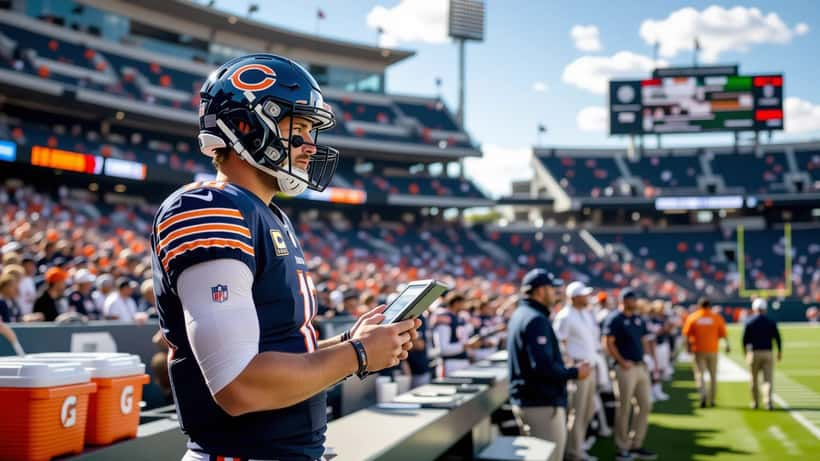
When Caleb Williams limped off the field for the second consecutive week with a hamstring injury in late September 2026, Chicago Bears backup Tyson Bagent went from clipboard-holder to starter — expected to take his first NFL snaps in that role since 2023 when the Bears face the New York Jets on October 5. The shift puts Bagent's 2-year, $10 million contract under a new spotlight: not just as a roster number, but as a case study in what NFL performance language actually means when a backup becomes the starter.
From Undrafted to $10 Million: How Bagent Got Here
Bagent's path to this moment is unusual by any standard. Undrafted out of Division II Shepherd University in 2023, he holds the NCAA record for career touchdown passes (159) and broke the Division II marks for completions (1,400) and passing yards (17,034). He earned his first NFL starts in 2023 when then-starter Justin Fields went down with injuries, going 2-2 before ceding the role.
The Bears rewarded that reliability in May 2026, extending him through 2027 on a 2-year deal worth $10 million with incentives potentially reaching $16 million, according to the National Football Post. His 2026 base salary sits at $4 million, with a $250,000 workout bonus already banked. Those incentive escalators, buried in contract language that most fans never read, are about to become very relevant.
Bagent spent the early weeks of the 2026 season clearing concussion protocol after being limited in practice, but cleared all league requirements by Sunday, per NFL Network's Ian Rapoport. Coach Ben Johnson had not publicly named a starter heading into Week 4, but Rapoport's reporting indicated that Bagent had taken the majority of first-team reps in practice — "all signs point to Tyson Bagent," as Windy City Gridiron summarized the situation.
Expert Reaction: What Contract Lawyers Say About "Games Started"
NFL player contracts are governed by the Collective Bargaining Agreement between the league and the NFL Players Association, last renewed in 2020 and operative through 2030. Under standard CBA provisions, performance-based escalators are tied to specific statistical thresholds — games started, completion percentage, passer rating, playoff appearances — rather than to a simple "started X games" clause.
For a backup quarterback, the key threshold is almost always games started. Most escalator structures in the $4–$6 million base salary range tie to a minimum of 6 games started in a given season. If a player hits that mark, the following contract year's base salary automatically increases — in many cases by $500,000 to $2 million — regardless of whether the original starter returns. The team cannot reverse the escalation after the fact; it triggers the moment the 6th start is recorded.
The distinction between "games started" and "games played" is not cosmetic. "Games played" counts a single snap from scrimmage. "Games started" requires the player to be the announced starter at kickoff. Most NFL backup deals use the stricter "games started" definition precisely because it limits escalation exposure for the team — a backup who relieves the starter in the second quarter of 12 games does not benefit; one who starts 6 games does.
Concrete Case: Running the Numbers on Bagent's Deal
Take Bagent's actual contract figures and apply standard escalator math. His 2026 base: $4 million. His projected 2027 base without escalation: approximately $5 million (the second year of a $10 million deal). His maximum contract value: $16 million over two years.
If Bagent starts 6+ games in 2026, then his 2027 base salary escalates by approximately $750K–$1.5M automatically — no renegotiation, no agent involvement required at that stage. At 6 starts, his total 2026–2027 compensation could reach $11.5–$11.75 million, meaningfully above the $10 million floor and potentially approaching the $12–$13 million range if additional performance bonuses (passer rating above 90.0, completions above 65%, playoff appearance) also activate.
The Bears committed to that $16 million ceiling only because they believed he could play when needed. If Bagent starts 6+ games this season and performs credibly, the team will owe him significantly more for 2027 — and he would enter 2028 free agency with one of the more valuable backup QB resumes in recent draft history.
For comparison, Mac Jones — another backup who stepped in for an injured starter in 2025 — received a revised 2026 San Francisco contract worth $3.55 million base plus $2.25 million in incentives, per NBC Sports Bay Area. Jacoby Brissett's contract restructure with Arizona in 2026 pushed his guaranteed value to $15.5 million after he became a presumptive starter. The market for proven backup starters is real; it activates the moment a player makes starts.
The Clause That Could Cost Bagent His Raise
There is a catch that contract attorneys flag in nearly every backup QB deal: the injury offset provision. If Williams returns from his hamstring injury after four weeks and reclaims the starting job, Bagent might finish the 2026 season with 3 or 4 starts — close to, but short of, a 6-game escalator trigger. His 2027 salary stays flat. Same player, same performances per start, but one fewer game separates a $750,000 automatic pay raise from nothing.
A lawyer reviewing Bagent's specific contract would look for three clauses in particular: the escalator threshold (exact games started required), the calculation method (flat bonus vs. salary bump), and whether any injury offset language reduces the threshold if the backup starts because of a starter's documented injury. Some CBA-negotiated contracts include lower thresholds for starts triggered by a starter's injury designation — a protection the NFLPA has pushed for in recent negotiations. Whether Bagent's extension includes this language is not public, but it is exactly the kind of detail his agent would have fought for when the deal was signed.
What This Means Beyond the NFL
The Bagent situation is unusually public, but the underlying structure — performance escalators that activate only if a specific threshold is crossed — applies well beyond professional football. Commissioned sales roles, executive compensation packages, consultant agreements, and freelance contracts frequently include clause language that works identically: a threshold triggers a financial change, and whether you cross it often depends on circumstances partly outside your control.
If you have a performance-escalator clause in your own employment or service contract, a contract attorney can verify whether the threshold is clearly measurable, whether force majeure or leave provisions create exceptions, and whether the escalator language is mutual (protecting you) or one-sided (protecting only the employer). The NFL's CBA establishes floor-level protections through the NFLPA's player rights framework, including the right to agent representation and mandatory disclosure of contract terms. For everyone outside a union contract, no equivalent structure exists — which makes individual legal review before signing substantially more important.
What to Do Now
Tyson Bagent's Week 4 start is a reminder that contract language finalized in May 2026 will face tests in October that nobody fully anticipated. The escalator clauses in his deal were not written for a multi-week starter absence caused by a hamstring injury — they were written for a standard backup season of two or three relief appearances.
If you are reviewing a job offer, renegotiating an existing deal, or structuring any agreement that includes performance-based pay triggers, consulting a contracts attorney before you sign is the right move — not after a threshold you misunderstood fails to protect you when your opportunity finally arrives.
ExpertZoom connects you directly with experienced contract lawyers who review employment and service agreements, identify ambiguous escalator language, and represent your interests in negotiation. The time required for a contract review is far shorter than the consequences of a clause that does not protect you when you need it most.
format_used: Expert reaction
