 David Miller
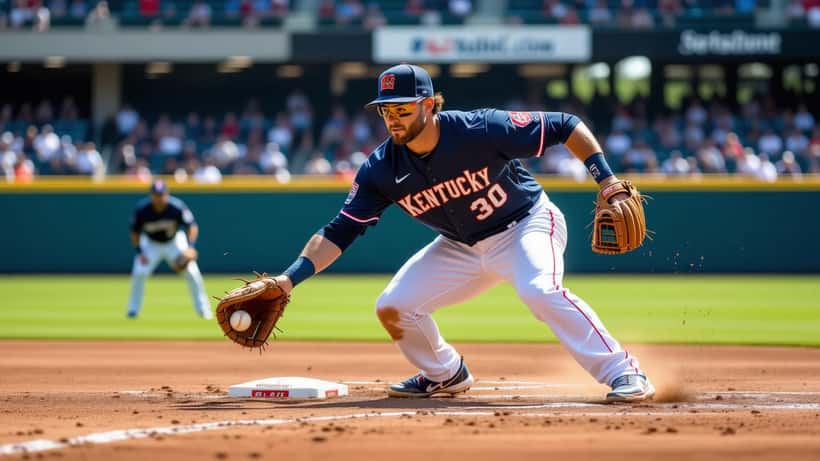
Tyler Bell has become one of the most talked-about names in the 2026 MLB Draft conversation, with scouts and analysts tracking every at-bat the Kentucky shortstop takes this spring. A former second-round selection by the Tampa Bay Rays in 2024 who opted to honor his college commitment, Bell entered the 2026 season as a consensus top-five prospect and has remained there despite battling a shoulder injury that briefly slowed his campaign. His decision to develop in the Southeastern Conference rather than sign professionally out of high school is now viewed as a calculated move that could push him toward the top of the draft board.
At 6-foot-1 and roughly 190 pounds, Bell profiles as a true shortstop with the instincts, arm strength, and athleticism to stay at the position long term. He is a switch-hitter who has shown the ability to impact the baseball from both sides of the plate, and his 2025 college debut offered a glimpse of that upside. Over 265 plate appearances, Bell slashed .296/.385/.522 with 10 home runs, 29 extra-base hits, and 11 stolen bases. His plate discipline was a work in progress, with 59 strikeouts against 24 walks, but the power and speed combination helped establish him as a first-round talent.
The 2026 season has been more complicated. A shoulder injury early in the year limited Bell's availability and raised questions about his medical status heading into the draft process. Even so, he has continued to produce when healthy, posting an OPS north of 1.100 in some reports while maintaining elite bat-to-ball metrics. Teams evaluating him are balancing the present injury against the long-term track record, and most scouts believe the medicals will come back clean enough for him to remain in the top tier of position players.
What makes Bell particularly interesting from an expert perspective is how his career arc illustrates the value of specialized guidance for elite athletes. Turning down a seven-figure signing bonus out of high school is not a decision made lightly. It requires input from sports agents, financial advisors, family members, and sometimes legal counsel. For a teenager facing that level of financial and professional pressure, access to experienced advisors can be the difference between a decision that optimizes a career and one that leaves money or development opportunity on the table.
Bell's choice to attend Kentucky also highlights the evolving landscape of college athletics. With NIL opportunities now available to NCAA athletes, top prospects can earn significant income while retaining amateur status and improving their draft stock. Navigating NIL contracts, tax obligations, and compliance rules demands expertise that goes beyond what a typical family or high school coach can provide. Athletes in Bell's position increasingly rely on consultants who understand both sports and business to structure deals that protect their long-term interests.
From a performance standpoint, Bell's development at Kentucky has benefited from professional-level coaching, strength and conditioning resources, and exposure to high-velocity pitching in the SEC. The jump from high school to college baseball is substantial, and the adjustment period often separates players who can handle advanced competition from those whose tools do not translate. Bell's ability to hold his own as a freshman, then elevate his profile as a sophomore eligible for the draft, speaks to both his physical tools and his capacity to process coaching.
Scouts generally grade Bell's tools as average or slightly above across the board, with the expectation that his hit tool and power could both tick up with pro instruction. His defensive actions at shortstop are considered more reliable than some of his college peers, and his arm is strong enough to make the throws required at the position. There is also flexibility in his profile; if he outgrows shortstop, he has the athleticism to handle second base or third base without losing much value.
The draft narrative around Bell is also shaped by the broader market for college position players in 2026. With several high-profile shortstops and infielders in the class, teams are comparing medical histories, performance trends, and signability. Bell's decision to return to Kentucky, or more precisely his decision not to sign with Tampa Bay in 2024, gives teams additional data points to evaluate. They have seen him against SEC competition, in the Cape Cod League, and in workout settings, which reduces some of the uncertainty that accompanies high school prospects.
For families and young athletes watching Bell's rise, there are practical lessons worth noting. The first is that development timelines are not uniform. Some players are ready for professional baseball at eighteen; others benefit from two or three years of college refinement. The second is that the business of baseball begins long before a player signs a contract. Decisions about representation, training programs, and financial planning can influence not only draft position but also career longevity.
Bell's shoulder injury also serves as a reminder of the physical risks inherent in baseball, particularly for players carrying heavy expectations. Proper load management, arm care, and recovery protocols are not optional for athletes hoping to reach the highest levels. Specialists in sports medicine, physical therapy, and performance science play an increasingly central role in keeping players on the field and maximizing their draft value.
As the 2026 MLB Draft approaches, Bell will continue to be evaluated through a combination of statistical production, medical evaluations, and private workouts. His final college statistics will matter, but so will the impressions he leaves in predraft meetings and training sessions. Teams drafting near the top of the board will weigh his floor against his ceiling, and his ability to answer questions about the shoulder will likely determine whether he hears his name called in the first five picks.
In the meantime, Bell's story offers a useful case study in how modern athletic careers are built through a network of experts. From coaching and training to legal and financial advice, the athletes who rise to the top are increasingly those who know how to assemble the right support team. For anyone following the 2026 draft, Tyler Bell is not just a name to watch; he is an example of how talent, patience, and expert guidance can converge at exactly the right moment.
