 Emily Wang
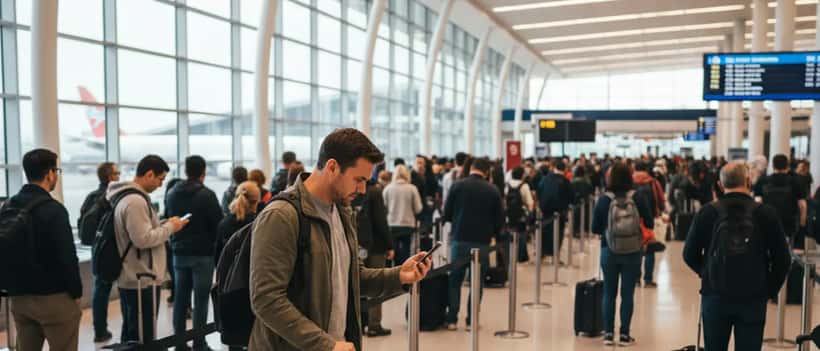
TSA officers at major U.S. airports went unpaid for the sixth consecutive week as the federal government shutdown entered its 35th day on March 21, 2026 — and American travelers are paying the price. Absentee rates surged to 10.22% nationally, with Atlanta recording a 37.1% callout rate and Houston's George Bush Intercontinental seeing security lines stretching beyond three hours. If your flight was delayed, missed, or if you're facing travel disruption during this crisis, you have more legal options than you may realize.
What's Happening at U.S. Airports Right Now
The partial government shutdown that began February 14, 2026 has left approximately 45,000 TSA officers working without pay. As of March 21, 366 officers have resigned since the shutdown began — a figure that compounds the staffing crisis with each passing week.
The worst-affected airports include Atlanta Hartsfield-Jackson, Houston IAH, New Orleans, New York-area airports, and Pittsburgh. Spring break travel coinciding with the staffing crisis has created a perfect storm: peak demand meeting record-low supply of security personnel.
Bloomberg reported on March 20, 2026 that Atlanta and Houston travelers were experiencing waits exceeding 2-3 hours, forcing many to miss connecting flights or abandon travel plans altogether.
Your Rights as a Traveler When TSA Delays Cost You
Missed Flights Due to Security Wait Times
Here is where most travelers get confused: the TSA is a federal security agency, not part of the airline's operation. Airlines are generally not legally obligated to compensate you for delays caused by government security processes under U.S. law.
However, your rights depend on several factors:
If you checked in on time: If you arrived at the airport with the airline's recommended lead time and missed your flight due to excessive TSA wait times — not your own lateness — you have a strong case to request a rebooking without fees. Most airlines have discretionary policies that allow agents to waive change fees in documented cases. Document your check-in time and the TSA wait time (screenshot the airline's queue tracker or take time-stamped photos of the security line).
If your airline misled you: Some airlines updated their check-in advisories during the shutdown crisis. If an airline told you to arrive two hours before departure and you missed your flight despite following that instruction, you have a complaint basis with the airline and potentially with the Department of Transportation.
Connecting flights: If you missed a connection on the same ticket due to TSA delays on your initial flight, the airline must rebook you at no charge. This is a firm obligation under DOT rules for domestic travel.
What to Document Immediately
If you're caught in a TSA delay situation:
- Time-stamp a photo of the security line and your boarding pass
- Ask a TSA officer for the current estimated wait time — if they refuse, note that refusal
- Screenshot the TSA wait time app or any airport queue board
- Keep all receipts for meals, hotels, or alternative transport you purchase as a result of the delay
- Request a written statement from your airline confirming the rebooking reason
When You May Have a Legal Claim
You may have legal recourse beyond airline discretion if:
- A travel insurance policy you purchased covers "government-caused delays" — many comprehensive policies include this
- Your employer sent you on a business trip and the delay caused demonstrable financial harm
- An airline made affirmative misrepresentations about security wait times that you relied on
- You paid for a premium service (business class, Priority TSA PreCheck) that was unavailable or inoperable
TSA PreCheck holders have a particularly strong complaint position: you paid for expedited screening and it is not being provided at adequate staffing levels. The TSA's own service standards commit to PreCheck lanes. File a formal complaint at the TSA Contact Center and document any PreCheck lane closures.
The Bigger Legal Picture: Sovereign Immunity and Its Limits
The federal government generally enjoys "sovereign immunity" — meaning you cannot easily sue the TSA for causing you to miss your flight. The Federal Tort Claims Act allows some claims against the government, but delay-caused economic losses are typically excluded unless there is negligence beyond the ordinary conduct of government functions.
However, this is an evolving area of law. Class action litigation has been floated in legal circles regarding the pattern of shutdown-related travel disruption. If you suffered significant losses — a non-refundable international ticket, a missed business deal, or serious documented damages — consulting a travel or administrative law attorney is worthwhile.
What to Do Right Now If You're Affected
Step 1: At the airport: Don't leave the security queue without documented proof of wait time. If you miss your flight, go directly to the airline service desk (not the app) and request immediate rebooking citing TSA delay documentation.
Step 2: File complaints: Submit formal complaints to both the TSA (tsa.gov/contact-center) and the DOT's Aviation Consumer Protection Division within 30 days.
Step 3: Claim travel insurance: Review your policy for "travel delay" coverage. Most policies cover delays of 4+ hours with receipts.
Step 4: Consult a lawyer: If your losses exceed $1,000 or involve contractual obligations (business travel, weddings, non-refundable international flights), a travel or consumer rights attorney can assess whether you have an actionable claim against the airline, a third-party travel agent, or under your insurance policy.
The Systemic Problem Behind the Headlines
The TSA staffing crisis is not random misfortune — it is the direct result of a policy decision to continue a federal shutdown while requiring security workers to work unpaid. Courts have repeatedly held that this practice is legal under the Anti-Deficiency Act, but the human and economic cost to travelers is real and documented.
Travel attorneys across the U.S. are currently busy. If you need legal advice on your travel rights during the TSA shutdown crisis, ExpertZoom connects you with qualified attorneys who specialize in travel, consumer, and administrative law.
Disclaimer: This article provides general legal information only and does not constitute legal advice for your specific situation. Laws vary by state and circumstance. Consult a licensed attorney for advice tailored to your case.
Facing airline delays or travel losses due to the TSA shutdown? Find a qualified travel and consumer rights lawyer on ExpertZoom USA — get expert guidance for your situation.
