 William Reed
At least nine tornadoes touched down across Indiana on the night of June 11, 2026, causing substantial damage in six counties and leaving thousands of vehicle owners scrambling to learn whether their auto insurance will actually pay for what the storms destroyed. The answer, according to the Indiana Department of Insurance, depends entirely on one optional and often overlooked line item in your policy: comprehensive coverage.
Nine Tornadoes, Six Counties, and Thousands of Auto Claims
The June 11 storms moved quickly through central and southern Indiana after dark, catching many residents off guard. Wind speeds in the Indianapolis metro were strong enough to toss recreational vehicles, strip awnings from structures, and send tree branches crashing through car roofs parked in driveways. At least four people were injured during the event, according to WISH-TV coverage filed the same night.
The insurance fallout was immediate and large-scale. State Farm alone reported receiving more than 12,000 home and auto claims from June storms spanning Indiana and six neighboring states. Reinsurance analysts tracking the wider June 2026 severe convective storm (SCS) outbreak described the combined event as potentially "one of 2026's costliest insurance events," with industry-wide losses estimated in the mid-single-digit billions of dollars, according to Insurance Business magazine.
For Indianapolis drivers, the acute questions are practical: is my vehicle damage covered? What should I document before calling my insurer? And does a mechanic need to inspect my car before I accept any settlement offer?
The One Coverage Type That Actually Pays
Indiana requires all registered drivers to carry liability insurance, and many add collision coverage for accidents involving other vehicles or fixed objects. Both policy types share a critical omission: neither covers damage caused by weather events.
Comprehensive auto insurance is the only policy type designed to pay for tornado damage. It covers your vehicle against falling trees, hailstones, flying debris, flooding, fire, and other incidents outside a conventional road accident. In Indiana, comprehensive is entirely optional — meaning every driver who chose to drop it to reduce their monthly premium is now responsible for 100% of their own repair bill.
This timing stings. Indiana car insurance rates rose noticeably in 2026, partly because of the very storm patterns that caused June's damage. Some drivers responded by trimming optional coverages to offset higher premiums. For those who dropped comprehensive before the June tornadoes struck, that decision now carries a concrete financial cost.
Nationwide, comprehensive coverage adds roughly $160 to $200 per year to an average auto insurance policy — approximately $13 to $17 per month. In hail-prone markets like central Indiana, the figure may run higher, but so does the expected payout when tornado season arrives.
Your $24,500 Toyota Camry After a Tree Strike on June 11: What the Numbers Mean
This is the situation facing a representative category of Indianapolis driver right now, and it makes the coverage question concrete.
Assume you own a 2023 Toyota Camry LE, which carried an actual cash value of $24,500 before the June 11 storms. That night, a large oak branch landed across the roof, cracking the windshield, collapsing the roof rail, and denting the front hood. Your body shop produces a repair estimate of $9,800.
If you carry only liability and collision insurance: Your insurer pays $0. The full $9,800 repair bill is your responsibility.
If you carry comprehensive insurance with a $500 deductible: Your insurer pays $9,300. Your out-of-pocket cost is $500.
If your adjuster declares the vehicle a total loss: Indiana insurers typically declare a total loss when estimated repair costs exceed approximately 70–75% of the vehicle's actual cash value. On a $24,500 car, that threshold activates at roughly $17,150 in repairs. If your Camry crosses that line, the insurer pays you $24,000 (ACV minus deductible) and takes title to the damaged vehicle.
The gap between the first and second scenarios is a single optional line item costing about $14 per month. That calculation deserves a hard look from every driver in a region that has now seen nine tornadoes in a single night.
One hard rule applies regardless of scenario: if you did not carry comprehensive coverage at the moment the storm hit, coverage cannot be added retroactively. The policy in force at the time of the loss is the policy that determines what you are owed — not what you add the following morning.
Drivers across the wider region are navigating similar claims questions after the June outbreak, including those in Louisville and the broader Ohio Valley corridor affected by the same storm system — a pattern detailed in our regional tornado insurance recovery guide.
What a Mechanic Finds That Your Adjuster's Visual Inspection Misses
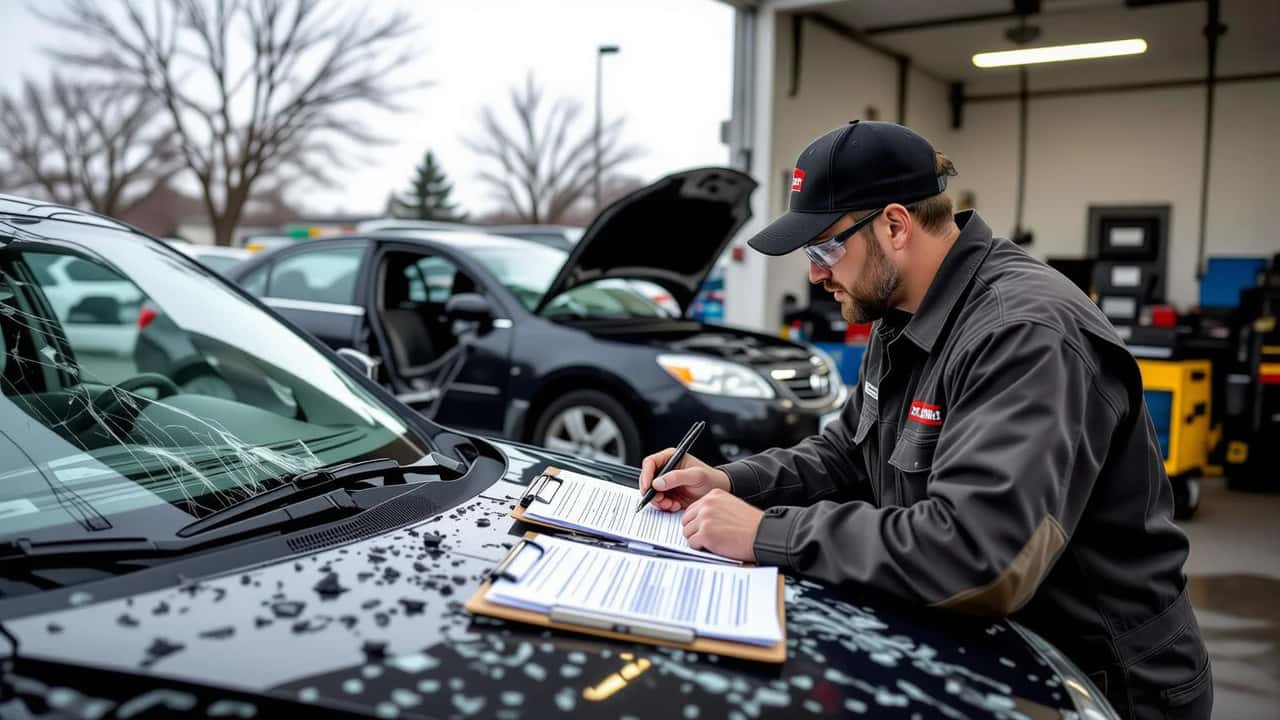
Visible tornado damage is rarely the complete picture. A crushed roof section and a shattered windshield are easy to photograph and price. What is not visible in a driveway walk-around includes bent chassis rails, compromised airbag sensor modules, water intrusion into electrical wiring, scored brake lines from flying debris impacts, and suspension geometry shifts from uneven point-loading during a tree strike.
Auto repair professionals flag several checks as essential before any settlement is accepted:
- Chassis and frame alignment: Even moderate overhead impact forces can displace structural members. Misalignment degrades steering precision, accelerates tire wear, and introduces long-term handling risk that may not surface until highway speeds.
- Airbag control module diagnostic scan: Impact sensors may record fault codes without deploying the airbags. A vehicle with a triggered module can fail future safety inspection or require full module replacement — a cost that runs $500 to $1,200 depending on make and model.
- Electrical continuity inspection: Water entering through broken seals or windows causes corrosion in wiring harnesses and CAN-bus connectors, typically appearing as intermittent dashboard faults weeks after the storm.
- Fuel and brake line visual inspection: Debris from below can score rubber lines without creating an immediate leak. The failure risk materializes later, under pressure and at speed.
An independent mechanical inspection — typically $100 to $200 at a qualified shop — produces written documentation that protects you during claim negotiations. Accepting a settlement based only on the adjuster's visual estimate and later discovering hidden mechanical damage is a difficult position to dispute once the claim is formally closed.
What to Do in the Next 72 Hours
The Indiana Department of Insurance issued formal guidance following the June 2026 tornado events, directing both homeowners and vehicle owners through the claim process. For drivers, the core steps are:
- Document before touching anything. Video and photos of the vehicle in its exact post-storm position establish cause of damage. Include surrounding debris in frame. Do not move the car to a more photogenic location.
- File your claim immediately. Indiana policies often include prompt-notice provisions; delays create grounds for coverage disputes even when damage is clear.
- Authorize only temporary protective repairs. Covering a broken window with plastic to prevent further water damage is appropriate — completing full body shop repairs before the adjuster inspects the vehicle can complicate the scope estimate.
- Request an itemized repair estimate. A line-by-line breakdown from your body shop makes it straightforward to dispute any single exclusion the adjuster applies.
- Schedule an independent mechanical inspection before closing the claim. This is the step most drivers skip, and the one most likely to surface hidden damage that would otherwise leave you driving a vehicle that is partially but not fully repaired.
For insurance complaints, policy disputes, or claim delays beyond Indiana's statutory handling window, the Indiana Department of Insurance maintains a consumer services line that handled a significant volume of storm-related inquiries following the June 2026 outbreak.
Disclaimer: This article is for informational purposes only and does not constitute legal or insurance advice. Consult a qualified auto insurance professional or licensed attorney for guidance specific to your policy and situation.
When the Offer Doesn't Cover What the Damage Actually Cost
When a settlement offer falls short — because the adjuster underestimated repair scope, applied steeper depreciation than market values support, or excluded hidden mechanical damage — the path to a fair outcome requires professional documentation and, in some cases, professional representation.
An independent mechanic produces a written assessment itemizing what the visual inspection missed. A licensed public adjuster negotiates directly with the insurer on your behalf. And if the insurer denied a covered claim without reasonable basis or delayed handling beyond statutory limits, a consumer protection attorney can advise on bad-faith remedies available under Indiana law.
ExpertZoom connects Indianapolis residents with licensed auto repair specialists and consumer claims professionals who can review your tornado damage documentation, assess whether the settlement reflects actual repair scope, and represent your interests if the figures are in dispute. A consultation before you sign a settlement release can change the final number significantly — especially when hidden mechanical damage adds thousands of dollars to the true cost of repair.
format_used: News brief
