 Richard Thomas
Tesla's head of Autopilot and AI, Ashok Elluswamy, stepped onto the stage at the Computer Vision and Pattern Recognition conference (CVPR 2026) in Denver, Colorado on June 3, 2026 — the opening day of a four-day event where his session runs back-to-back with XPENG's head of general intelligence in what analysts are calling a direct public comparison between the two leading vision-based autonomous driving systems. The same week, Tesla reported its strongest China sales month of 2026: 85,982 vehicles delivered in May, a 39.4% year-over-year increase. For IT specialists and business technology managers, the convergence of these events signals the autonomous vehicle landscape is shifting faster than most enterprise roadmaps currently account for.
What CVPR 2026 Reveals About the Autonomous Driving Race
CVPR — the Computer Vision and Pattern Recognition conference — is the premier academic forum for computer vision research, drawing the leading AI researchers and practitioners from around the world each year. Tesla's senior AI leadership has attended consistently as the company pursues full self-driving capability built exclusively on camera-based perception, without lidar. XPENG, the Chinese EV maker that has expanded aggressively into European and North American markets, is pursuing a parallel approach based on its own vision foundation model for autonomous navigation.
Having both companies' AI heads in back-to-back sessions at CVPR 2026 is unusual and deliberate. It signals that both companies are positioning their autonomous AI systems as enterprise-ready technologies — not just consumer vehicle features. For IT departments at logistics firms, fleet operators, and companies evaluating autonomous vehicle integration, the gap between "research demonstration" and "operational deployment" is closing in measurable ways.
According to NIST's Artificial Intelligence guidance, deploying autonomous AI systems in operational environments requires risk frameworks that cover model accuracy, adversarial robustness, explainability, and integration with existing IT infrastructure. These are precisely the areas that Elluswamy's CVPR session will address publicly — making the proceedings a practical reference point for enterprise technology teams evaluating autonomous systems.
Tesla's 85,982-Unit May and Its Enterprise IT Implications
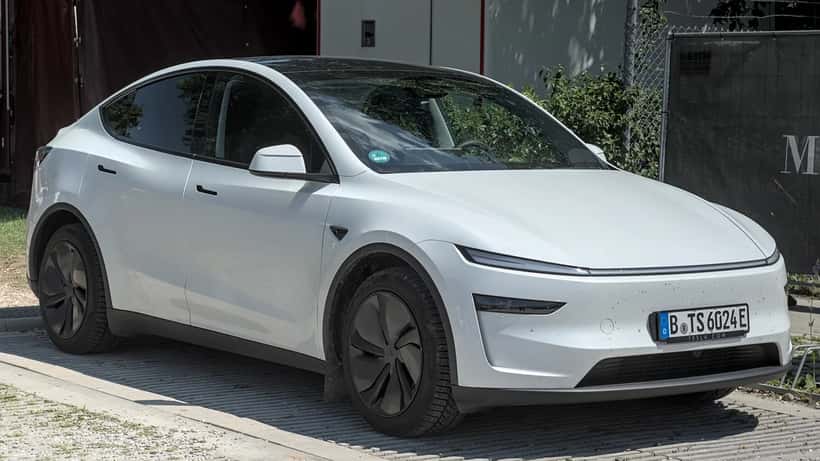
Tesla's China operations delivered 85,982 vehicles in May 2026 — the company's strongest single month of the year, up 39.4% year-over-year and 8.2% month-over-month from April. The Model Y refresh and a reduced minimum down payment (55,900 yuan, approximately $8,200) drove the acceleration. Tesla's stock closed at approximately $421 on June 2, 2026, pushing the company's market capitalization to $1.39 trillion.
From an enterprise IT standpoint, the scale of Tesla's fleet deployment has concrete implications for businesses managing or evaluating Tesla vehicles. Each Tesla is a software-defined device generating continuous telemetry, receiving over-the-air (OTA) software updates, and feeding data back into the autonomous driving model. Fleet operators managing Tesla vehicles — whether a handful of company cars or a large commercial fleet — need IT infrastructure capable of handling OTA update cycles, cybersecurity monitoring for connected hardware, and integration with existing fleet management platforms.
As Tesla's fleet grows by tens of thousands of units per month globally, the software update cadence and data pipeline complexity grows with it. IT teams that plan for this now will be better positioned than those who treat connected vehicles as traditional automotive assets.
The Optimus Wildcard: AI Robotics Enters the Enterprise
Tesla's humanoid robot program adds another dimension to the enterprise technology story. Elon Musk confirmed at Tesla's Q1 2026 earnings call on April 22 that Optimus V3 production begins at the Fremont factory in late July or August 2026, following the closure of the Model S/X production lines. A second production facility at Giga Texas is targeting summer 2027 for the next-generation model.
Optimus is initially designed for in-factory use at Tesla's own facilities, but the company's stated roadmap targets deployment in third-party industrial and logistics environments within this decade. IT departments at manufacturing, warehousing, and distribution firms should begin forming cybersecurity and procurement policies for humanoid robot integration now — not when the hardware arrives at loading docks.
Autonomous robots require network access for operational updates and performance monitoring, which creates new attack surfaces in enterprise environments. Existing endpoint security and network segmentation policies may not adequately cover hardware that moves through physical space, handles physical objects, and transmits continuous operational telemetry.
3 IT Questions Every Business Should Answer Now
1. Is your fleet management infrastructure compatible with over-the-air updates? As vehicle software evolves across Tesla's platform and increasingly across all major OEM lines, fleet operators need IT pipelines capable of verifying, logging, and selectively applying OTA updates without creating security gaps or operational disruptions during business hours.
2. What is your cybersecurity policy for connected vehicles and autonomous robotics? Connected vehicles and autonomous robots generate continuous telemetry. IT security teams should classify this data, establish retention and access policies, and build incident response plans for connected hardware breaches — as a separate category from traditional endpoint and server security.
3. Have you assessed vendor dependency risk for autonomous AI systems? Tesla's camera-only approach and XPENG's foundation model represent two distinct architectural bets on how autonomous AI will evolve. Deploying either at scale creates dependency on that vendor's model performance, update schedule, and long-term business continuity. For a related view on how AI compliance is changing what US businesses need from IT partners, see AI at work in 2026.
When to Consult an IT Specialist
Autonomous vehicles, AI robotics, and software-defined hardware are converging faster than most enterprise technology teams anticipated two years ago. For businesses evaluating fleet electrification, logistics automation, or operational AI deployment, an IT specialist with autonomous systems experience can assess integration readiness, model vendor risk, and design a cybersecurity framework that accounts for connected and mobile hardware.
The back-to-back CVPR 2026 sessions from Tesla and XPENG are public indicators of where autonomous AI is headed in the next 24 to 36 months. An IT professional who tracks applied AI research can translate conference outputs into actionable enterprise risk assessments — before autonomous systems are already operating at your facility.
