 Michael Campbell
Oil has fallen nearly $30 per barrel in six weeks — and that move may be just beginning. As negotiations advance over reopening the Strait of Hormuz following the April 2026 ceasefire, U.S. investors face a pivotal decision: hold their energy positions, rotate out, or layer in new trades. Getting it wrong could cost thousands. A wealth manager can help you get it right.
The Biggest Oil Supply Shock in Modern History
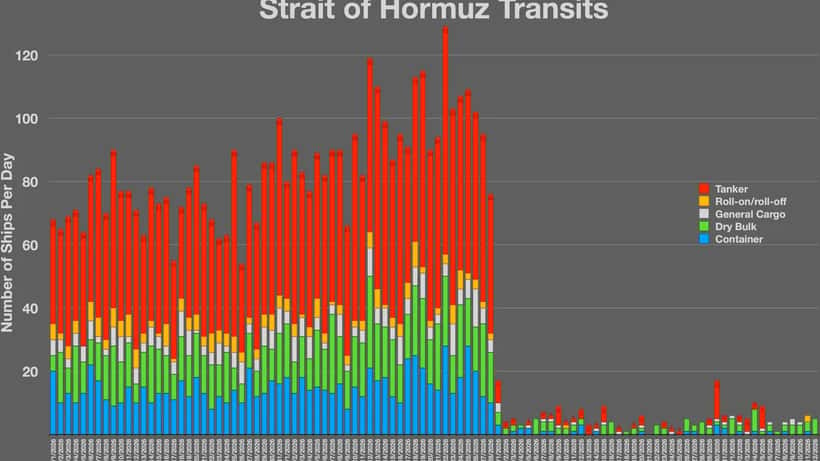
The Strait of Hormuz has been largely blocked since February 28, 2026, when the United States and Israel launched an air campaign against Iran. The closure triggered what the U.S. Energy Information Administration now calls the largest supply disruption ever recorded against global production: roughly 20 million barrels of oil and refined products that previously transited the strait each day were effectively shut off overnight.
World Trade Organization data reported a 95% reduction in crude oil tankers and a 99% reduction in liquefied natural gas shipments through the strait. Brent crude spiked to $118 per barrel in late April 2026 — a generational high — as markets priced in a prolonged closure.
Since the April 7 ceasefire, however, the picture has shifted. Brent crude averaged $107 per barrel in May, the first monthly decline since December 2025, according to the EIA's Short-Term Energy Outlook. By June 2026, prices have retreated further to approximately $90 per barrel as 50 nations continue negotiations to reopen the strait and the United Kingdom has deployed naval assets to escort commercial shipping.
Three Scenarios Every U.S. Investor Must Understand
The Hormuz situation creates three plausible paths for markets — and each demands a different portfolio posture.
Scenario 1: Full Reopening Within 90 Days. If negotiations succeed and commercial traffic resumes at scale, Brent crude could retreat toward the $70–$75 range. Energy company stocks that surged 35–50% during the crisis face meaningful correction risk. Airlines, trucking firms, consumer goods companies, and emerging market importers would benefit sharply.
Scenario 2: Selective Access Continues. Iran has been charging tolls for permitted transit and selectively approving passage for some vessels. If this partial-blockade equilibrium persists, oil could stabilize in the $85–$100 band. Energy firms would maintain elevated margins while the broader economy adjusts to reduced throughput.
Scenario 3: Crisis Reignition. A breakdown in talks or a new military incident could push oil back above $110. In that environment, inflation hedges — commodities, Treasury Inflation-Protected Securities (TIPS), energy equities — would regain their appeal and traditional bond holdings would face renewed pressure.
Most individual investors are not positioned for all three. That asymmetry is exactly what professional wealth management addresses.
What a Wealth Manager Sees That You Don't
A wealth manager brings three capabilities that financial news apps cannot replicate.
Your true oil-price sensitivity is larger than you think. Your portfolio's energy exposure extends well beyond any energy ETF you hold. Airlines, plastics manufacturers, shipping companies, agricultural firms, and consumer staples all carry embedded fuel cost exposure. A certified financial planner can map precisely how a $10 move in Brent crude affects your net worth — across every holding, not just the obvious ones.
Tax-optimized rotation requires planning. If you bought energy stocks when they were priced below crisis levels and they are now trading 40–50% higher, a thoughtful exit strategy involves tax-loss harvesting, wash sale rule management, and timing gains across fiscal quarters. Selling in response to a headline rarely produces the best tax outcome. A wealth manager designs the sequence.
Scenario-weighted positions outperform single bets. Professional advisors build portfolios that work across multiple outcomes rather than betting on one direction. This can mean a partial trim of energy exposure while adding to beneficiaries — without going all-in on either thesis. The result is a portfolio that does not require you to correctly predict whether Hormuz fully reopens in August or stays restricted through year-end.
Why the June 2026 Window Is Critical
The period between a ceasefire and full market normalization is historically one of the most treacherous for investors. Markets tend to overshoot in both directions: first pricing in a complete catastrophe, then pricing in an instant return to normalcy. Neither extreme tends to be accurate, and the volatile middle ground is where most individual investors lose money.
Several structural factors complicate the Hormuz outlook in ways that are not fully reflected in current prices. The U.S. Strategic Petroleum Reserve, drawn down significantly during the crisis to stabilize domestic fuel prices, will need to be refilled once the strait reopens — providing a persistent floor for oil demand. Simultaneously, emergency production increases from Saudi Arabia and U.S. shale producers have partially filled the supply gap, limiting how far oil can rally if talks collapse. The two forces effectively cap both the downside and the upside for Brent crude in the near term.
This is not a market that rewards intuition. It is a market that rewards structured analysis — which is what wealth managers provide.
For related context on how the Iran ceasefire has already reshaped energy investment strategies for U.S. portfolios, see Iran War Ceasefire 2026: What Financial Advisors Are Saying.
Three Questions to Bring to a Wealth Manager This Week
If you are reviewing your investments in light of the Hormuz crisis, these three questions are worth walking through with a financial professional before making any moves.
"What is my total oil-price sensitivity?" Not just your energy fund, but your entire portfolio. Many investors are surprised to discover that their "diversified" holdings have significant embedded commodity exposure through sector ETFs, international funds, and individual positions.
"If Brent falls to $70, which of my holdings benefit and which suffer most?" The rotation story — out of energy, into consumer discretionary, transport, and rate-sensitive assets — may matter as much as the energy story itself over the next six months.
"How do I hedge against both a reopening and a reignition simultaneously?" Options strategies, commodity ETFs with defined exit points, and balanced sector allocations can protect you in both directions. These structures exist but require professional design.
Connect with a Wealth Manager on ExpertZoom
The Strait of Hormuz crisis has been a generational test for U.S. investor portfolios. Those who reacted on emotion — panic-buying energy equities in February or panic-selling in May — have likely underperformed those who worked from a structured plan.
ExpertZoom connects you with certified wealth managers and financial advisors who have guided clients through the entire arc of this crisis: from the initial supply shock and price spike to the current retreat and negotiation phase. Consultations are available by video, phone, or chat — no minimum assets required.
Disclaimer: This article is for informational purposes only and does not constitute financial advice. Consult a qualified wealth manager or financial advisor before making investment decisions.
