 Katherine Choi
Space exploration is having its biggest year in a generation, and classrooms are feeling the ripple effect. On April 11, 2026, NASA's Artemis II crew splashed down safely in the Pacific after the first crewed lunar flyby in more than 50 years — a mission that, days earlier, became the farthest human spaceflight in history. In July 2026, China's Tianwen-2 probe reached the near-Earth asteroid Kamoʻoalewa to collect a sample, while Japan's Hayabusa2 flew past the asteroid Torifune. For students, these headlines are more than news. They are a rare opening to turn excitement into real math and science skills — often with a little help from a tutor.
Why space is suddenly on every student's radar
Space missions capture attention in a way few school subjects can. When astronauts circle the Moon and robotic probes touch distant asteroids, abstract lessons about gravity, orbits and chemistry suddenly have a face and a countdown clock.
According to NASA, Artemis II carried four crew members on a roughly ten-day flight that looped around the far side of the Moon before returning to Earth. NASA has since named the prime crew for Artemis III, the mission that aims to land astronauts near the lunar south pole as early as 2028. Each announcement lands in the middle of the school year, giving teachers and parents a timely hook.
The challenge is that curiosity fades fast. A student who is fascinated by a rocket launch on Monday can be stuck on the same physics worksheet by Friday. That gap — between wonder and understanding — is exactly where structured support makes the difference.
Turning headlines into homework wins
The science behind Artemis and the asteroid missions maps directly onto the standard curriculum. A parent does not need a physics degree to see the connections, but knowing where to point a child helps.
Consider a few examples drawn straight from 2026's missions:
- Orbits and gravity. Artemis II's free-return trajectory around the Moon is a live lesson in Newton's laws and gravitational pull — core topics in middle- and high-school physics.
- Ratios and scale. Comparing the distance record set by Artemis II to the Apollo 13 mark it surpassed is a natural way to practice large numbers, scientific notation and unit conversion.
- Chemistry and materials. Sample-return missions like Tianwen-2 open questions about what asteroids are made of, tying into lessons on elements and the periodic table.
- Data and probability. Mission timelines, fuel budgets and launch windows are real-world data sets for statistics practice.
The trick is translating a dramatic headline into a specific, gradable skill. That is a task many families find easier with an outside guide who can build a short bridge from "that's cool" to "I can solve this."
Where a tutor changes the outcome
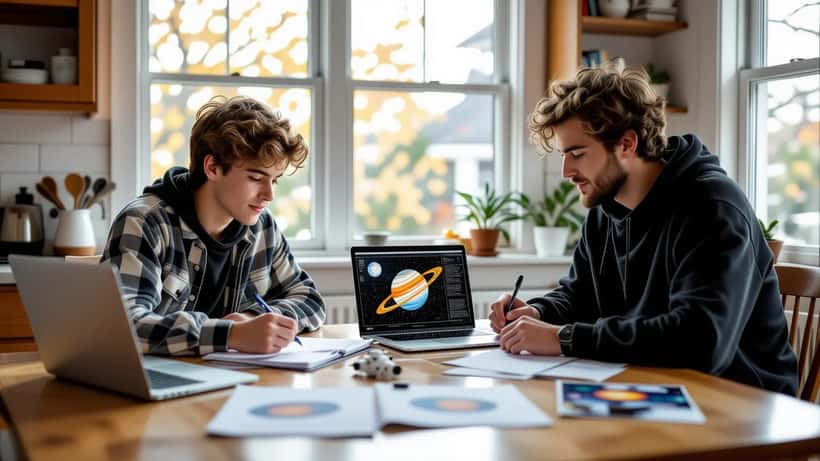
A private tutor or homework-help specialist does something a viral launch video cannot: they diagnose what a specific student actually needs. Space enthusiasm is the motivation; the tutor supplies the method.
An experienced tutor typically works on four fronts. First, they anchor a lesson to a topic the student already cares about — using an Artemis orbit to teach the math the student was avoiding. Second, they identify the precise gap, whether it is fractions, algebra or reading comprehension in a science text. Third, they set a realistic pace so a curious student does not burn out. Fourth, they help with study habits and test preparation that outlast any single mission.
For families weighing the cost, the return is not just a better grade on one unit. Students who connect schoolwork to a genuine interest tend to stay engaged longer, and STEM confidence built in middle school often shapes the courses — and careers — a student feels able to pursue later.
How parents can start this week
Parents do not have to wait for a tutor to seize the moment. A few practical steps keep the momentum going while the missions are still in the news:
- Watch a NASA mission recap together, then ask your child to explain one concept back to you in their own words.
- Pull one number from the news — a distance, a speed, a countdown — and build a quick math problem around it.
- Encourage a short project: a sketch of the Artemis trajectory, or a one-page summary of what an asteroid sample might reveal.
- Use free, official learning materials. NASA publishes classroom-ready activities and guides through its education and learning resources, a solid starting point for age-appropriate projects.
If your child hits a wall — the algebra behind an orbit, or the chemistry behind a sample analysis — that is the signal to bring in help rather than let frustration undo the enthusiasm.
The bigger picture for 2026 and beyond
The pace of space news is unlikely to slow. NASA is targeting a low-Earth-orbit demonstration of commercial lunar landers in 2027 and continues to develop plans for a staged Moon base built through more frequent crew and cargo flights. Each milestone will land in front of students as fresh motivation.
The families who benefit most will be the ones who treat these moments as more than entertainment. A launch is a spark. Whether it becomes a lasting interest in science — or fades by the next quiz — often depends on the support a student gets in the weeks that follow.
A homework-help expert can be the difference between a child who watched a rocket and a child who understood one. In a year when space exploration is everywhere, that is a connection worth making. Connecting with a qualified tutor through Expert Zoom is a straightforward way to turn 2026's headlines into skills that stay long after the mission ends.
