 Laura Clark
The Round of 32 at the FIFA World Cup 2026 delivers one of the most historically significant undercard matches of the tournament: South Africa takes on Canada at SoFi Stadium in Inglewood, California on June 28, 2026, with kickoff at 3:00 PM EDT. For both nations, this is uncharted territory. Neither has ever played in a men's World Cup knockout match. But hovering over Canada's preparations is a single question the soccer world has been asking since March 2025: Is Alphonso Davies fit enough to play?
A Historic First Knockout for Both Nations
South Africa earned their place in the Round of 32 with a stunning 1-0 victory over South Korea in their final group game, courtesy of a Thapelo Maseko strike that sent shockwaves through the tournament. It was the first time Bafana Bafana — a team ranked 60th in the world — had ever advanced beyond the group stage of a men's World Cup. Coach Hugo Broos called it "the greatest moment in our football history."
Canada's path was different but equally historic. Jesse Marsch's side drew with Bosnia-Herzegovina, thrashed Qatar 6-0 for their first-ever World Cup win, then stumbled in their final group game. Finishing second in Group B, they secured their first knockout berth since co-hosting in 1986 — a seismic shift for North American soccer.
The winner of today's match faces either the Netherlands or Morocco in Houston on July 4 — a Round of 16 date that would confirm either nation's place in the history books permanently.
The Alphonso Davies Question
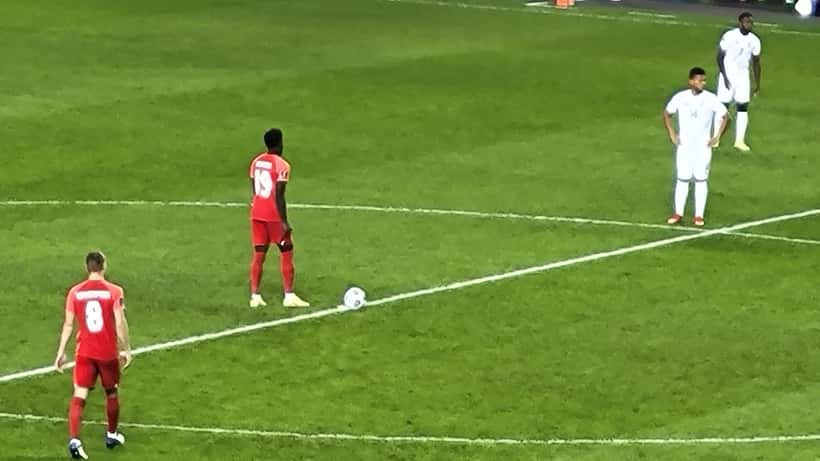
Davies, the 23-year-old Bayern Munich left back widely considered one of the most explosive players in world football, suffered an ACL (anterior cruciate ligament) tear while playing for Canada's national team in March 2025. He spent months in rehabilitation, returned to club action with Bayern, then arrived at the World Cup carrying a hamstring complaint on top of his ACL recovery. He has not played a single minute in any of Canada's group stage matches.
According to CBC Sports and TSN, Davies remains a "major doubt" and a "late fitness call" for today's knockout clash. His return would be transformational for Canada — he is arguably their most dynamic player in transition, capable of outrunning defenders down the left flank and delivering dangerous crosses at speed. His absence forces Canada into a more conservative shape, particularly on the left side.
South Africa's Sport Minister Gayton McKenzie publicly predicted a 3-0 Bafana Bafana victory before the match. Canadian winger Tajon Buchanan dismissed the comment as competitive banter. Whether Davies features may well determine who is proven right.
What ACL Recovery Really Involves
The ACL is one of the four major ligaments of the knee, connecting the femur (thigh bone) to the tibia (shin bone). A complete tear — like the one Davies suffered — is one of the most feared injuries in professional sport. Recovery is not merely a matter of time; it is a medically complex, multi-stage process with physical and psychological dimensions.
The standard rehabilitation timeline for ACL reconstruction is nine to twelve months, according to the American Academy of Orthopaedic Surgeons. Returning to elite competition — particularly for a position like left back, which demands rapid direction changes, repeated sprinting, and physical duels — typically takes athletes toward the upper end of that range or beyond.
Rehabilitation progresses through distinct stages: early swelling control and range-of-motion work; progressive strength training; then sport-specific drills — running, cutting, jumping — before a formal return-to-play protocol that includes psychological readiness assessments evaluating fear of reinjury.
"Clearance to train with the team is not the same as being ready to compete at full intensity" is a guiding principle in sports medicine. For Davies, whose position demands repeated 30–40 meter sprints and sudden deceleration, every distinction matters.
Why Adding a Hamstring Injury Complicates Everything
Davies's situation is further complicated by a hamstring strain layered on top of his ACL rehabilitation. The hamstrings serve as the primary dynamic stabilizers of the knee, working synergistically with the ACL to protect the joint during high-speed activities. After ACL reconstruction, the hamstrings frequently remain measurably weaker on the operated side for many months — even when the athlete reports feeling recovered.
A hamstring strain during that window raises the risk of re-injuring the knee significantly. Sports medicine physicians and physiotherapists who specialize in post-operative rehabilitation evaluate return-to-sport readiness using functional testing: the limb symmetry index (comparing strength and power output between both legs), reactive agility drills, and validated psychological readiness questionnaires like the ACL-RSI (Return to Sport after Injury) scale. All three dimensions must clear before elite athletes receive the green light for competitive minutes.
For Canada's medical staff, every decision about Davies represents a careful calculation between short-term tournament needs and long-term career health. The wrong call — rushing him back before his knee can handle the explosive demands of knockout football — could end his season and compromise his future.
What Recreational Athletes Can Learn From This Moment
Most fans watching Davies's story unfold have experienced their own version of this dilemma — a sprained ankle before a 5K, a torn meniscus interrupting a weekend league, a shoulder injury pulling them off the field. The temptation to return early is powerful, but premature return after a ligament injury is consistently associated with re-injury, longer absences, and in some cases permanent joint damage.
A sports medicine physician or physiotherapist can design a personalized return-to-play protocol based on your specific injury, fitness baseline, and goals. For recreational athletes, this individualized approach matters as much as it does for professionals — the knee does not know the difference between a World Cup and a Saturday league.
Consulting a health expert early — rather than waiting until pain forces you off the field — consistently improves outcomes. For fans inspired by Davies's comeback, that lesson translates directly from elite sport to everyday life.
You can follow all of today's World Cup 2026 match times and streaming options to watch South Africa vs Canada live from SoFi Stadium.
The Match Ahead — And What History Looks Like
For South Africa, today's match is an opportunity to accomplish something their 1996 Africa Cup of Nations generation never did: win a World Cup knockout game. Broos has built a disciplined counter-attacking unit, with Oswin Appollis providing pace and striker Evidence Makgopa a physical threat. The loss of Themba Zwane through suspension is offset by Teboho Mokoena's return from his own ban.
For Canada, Marsch has pledged an aggressive, high-pressing game regardless of Davies's availability. A victory sends Canada to a Fourth of July Round of 16 date in Houston — a result that would redefine what Canadian soccer can achieve.
Whatever the final scoreline at SoFi Stadium, Alphonso Davies's journey reminds every fan: in sport as in life, the most important comeback is not the one that happens under the floodlights. It is the one that happens first in the clinic, the gym, and the quiet work of a rehabilitation room.
This article is for informational purposes only and does not substitute for personalized medical advice. If you are recovering from a sports injury, consult a qualified healthcare professional.
