 Charles Jackson
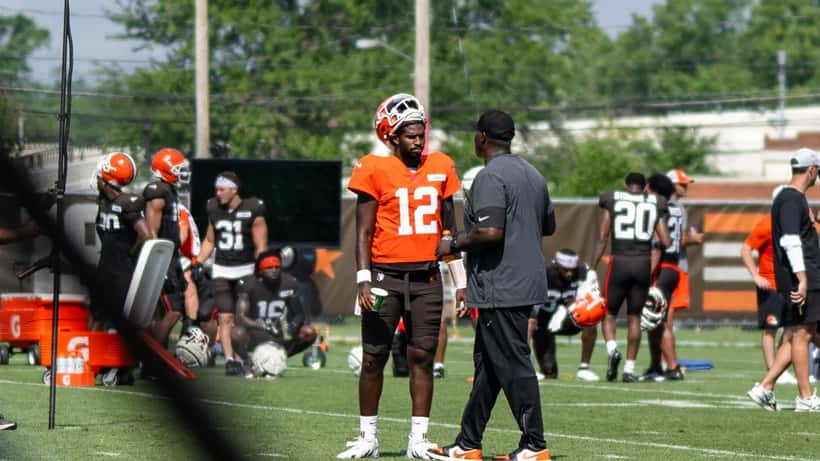
Shedeur Sanders entered the 2026 Cleveland Browns preseason with everything to prove — and now, after an uneven debut against the Chicago Bears, his name is surfacing in active trade discussions while Deshaun Watson reclaims the QB1 spotlight. The story dominating sports radio is about football performance. The story that matters to anyone who has ever signed a multi-year employment contract is legal: what does a $4.6 million NFL rookie deal actually guarantee, and what happens to a player's rights the moment a trade request gets filed?
The News: Browns Explore Trade Options as Watson Regains Ground
The Cleveland Browns are not ruling out a trade of Sanders, the former fifth-round pick who started seven games in 2025, according to multiple reports published this August 2026. Head coach Todd Monken had structured the preseason with purpose: Watson would start the opener against Chicago, Sanders would start the second game against the Buffalo Bills, and a final depth-chart decision would follow. But Watson's return from consecutive injury-plagued seasons has been stronger than expected, and Cleveland's front office is quietly fielding trade offers.
The financial backdrop makes the math almost self-explanatory. Watson's fully guaranteed $230 million contract expires after the 2026 season — a financial albatross the Browns have been carrying for four years. Sanders, by contrast, earns a base salary of $1,005,000 in 2026 on a four-year deal totaling $4,647,380. If the Browns identify a playoff-ready trading partner willing to offer a mid-round pick for a young quarterback on a team-friendly deal, the front office has every financial incentive to listen.
Expert Angle: What a Standard NFL Rookie Contract Contains — and What It Doesn't
An NFL rookie contract carries far fewer protections than most fans — or even many players — assume when they sign it. Sports attorneys who specialize in player representation consistently flag three structural elements that determine the real floor of a player's security.
Signing bonus: The $447,380 signing bonus Sanders received was paid at signing and is non-returnable. Regardless of whether he is traded, cut, or never takes another snap, he keeps every dollar. From the team's side, this amount is spread across the contract years as a prorated "dead cap" charge — roughly $112,000 per season over four years.
Base salary guarantees: NFL contracts distinguish sharply between "guaranteed for injury" (the team must pay if the player sustains a football injury) and "fully guaranteed" (the team must pay regardless of performance, injury, or roster decisions). Sanders' total guarantee of $447,380 covers only the signing bonus. His base salaries for 2027 through 2029 carry zero future guarantee unless the team voluntarily adds protection through a contract amendment. A trade or release in any of those years triggers no additional financial obligation from the Browns.
No-trade clause: Unlike Major League Baseball or the NHL's modified no-movement provisions, NFL standard contracts contain no right for a player to block a trade. Once the Browns submit a trade to the league, Sanders has no formal veto. The receiving team inherits the remaining contract at its existing terms.
This combination — low guarantee, no-trade protection — means the $4.6 million headline number describes only the maximum the team might spend over four years, not the amount Sanders is entitled to receive.
If Sanders Gets Traded: A Scenario With the Actual Numbers Applied
Here is a concrete situation that illustrates the mechanics, whether you are an athlete, an agent, or a professional navigating your own restructuring clause.
Assume the Browns finalize a trade on August 24, 2026 — two days before the league-wide roster cutdown to 53 players.
Under current NFL CBA rules, the Browns absorb a dead cap charge of $335,535, representing the un-amortized portion of the signing bonus already paid. That amount immediately reduces Cleveland's remaining 2026 cap space, regardless of whether Sanders plays another game in an orange helmet.
The receiving team inherits the full remaining contract: $1,005,000 base salary for 2026 (already partially elapsed through preseason), plus option years in 2027 through 2029 totaling approximately $3,195,000 at CBA-slotted values. The new team owes nothing to Cleveland beyond the trade compensation agreed upon — no buyout, no indemnification.
The if/then that defines Sanders' long-term leverage: If Sanders accumulates four or more "accrued seasons" in the NFL — defined under the CBA as seasons in which a player is on the active roster or injured reserve for at least six regular-season games — he earns unrestricted free agency at the expiration of his contract. Sanders currently holds one accrued season (2025). If he plays for a new team in 2026 and completes two additional seasons under his existing contract, he reaches unrestricted free agency in February 2029 with the right to negotiate with any team at market value. But if a team cuts him before reaching that four-season threshold, he lands on waivers, where any club can claim him at his existing contract terms for $0 in compensation — resetting the leverage clock entirely.
That single vesting trigger — four accrued seasons — is worth tens of millions of dollars in future negotiating power. It is also the detail most likely to be overlooked by a 22-year-old reviewing a rookie contract for the first time.
What the NFLPA Recommends for Players Facing This Window
The NFL Players Association publishes clear guidance on player rights during the preseason cutdown period. Its core recommendation for players in Sanders' position: retain a certified contract advisor before trade discussions formally begin, because once a trade is officially submitted to the league, a player's contractual options narrow sharply — they can accept assignment to the new team under the existing deal or face outright release.
The NFLPA also tracks a structural protection that Sanders has not yet earned: "vested veteran" status, which applies to players with four or more accrued seasons. Vested veterans cannot be placed on waivers without consent; they must be released outright, becoming free agents immediately rather than passing through the waiver wire. The gap between "four accrued seasons" and "fewer than four accrued seasons" is, legally, the difference between negotiating leverage and almost none.
This article addresses general legal principles in professional sports contracts. Individual situations vary. Consult a licensed attorney or NFLPA-certified contract advisor for guidance specific to your circumstances.
Practical Implications: The Pattern Is Wider Than the NFL
Sanders' situation is more common across industries than the football-specific language suggests. Athletes, corporate executives, and senior employees regularly sign multi-year contracts that appear protective on paper but contain quietly narrow guarantee provisions. The key questions a lawyer asks when reviewing any such agreement are structurally identical: what compensation is actually guaranteed versus merely promised; under what conditions can the employer exit without payment; and how does the contract handle involuntary transfers between entities?
In NFL terms: $447,380 is guaranteed; the Browns can exit by absorbing a $335,535 cap charge; and the contract carries to the new team unchanged. For a 23-year-old professional, those numbers represent the real boundary of his financial floor — not the four-year, $4.6 million figure that appeared in draft-day headlines.
Sanders also carries substantial NIL partnership agreements from his Colorado career. Standard NFL player contracts do not address personal sponsorship obligations upon a team change, leaving that question to separately negotiated brand agreements. Any trade would immediately require his representation team to review each endorsement contract's "key man" or assignment clause — a detail that gets lost when roster moves happen at preseason speed.
What to Do If You Are in a Similar Position
The August preseason window is the worst time to discover what your contract actually says. If you are a professional — athlete or otherwise — with a multi-year agreement that includes vesting thresholds, partial guarantees, or transfer provisions, the standard attorney review covers four areas: the exact amount and conditions of any guaranteed compensation; the trade, transfer, or assignment clause; any vesting or accrual milestone that changes your legal status; and what happens to ancillary agreements (endorsements, equity grants, non-competes) in the event of an involuntary move.
For anyone currently navigating an employment contract with complex guarantee or transfer language, consulting a contract law specialist on Expert Zoom can surface the provisions that matter before a deadline removes your options. Sanders' story is a useful reminder that the dollar figure on a contract and the dollar figure actually guaranteed are, in professional sports and many other industries, two very different numbers.
