 Richard Thomas
The S&P 500 pushed past 7,200 in May 2026, capping a remarkable recovery from April's volatility that saw the benchmark index swing by roughly $1.7 trillion in market capitalization during a single week of geopolitical tension. While investors celebrate the milestone, the technology infrastructure powering these massive market movements is attracting renewed attention from risk managers and IT leaders across the financial sector.
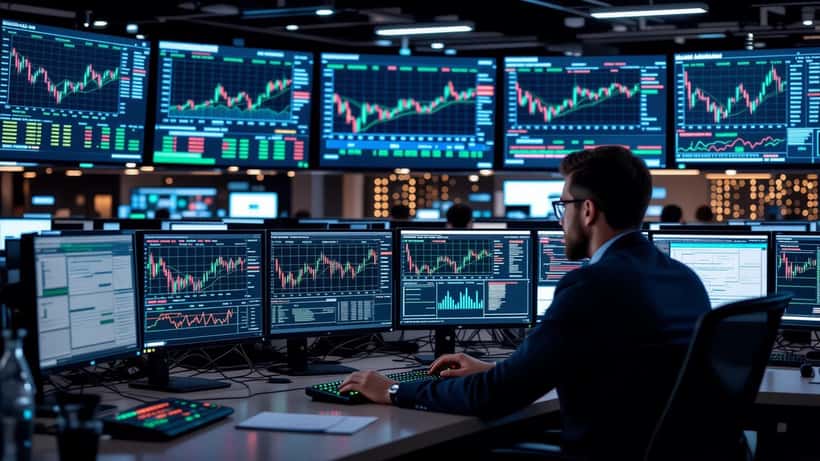
Behind every index tick lies a complex ecosystem of algorithmic trading systems, real-time data feeds, and risk management platforms that process millions of transactions per second. As institutional trading increasingly depends on automated decision-making, the reliability and security of this infrastructure has become a board-level concern for brokerages, asset managers, and fintech platforms.
How the S&P 500's Record Run Stress-Tests Trading Infrastructure
The S&P 500's climb to 7,200 in May 2026 followed a turbulent spring. April saw sharp selloffs triggered by macroeconomic uncertainty and geopolitical developments, including fluctuations around international negotiations. When markets reversed course in May, trading volumes surged to levels that tested the limits of legacy systems at several major brokerages.
According to market data analysts, high-frequency trading algorithms now account for approximately 60% of equity market volume in the United States. During periods of elevated volatility, these systems can amplify price movements as algorithms react to the same signals simultaneously. The result is a market environment where infrastructure stability directly impacts price discovery and investor outcomes.
For technology leaders in financial services, the lesson is clear: algorithmic trading infrastructure cannot be an afterthought. Latency spikes, data feed interruptions, or risk engine failures during peak volume periods can result in regulatory scrutiny and significant financial losses.
The Hidden Complexity of Index Calculation and Data Pipelines
The S&P 500 itself is not merely a number. Its calculation requires real-time aggregation of 500 constituent stock prices, each sourced from multiple exchanges, adjusted for corporate actions, and validated for accuracy. The index updates every 15 seconds during trading hours, with sub-second dissemination to data vendors, trading platforms, and derivative pricing engines.
This data pipeline involves hundreds of individual connections between exchanges, clearinghouses, index providers, and downstream consumers. A single point of failure — a delayed corporate action update, a corrupted price feed, or a misconfigured risk parameter — can cascade through the system within milliseconds.
Exchange-traded funds and index derivatives compound the complexity. When the S&P 500 moves, automated systems simultaneously rebalance ETF portfolios, adjust options hedges, and trigger futures arbitrage strategies. The volume of interconnected transactions means that IT infrastructure resilience is not merely a technical priority but a systemic risk management imperative.
Why Algorithmic Trading Demands Specialized IT Expertise
Modern trading infrastructure spans multiple technology domains that require specialized expertise:
Low-latency network engineering ensures that market data reaches trading algorithms within microseconds. This involves microwave links, fiber optic optimization, and co-location strategies that place servers physically adjacent to exchange matching engines.
Real-time analytics platforms process streaming market data to identify patterns and execute trades before human traders can react. These systems require expertise in stream processing frameworks, in-memory databases, and distributed computing architectures.
Risk management systems must monitor positions across asset classes and enforce pre-trade compliance checks without introducing meaningful latency. A risk engine that adds even a few milliseconds of delay can render a trading strategy uncompetitive.
Cybersecurity represents a particularly acute concern. Trading systems are high-value targets for sophisticated threat actors, and a successful breach could manipulate markets or exfiltrate proprietary strategies.
What Financial Firms Should Audit Now
Organizations participating in equity markets — whether directly as traders or indirectly through pension fund allocations — should evaluate their exposure to trading infrastructure risk. Three areas warrant immediate attention:
First, data lineage and accuracy validation. Firms should verify that the market data feeding their analytics and risk systems is complete, accurate, and properly synchronized across sources. Discrepancies between data vendors can lead to phantom arbitrage opportunities or mispriced risk.
Second, disaster recovery and business continuity. The April 2026 volatility demonstrated that market stress events can coincide with technology failures. Recovery time objectives should be measured in seconds, not hours, for critical trading functions.
Third, algorithm testing and monitoring. Trading algorithms that perform well in normal market conditions can behave unpredictably during volatility spikes. Rigorous backtesting and real-time monitoring with kill-switch capabilities are essential safeguards.
When to Bring in an IT Specialist
The intersection of financial markets and technology has become too specialized for generalist IT departments to manage alone. A consultant with expertise in financial services infrastructure can assess trading system architecture, identify latency bottlenecks, review cybersecurity posture, and validate disaster recovery plans.
As the S&P 500 continues its climb and trading volumes remain elevated, firms that treat infrastructure as a strategic advantage rather than a cost center will be best positioned to navigate the next period of market turbulence.
This article is for informational purposes only and does not constitute investment advice. Market indices carry inherent risk, and past performance does not guarantee future results. Consult a qualified financial advisor before making investment decisions.
