 Joseph Wallace
The remnants of Tropical Storm Bertha — now officially dissipated — are delivering a flooding punch that meteorologists say may be more damaging than the storm itself. On July 23, 2026, flash flood warnings stretched from North Carolina through Virginia and into parts of Georgia, as Bertha's moisture plume merged with a stationary cold front and dumped up to 6 inches of rain in just 12 hours across Greensboro and Winston-Salem. For homeowners in these regions, the window to act is narrow.
Context: How Bertha's Remnants Became a Separate Threat
Tropical Storm Bertha made landfall in St. Bernard Parish, Louisiana, on July 22, 2026, at 2 p.m. CT. The storm brought winds of up to 65 mph and coastal flooding to the Gulf Coast before rapidly weakening to a tropical depression and then dissipating entirely by July 23. But Bertha's story didn't end with the storm.
As Bertha died, it left behind an expansive plume of tropical moisture that merged with a cold front sitting over the Southeast. According to the National Hurricane Center, this atmospheric handoff pushed a Level 3 out of 4 flooding risk across a section of the Virginia–North Carolina border through July 25. Rainfall totals of 4 to 6 inches are forecast across the Carolinas, with localized areas expected to receive more where storms stall.
The National Weather Service issued flash flood warnings for Guilford and Forsyth counties in North Carolina, where radar-estimated rainfall hit 6 inches in 12 hours on the night of July 23. While drought conditions heading into the event absorbed much of the initial rainfall, soils are now saturated. Each additional inch of rain on waterlogged ground runs off immediately — directly toward foundations, crawlspaces, and basements.
The East Coast flooding from Bertha's remnants may ultimately cause more structural damage to homes than the Gulf Coast impact from the storm itself.
Why Water Damage Gets Worse the Longer You Wait
The moment floodwater enters a home, a 48-hour clock starts. Water damage does not stay static — it spreads through porous materials, wicks up drywall, soaks into insulation, and within 24 to 48 hours creates ideal conditions for mold growth.
Home improvement professionals classify water damage into four severity categories. Class 1 damage — minimal absorption affecting a small area — typically costs $150 to $500 to remediate. Class 4, the most severe category involving saturated structural materials and hardwood floors, can exceed $100,000. The national average for water damage restoration in 2026 sits at $3,860, according to industry data from Angi — but that figure assumes prompt action. Delayed response drives costs significantly higher.
Mold is the primary cost amplifier. According to the U.S. Environmental Protection Agency, mold can begin colonizing surfaces within 24 to 48 hours of water exposure in warm, humid conditions. Mold remediation adds $1,500 to $15,000 or more to any restoration project — costs that are entirely avoidable with fast action.
The type of water also matters. Clean rainwater is far less contaminated than so-called gray or black water, which includes sewage backflow. During flash flood events like those sweeping across the Carolinas this week, overwhelmed storm drains can push contaminated water into basement drains and floor-level openings.
What This Looks Like for a Homeowner Right Now
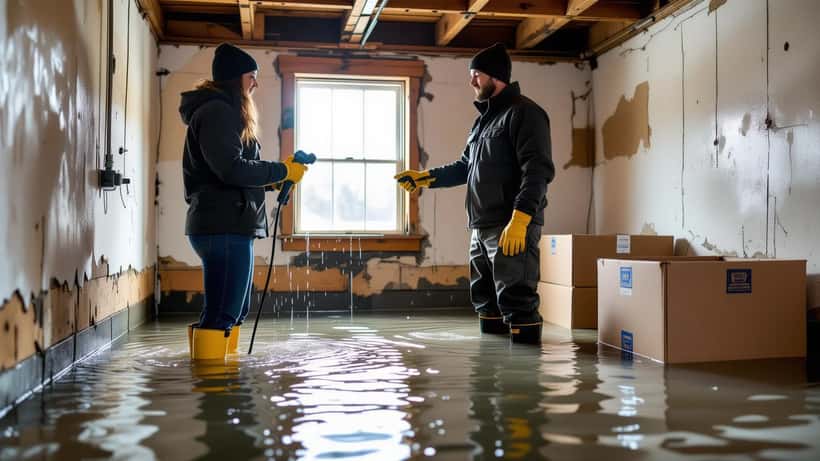
Consider a family in Charlotte, North Carolina, whose split-level home received 4 inches of standing water in the lower-level utility room and crawlspace on the evening of July 23, 2026, as Bertha's remnants stalled over the region.
If that homeowner responds within 6 to 12 hours — running a submersible pump, extracting standing water, and opening windows to promote airflow — the damage will likely fall into the Class 1 to 2 range. According to 2026 pricing data from Angi, restoration costs in this scenario typically run $500 to $1,500. A professional water damage crew can extract standing water from a 1,500-square-foot area and begin industrial drying within a single day.
If the same homeowner waits 48 to 72 hours — perhaps because the flooding looks minor, or because they assume their homeowners insurance claim requires the adjuster to visit first — the math changes sharply. Drywall absorbing 4 inches of floodwater for 48 hours must be cut out and replaced. Insulation becomes unsalvageable. Subfloor panels buckle and separate. And if mold appears — which it will in summer humidity above 80%, the standard condition across North Carolina in late July — the remediation scope expands to include containment, air filtration, and antifungal treatment. That same $1,500 situation now costs between $8,000 and $25,000, depending on how far the mold has spread.
One rule every homeowner in Bertha's path should follow: if standing water remains in any part of your home for more than 24 hours, treat it as a Class 3 emergency. Call a licensed water restoration contractor immediately — do not wait for an insurance adjuster to arrive before starting mitigation work. Most policies explicitly allow emergency remediation to begin before a claim is formally assessed.
What Home Improvement Experts Recommend Doing Right Now
The first step, according to water damage professionals, is documentation — not cleanup. Before moving anything or extracting water, photograph and video every affected room from multiple angles. Capture the water line on walls, floating debris, and all visible structural elements. This documentation protects your insurance claim and gives a contractor the baseline needed to scope the work accurately.
Second, shut off electricity to affected areas from the main circuit breaker panel — not from switches inside the flooded zone. Do not re-enter a flooded space until you are certain power is off to that area.
Third, contact your insurer immediately. But be aware of a distinction that catches many homeowners off guard: standard homeowners insurance does not cover flood damage. Coverage for flooding caused by external storm events requires a separate flood insurance policy, typically through the National Flood Insurance Program (NFIP) or a private flood carrier. If you are uncertain whether you carry flood coverage, check your declarations page before your call.
Fourth, begin water extraction as quickly as possible. Wet vacuums, submersible pumps, and industrial dehumidifiers are available for rental at most home improvement stores. A professional restoration crew moves faster and carries moisture meters to detect water hidden inside walls and subflooring — something a pump alone cannot find.
Finally, avoid running standard household fans to dry a flooded space. This distributes mold spores into unaffected areas. Use dehumidifiers positioned near open doors and windows instead.
The Flood Insurance Gap Bertha's Remnants Are Exposing
According to FEMA, fewer than 5% of homeowners nationally carry flood insurance, even though flooding is the most common and most costly natural disaster in the United States. The NFIP provides coverage for both the structure of a primary residence — up to $250,000 — and contents up to $100,000, with a standard 30-day waiting period before coverage activates.
If you are in Bertha's flood zone without flood insurance right now, this event cannot be covered retroactively. But it is exactly the right moment to assess your exposure. Properties in FEMA-designated Flood Zone AE — which covers broad stretches of the NC and SC coastal plains — are legally required to carry flood insurance if they carry a federally backed mortgage. Millions of homeowners in moderate-risk zones outside those mapped areas, however, flood every year and receive no reimbursement.
The NFIP's official resource at FloodSmart.gov offers a free flood risk assessment by address, average premium estimates by zone, and a directory of participating insurers. A policy costs an average of $800 to $1,000 per year for moderate-risk properties — far less than a single remediation event.
Note: This article provides general information only. Consult your insurance policy documents or a licensed insurance professional for guidance specific to your property and coverage situation.
Connect With a Home Improvement Expert Before the Next Wave
The 48-hour window after flooding is when professional intervention makes the biggest financial difference. Water damage specialists can assess what is visible and what is hidden inside walls, beneath floors, and in ductwork — areas homeowners cannot evaluate without equipment.
On ExpertZoom, licensed home improvement specialists are available for immediate consultation. Whether you are managing active cleanup, preparing to file an insurance claim, or trying to understand the full remediation scope your property requires, speaking with a qualified professional in the next few hours — not days — is the single most impactful step you can take.
format_used: News brief
