 Davis Caesar
Why California Takes So Long to Count Votes: Legal Rights Every Voter Should Know
The 2026 California primary election is over, but the count is not. Weeks after election night, races remain uncalled. The phrase "reasons for slow California counting" has trended nationally, drawing scrutiny — and unfounded allegations of fraud — from critics across the political spectrum.
But California's extended ballot count is not a bug. It is the result of deliberate legal protections designed to ensure every valid vote is counted. Here is what is actually happening — and what legal rights you have when the process feels uncertain.
Why the Count Takes So Long: The Legal Framework
California is one of a small number of all-mail states. Every one of its approximately 23 million registered voters receives a ballot by mail. That scale alone sets it apart from virtually every other state.
Under California Election Code, a mail-in ballot is valid if it is postmarked by Election Day and received by the county within seven days afterward. That means hundreds of thousands of legitimate votes arrive at county election offices after Tuesday night — and all of them must be counted.
Governor Gavin Newsom signed legislation in 2025 reducing the final certification window from 30 days to 13 days. That is a significant improvement, but 13 days is still long enough for close races to remain officially undecided well into the month after the election.
The California Secretary of State's office provides a public ballot-tracking portal where every California voter can check the status of their mail-in ballot in real time — confirming receipt, signature verification status, and whether the vote was counted.
The Signature Verification Process
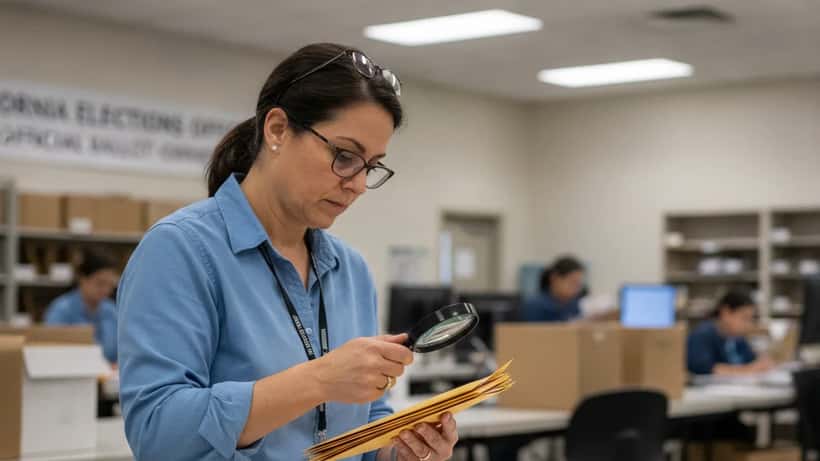
Before any mail-in ballot is opened, its envelope signature must be matched against the voter's signature on file with the county. California's 58 counties handle this individually — and accuracy is non-negotiable.
If a signature does not match, the voter must be notified and given a "cure period" — the opportunity to confirm their identity and save their ballot from rejection. This process, known as signature curing, is a voter protection, not an obstacle. It prevents legitimate votes from being discarded due to minor inconsistencies in how a person's signature changes over time.
The downside is speed. Signature verification is labor-intensive, and uneven investment in counting equipment across counties means some jurisdictions process ballots far more slowly than others. Some counties simply have not purchased the scanning machines they need to keep pace.
Federal Legal Battles Surrounding California's 2026 Count
The primary has triggered active federal legal intervention. First Assistant U.S. Attorney Bill Essayli announced multiple election fraud investigations are underway — without specifying evidence — drawing immediate pushback from state officials who called the allegations unfounded.
More consequentially, the U.S. Department of Justice filed a lawsuit against California Secretary of State Shirley Weber, demanding access to California's full voter registration list under the National Voter Registration Act, the Help America Vote Act, and the Civil Rights Act. California has contested the scope of the request.
Meanwhile, a case before the U.S. Supreme Court could reshape mail-in voting nationally. A challenge argues that states should be barred from counting mail-in ballots postmarked by Election Day but received afterward. A ruling before the 2026 midterms would eliminate the seven-day receipt window that California relies on — and would affect millions of voters.
The California Voting Rights Act of 2026
On April 22, 2026, the California Senate passed an updated Voting Rights Act. The legislation prohibits voter suppression and strengthens protections for communities whose voting power has historically been weakened through discriminatory district maps. It also reinforces access to voting opportunities across the state's diverse population.
The act reflects a broader national tension: while federal courts scrutinize California's counting process, the state itself is legislating additional protections for its voters.
Your Legal Rights as a California Voter
If you voted in the California primary and the count feels uncertain, here is what you are legally entitled to:
Track your ballot. Every California voter can confirm whether their ballot was received, whether the signature matched, and whether the vote was counted. This is a legal right protected by state election code.
Cure a rejected signature. If your signature was flagged, you have the right to cure the discrepancy. Your county must notify you and give you time to resolve it. A failure to notify you of a rejection is a violation of your rights.
Contest provisional ballot rejection. If you voted provisionally — because you had moved, changed registration, or were not on the rolls — you can formally challenge a rejection through your county elections office.
Report irregularities. If you observed actual procedural violations — not just a slow count, but real irregularities — you have the right to file a formal complaint with the Secretary of State's office.
When Should You Consult an Election Lawyer?
The vast majority of voters will never need legal advice about their ballot. But there are specific situations where consulting an election attorney can make a decisive difference:
- Your ballot was rejected and you believe the rejection was improper
- You were turned away at a polling location without lawful justification
- You are a candidate in a close race where procedural errors appear to have affected the outcome
- You represent an organization challenging redistricting or voting access in California
- You received intimidation or misinformation related to your right to vote
Election law is highly specialized. An experienced election attorney can assess whether your situation rises to a legal claim, guide you through the curing and complaint processes, and represent you in administrative or court proceedings if needed.
For voters with questions about 2026 midterm registration and rights across states, the window to act is narrow — certification deadlines are firm and legal remedies must be pursued promptly.
ExpertZoom connects users with qualified election law attorneys and legal consultants who can provide guidance on voter rights, ballot disputes, and election integrity questions specific to California and beyond.
