 Jessica Johnson
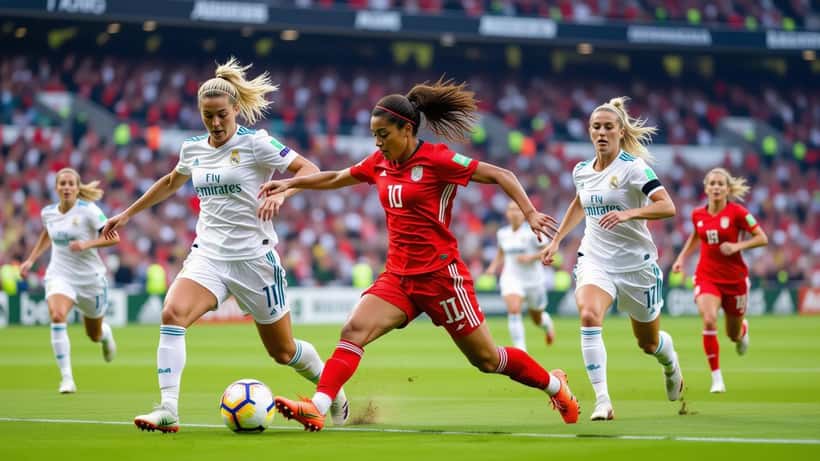
Real Madrid Femenino faces Atlético Madrid today in a Liga F derby that puts second place on the line — and the match is being watched from Los Angeles to New York. As women's soccer reaches a global commercial tipping point in 2026, thousands of US players and families are realizing that the contracts binding women athletes to clubs often lack the protections their male counterparts take for granted.
Today's high-stakes fixture is a reminder: when the stakes are this high, legal protection matters.
The Liga F Derby That Has US Fans Watching
On May 10, 2026, Real Madrid Femenino and Club Atlético de Madrid Femenino squared off at the Alfredo Di Stéfano stadium in Madrid. With three matchdays remaining in the Liga F 2025/2026 season, second place in the standings is at stake — a result that carries direct implications for European competition spots and club investment.
US fans follow Liga F through DAZN, and the National Women's Soccer League actively recruits from Liga F's talent pool. Real Madrid Femenino alone has produced several players who later crossed the Atlantic to play in the NWSL. Each of those transfers involves a legal transaction: release clauses, image rights assignments, injury continuation clauses, and governing law provisions that determine which country's courts resolve disputes.
Many women athletes sign these documents without legal review — and discover the gaps only after an injury, a transfer dispute, or a contract non-renewal.
Equal Pay Protections Under US Law: What Athletes Need to Know
In the United States, the Equal Pay Act of 1963 prohibits employers — including professional sports organizations operating in the US — from paying women less than men for substantially equal work. The US Equal Employment Opportunity Commission enforces this law and has expanded its interpretation in recent years to cover performance bonuses, travel allowances, and prize money structures tied to commercial revenue.
Women soccer players in the NWSL are covered by the league's collective bargaining agreement, which since 2022 has established minimum annual salaries, health insurance coverage, and maternity leave guarantees. But those protections apply only to players on active NWSL rosters. US citizens playing in Liga F, the French Division 1 Féminine, or England's Women's Super League operate under the labor law of the host country — not US federal law.
"This surprises players every year," says a Chicago-based sports attorney who advises international women soccer clients. "They think their US rights travel with them. They don't. The club's home country controls the contract unless a US arbitration clause is specifically negotiated."
3 Contract Clauses Women Soccer Players Often Miss in 2026
Sports lawyers who represent women athletes — from Liga F signings to NWSL rookies — consistently identify three problem areas in standard women's soccer contracts:
1. Injury Pay Continuation
Most women's soccer contracts guarantee salary continuation during injury, but define the duration loosely. A knee reconstruction that requires nine months of rehabilitation could exhaust a 90-day injury pay provision, leaving a player unpaid for six months despite contractual obligations that prevent her from signing elsewhere. Athletes should negotiate full salary continuation through the period certified jointly by the club's physician and an independent doctor of the athlete's choosing.
2. Image Rights and Social Media Revenue
In 2026, a Liga F player with 80,000 Instagram followers is a meaningful marketing asset. Standard contracts routinely assign all image rights to the club during the contract term. This means the club can use the player's likeness for commercial campaigns without additional compensation. A lawyer can negotiate a 50/50 image rights split for club-related commercials and a full carve-out for independent, non-competing endorsements — a provision that can add $10,000–$50,000 annually for mid-tier players.
3. Release and Transfer Clauses
Women's soccer release clauses are often written asymmetrically: clubs can loan players with 14 days' notice, but players who want to leave face buyout fees equal to six to twelve months of salary plus penalties. International clubs have begun including fixed-fee release clauses — a flat sum that any foreign club can pay to trigger a transfer — which is far preferable to open-ended compensation demands. Without a fixed clause, a player's market value is effectively held hostage to the current club's negotiating leverage.
US Athletes Playing in Spain: Jurisdiction and Tax Complications
For American women playing in Liga F — and there are more than a dozen currently — the legal complexity does not end with the employment contract. US citizens owe federal income tax on worldwide earnings, regardless of where they live or play. Spain taxes Liga F salaries under its own progressive system. Without proper planning under the US-Spain tax treaty, players face dual withholding on the same income stream.
A US-licensed international tax attorney can structure income — base salary, signing bonus, image rights payments — across treaty-covered categories to legally minimize double taxation. Players who skip this step have reported effective tax rates above 55% on European salaries.
Additionally, if a dispute arises under a Liga F contract, US courts will generally enforce a governing law clause selecting Spanish jurisdiction. That means the athlete must retain Spanish-licensed counsel to pursue remedies — an additional cost that could have been avoided by negotiating a bilateral arbitration clause at signing.
When Should a Women Soccer Player Consult a Sports Lawyer?
Sports attorneys who specialize in women's soccer recommend seeking legal review at four specific moments:
- Before signing any professional contract, at any level — even a development or academy contract that grants the club future rights
- Before accepting a loan or transfer, including informal arrangements between clubs
- After any serious injury, to verify that the club is fulfilling all contractual obligations around salary, medical care, and rehabilitation
- If a contract is not renewed, to evaluate whether the non-renewal may have violated anti-discrimination protections — particularly relevant for players who disclosed pregnancies during their contract period
Today's Real Madrid vs. Atlético Liga F derby reflects how far women's soccer has come commercially. The contracts governing these players need to reflect that same progress. Women athletes at every level — from Liga F to NWSL to amateur US clubs with contractual clauses — deserve the same legal scrutiny their male counterparts receive as a matter of course.
This article is for informational purposes only and does not constitute legal advice. Consult a licensed attorney for advice specific to your situation.
If you're a women soccer player, agent, or parent navigating a professional contract in 2026, ExpertZoom connects you directly with sports and employment lawyers — no waiting, no gatekeeping.
