 Daniel Miller
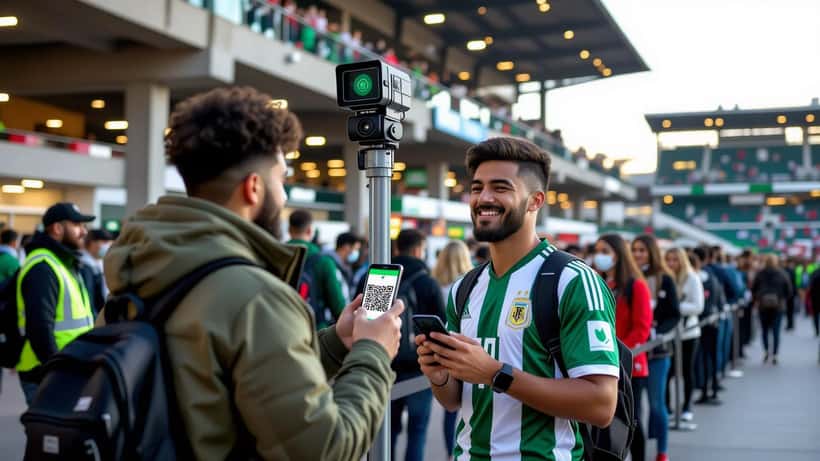
When Querétaro hosted América at Estadio La Corregidora on Saturday, July 18, 2026, to open the Apertura 2026 season, every fan who walked through the turnstiles had already handed over something far more valuable than a ticket: their face. Entry required a valid Fan ID, the biometric registration system Liga MX rolled out to eliminate anonymity in the stands. The timing was pointed. Just days earlier, on July 12, 2026, Mexico's Secretaría Anticorrupción y Buen Gobierno fined the Mexican Football Federation (FMF) 42.8 million pesos for mishandling exactly this kind of sensitive data, according to reporting from Periódico Correo and La Razón.
For the millions of Liga MX followers in the United States who stream these matches and travel south to attend them, the story is more than a Mexican regulatory headline. It is a preview of the biometric turnstile that is coming to stadiums everywhere — including the U.S. venues preparing for the 2026 World Cup.
What the Fan ID fine actually found
The penalty was not a slap over paperwork. Regulators concluded that the Fan ID privacy notice never told fans that the facial images it captured qualified as sensitive biometric data, according to Siete24. Because that disclosure was missing, supporters could not understand how their faces would be used or make an informed choice about it.
The second finding was arguably worse. Investigators determined that the registration portal only asked users to tick a box, with no signature and no authentication step to prove the person actually consented to sensitive-data processing, as UnoTV reported. Under Mexican data-protection rules, sensitive information requires express written authorization — a checkbox does not meet that bar.
The consequence for fans is limited but real: the Fan ID will not disappear. It remained mandatory for entry throughout the Apertura 2026, including the Querétaro–América opener. What must change is the process — the FMF and Liga MX now have to rebuild consent so it is lawful.
Why Querétaro, of all places
There is a grim symmetry in this match being the stage. The Fan ID system exists because of what happened at this exact stadium. Liga MX built biometric identification after a brawl between Querétaro and Atlas supporters at Corregidora, aiming to identify every attendee and permanently ban anyone who started violence. The intention — safer stands — was sound. The execution created a database of faces that a federal authority has now judged to be unlawfully collected.
That tension is the heart of the modern privacy problem. Safety and surveillance are sold as the same product. A biometric turnstile that keeps a violent fan out is the same technology that logs where you were, when, and with whom, in a file you cannot easily delete.
The 2026 World Cup makes this a U.S. story
Biometric entry is not staying in Mexico. Facial-recognition access control is already being tested at large U.S. venues, and the 2026 World Cup — co-hosted across the United States, Mexico, and Canada — is accelerating adoption. Whatever consent standard Mexico settles on will shape what fans on both sides of the border are asked to sign next summer.
That is why the practical questions matter now, not later. When a stadium, an app, or a ticketing platform asks you to scan your face, you rarely get a lawyer's read on the fine print in the queue. This is where a data-privacy or IT-security specialist earns their fee: reading what a "privacy notice" really authorizes, telling you whether a checkbox is legally meaningful, and identifying whether your image is being stored, shared with third parties, or fed into a recognition model.
How to protect your biometric data before you scan
You do not have to be an engineer to reduce your exposure. A few habits, confirmed by consumer-protection guidance, go a long way.
- Read what counts as "sensitive." If a form captures your face, fingerprint, or voice, that is biometric data — a category with stronger legal protection than your email address. The U.S. Federal Trade Commission publishes guidance on how companies must handle consumer privacy and biometric information.
- Look for real consent, not a checkbox. The Fan ID fine turned on this exact point. A single tick with no explanation is a red flag that the operator has not done the legal work.
- Ask where the image goes. A photo used once to verify entry is different from a photo stored indefinitely and matched against a watchlist. If the notice does not say, assume the more invasive option.
- Separate your data streams. The same scam economy that clones stadium tickets also harvests personal data. If you have wrestled with fraudulent QR entry passes before, you already know how quickly a stadium credential becomes an attack surface — our reporting on how scammers clone Liga MX ticket QR codes walks through the mechanics.
- Keep a record. Screenshot the privacy notice you agreed to. If your data is later misused, that screenshot is your evidence.
The takeaway from Corregidora
Querétaro lost 2-1 to América in their most recent league meeting back in March 2026, with goals from Brian Rodríguez and Patricio Salas, per El Informador — and the Águilas have dominated the recent series. But the more durable result from this fixture has nothing to do with the scoreline. It is the reminder that the price of admission to modern sport is increasingly paid in personal data, and that the rules governing that data are still being written in real time.
A 42.8-million-peso fine proves regulators are watching. It does not guarantee your face is safe. If your work, your travel, or your fandom is pushing you toward biometric checkpoints in 2026, a short consultation with an IT-security or data-privacy expert on Expert Zoom is the cheapest insurance you can buy — long before you reach the turnstile.
