 Kristen Williams
Lucas Herbert arrived at Royal Birkdale this week for the 2026 Open Championship carrying the best form of his career. The 30-year-old Australian won LIV Golf Virginia in May 2026, his first individual league title, a result that earned him a U.S. Open spot and pushed him into back-to-back majors for the first time since 2023, according to Golf Monthly. It is his sixth Open appearance, and his best finish remains a tie for 15th at St Andrews in 2022.
For the professionals in the field, distance is a solved problem. Herbert and the 15 LIV golfers competing at Birkdale walk courses their caddies have mapped to the yard, with green books, wind charts and years of tournament memory. Weekend golfers have none of that. They have gadgets. And in 2026, the gap between a good gadget and a gimmick is wider than most buyers realize.
The devices behind every pro-style number
Three categories of consumer electronics now dominate the amateur game: laser rangefinders, GPS units and personal launch monitors. Each measures something different, and confusing them is the most common mistake shoppers make.
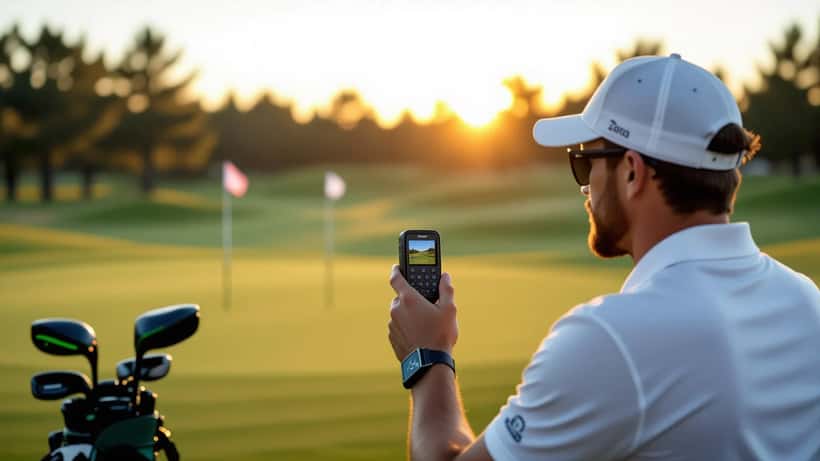
A laser rangefinder points at a target and fires a beam to measure the exact distance. The Bushnell Tour V6 Shift, priced at $334.99, is accurate to within about one yard and is a common pick for everyday players, per MyGolfSpy's 2026 testing. Budget models such as the GoGoGo Sport ZeroIn deliver the same core function for a fraction of the price. Speed, clear optics and a simple display separate a reliable unit from a frustrating one.
A GPS device works differently. It uses satellite positioning to show preloaded distances to the front, center and back of the green without you aiming at anything. Testing summarized by PlayBetter found the best GPS units landed within a yard, while the worst were off by nearly a full club. The Bushnell Phantom 3 Slope pairs strong accuracy with an 18-hour battery, roughly nine rounds between charges.
A launch monitor is a different animal entirely. It measures your swing, not the course. The Garmin Approach R10, at around $500, uses radar to track ball speed, spin and club data, and connects to simulators with more than 42,000 virtual courses. Higher-end units like the Mevo+ use 3D Doppler radar, the same category of technology found in $15,000 tour systems.
The rule most buyers never read
Here is where a technology purchase quietly becomes a rules problem. Under the Rules of Golf, a distance-measuring device is only permitted when a Local Rule allows it, and even then it may not be used to measure elevation change or read slope during a round. The governing body's Rule 4.3 on player equipment is explicit: using a device to gauge conditions that affect play, such as slope, brings a penalty, and repeated breaches can mean disqualification.
This is why nearly every modern rangefinder ships with a "slope" mode that can be toggled off, often with a visible external switch. In a casual weekend round it helps you club up for an uphill approach. In a club competition or any event run under standard rules, that same feature must be disabled. Buyers who do not understand the setting risk a scorecard penalty for a device they bought to shoot lower.
Why this matters for the average golfer
The professional at Birkdale gains a fraction of a stroke from precise numbers. The amateur gains far more, because amateurs misjudge distance constantly and rarely find the middle of the green. A device that reliably reports 152 yards instead of a guessed "about 145" changes club selection on every full shot. Over 18 holes, that compounds.
But accuracy claims are marketing until they are tested. Independent 2026 reviews stress that headline specs hide real differences: battery life, how fast a laser locks onto a flag in bright sun, whether a GPS has your local course mapped, and how a launch monitor performs outdoors versus in a garage. A $600 hybrid such as the Garmin Approach G82, which bundles GPS and launch-monitor functions, can be better value than two separate purchases, or a redundant expense if you only ever play the same three courses.
What to check before you buy
An electronics or gadget specialist can save you from the two expensive errors in this market: buying more device than your game needs, and buying a device with features that are illegal in the events you actually play.
Ask three questions first. Do you play competitions, or only social rounds? That decides whether slope-mode legality matters to you. Do you want on-course help, swing analysis, or both? That decides between a rangefinder or GPS and a launch monitor. And how consistent is the tested accuracy, not the advertised accuracy, in the conditions you play in?
A consultation with a consumer electronics expert on ExpertZoom can match a real budget to a real use case, compare current 2026 models on measured performance rather than brand loyalty, and flag which settings to disable before your next club event. It is a small step that turns an impulse purchase into a genuine scoring tool.
Herbert will not touch a rangefinder in competition at Royal Birkdale; the pros play by feel and preparation. For everyone else, the right piece of technology, understood and configured correctly, is the closest thing to a caddie the amateur game offers. Just make sure you know which button to switch off before the first tee.
