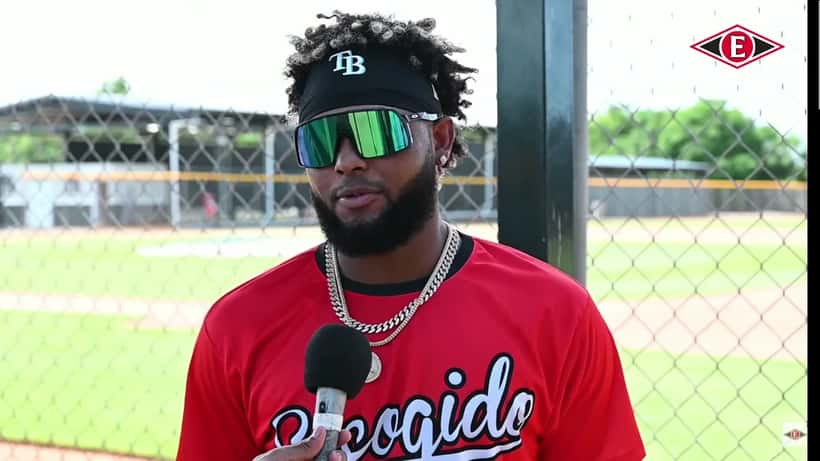
 Daniel Sterling
Junior Caminero's selection to the Dominican Republic's 2026 World Baseball Classic roster — announced by manager Albert Pujols this week — generated the kind of buzz that only a 22-year-old with 45 home runs in a single season can produce. But behind the celebration, Caminero's WBC call-up quietly surfaces a legal question that follows every international baseball tournament: when your employer and your national team compete for the same body, who actually protects you?
The Announcement Behind the Headline
Albert Pujols, serving as manager of the Dominican Republic's WBC squad, made the roster announcement on Monday. For Caminero, the Tampa Bay Rays third baseman who had told reporters in late September that he would show up as a fan if no invitation came, the news was personal. For his attorney and agent, it was the start of a legal review process.
The 2026 World Baseball Classic brings together the world's best players under the banner of their national federations. But unlike an Olympic athlete's arrangement, MLB players at the WBC operate at the intersection of two overlapping legal frameworks: the Major League Baseball Collective Bargaining Agreement (CBA), which governs their club employment, and the World Baseball Classic, Inc. (WBCI) participant agreement, which governs their international competition rights and coverage.
Those two frameworks do not always align — and for a young player in Caminero's exact position, the gap between them can be significant.
What the CBA and WBCI Actually Guarantee
Under the MLB CBA, clubs cannot prevent players from participating in the WBC if selected by their national federation. That protection is meaningful: it means the Rays cannot legally block Caminero from going to the Dominican Republic's camp, regardless of their preference.
However, "the right to participate" is not the same as "full financial protection during participation."
The WBCI carries primary insurance for players competing in the tournament. According to the MLBPA — the Major League Baseball Players Association, whose CBA and event guidance documents are publicly accessible at mlbplayers.com — this coverage addresses:
- Medical costs related to in-game injuries
- Current salary continuation if an injury prevents a player from fulfilling their club contract
What it does not automatically cover is the difference between a player's current contract value and their projected future earnings — the number that matters most for a player on the edge of a major free-agent deal.
Caminero, at 22 and still in his pre-arbitration years, earns approximately $760,000 under his current Tampa Bay deal. His performance — two consecutive All-Star selections, 45 home runs in 2025, and a .265 average in 2026 — points toward a first arbitration salary in the $6 million to $9 million range after this season, and a potential max contract within three years.
That gap is where the legal exposure lives.
Why Pre-Arbitration Players Carry Unique Risk
Sports attorneys describe players in Caminero's position as sitting in a "pre-max vulnerability window." Their financial security is not yet locked in through a long-term guaranteed deal. Every healthy season adds to the foundation; every lost season erodes it in ways that are difficult to recover.
For a veteran with a $200 million guaranteed contract already signed, a WBC injury is covered by the deal's guarantees regardless of when or how it occurs. For Caminero, the equivalent protection doesn't exist yet — it's still being earned, month by month, through the 2026 season and the arbitration cycle that follows it.
This creates a specific legal question any attorney representing Caminero would raise before the WBC begins: Does the WBCI insurance policy cover the player's projected arbitration and free-agent value, or only his current contract salary?
The answer, in most cases, is the latter. And the player's personal insurance — typically a disability policy obtained through the MLBPA's group plan or independently — must be reviewed for clauses that exclude coverage during "competing professional events." Some policies contain exactly this exclusion.
A Concrete Case: The UCL Scenario
Consider a scenario grounded directly in Caminero's current situation.
Caminero enters the 2026 WBC under his $760,000 Rays contract. In a group-stage game against Team USA, he dives to field a hot grounder, plants awkwardly, and tears his ulnar collateral ligament (UCL). Tommy John surgery is required.
Standard UCL recovery: 12 to 18 months. Best-case timeline: he returns for the second half of the 2027 season.
If the injury occurs during WBC play:
- WBCI insurance covers: ~$760,000 (current salary replacement)
- Projected 2027 arbitration salary (conservatively): $6,000,000 to $9,000,000
- Gap between insured compensation and projected earnings: $5.2 million to $8.2 million
If his personal disability policy contains a competing-event exclusion — which is common in standard disability riders — then that $5-8M gap is entirely uninsured. The player bears the loss.
This is not a theoretical risk. In the 2023 WBC, multiple high-profile injuries occurred, including Edwin Díaz's catastrophic knee injury during a Dominican Republic celebration. Díaz, fortunately, had a fully guaranteed contract in place. Players who do not have that protection face a structurally different exposure.
For Caminero, the conversation with a sports attorney in the two weeks before the WBC is not a formality. It is the mechanism by which this specific coverage gap either gets addressed — through an insurance rider, a contract addendum with Tampa Bay, or a documented acknowledgment of the risk — or remains open.
The Legal Framework for International Athlete Participation
Under U.S. contract law, an employee's participation in a secondary professional engagement while under a primary employment contract creates what attorneys call a "dual-engagement liability question." The analysis addresses three core issues:
Primary liability: Which entity — the club, the tournament organizer, or both — is legally responsible for any harm to the player's earning capacity during the outside event?
Insurance stacking: Does the player's personal coverage stack with, or exclude, coverage provided by the tournament organizer? Can the player file claims under both simultaneously?
Service time and performance benchmarks: In MLB arbitration, salaries are calculated using performance statistics and service time accumulated in the current contract year. An injury that cuts a season short — whether it occurs at the WBC or in a club game — affects both. The legal question is whether an injury at the WBC should be treated differently under the club contract than one sustained in a regular-season game. The current CBA addresses this, but not comprehensively.
These aren't abstract questions. They are the specific legal review that any player's representation team — agent, attorney, and financial advisor working together — should complete before the player signs the WBC participant agreement.
When the Overlap Between Two Employment Frameworks Affects You
Caminero's situation is high-profile, but the underlying legal dynamic is more common than most workers realize. Anyone who holds a specialized skill and occasionally works under the umbrella of a second organization — a contractor seconded to a client, a salaried employee participating in an outside consulting arrangement, a gig worker operating across multiple platform agreements — faces a version of this question.
The specific variables differ, but the structure is the same:
- Your primary employer has one set of obligations toward you.
- The secondary engagement has a different, often narrower, set of obligations.
- If something goes wrong during the secondary engagement, the gap between those two frameworks is your financial exposure.
The first step in closing that gap is identifying it. That requires someone who has read both agreements and can explain, in plain terms, what each one actually covers and where the coverage ends.
Under U.S. employment and contract law, workers are entitled to independent legal review before entering any agreement that shifts or waives liability. For a professional athlete, that review happens through a sports attorney. For everyone else, it happens through a contracts or employment lawyer.
Getting the Right Advice Before the Moment Matters
Junior Caminero's WBC selection is a story about one of baseball's most exciting young talents stepping onto the international stage. It is also, quietly, a story about the legal infrastructure — contract review, insurance analysis, liability gap assessment — that every high-earning professional should have in place before accepting a major outside commitment.
The questions worth bringing to a legal consultation:
- Does my current contract restrict or create consequences for outside professional engagements?
- Does the outside engagement's insurance cover my full projected earnings, or only my current compensation?
- Is there a provision in either agreement that creates an uninsured gap I should document or address?
A single consultation with a contracts or employment attorney can answer all three — and the cost of that conversation is a fraction of the exposure it prevents. On ExpertZoom, licensed attorneys experienced in employment and contract law are available for virtual consultations and can review your specific situation regardless of industry.
format_used: Expert reaction
