 Evelyn Carter
Algeria came from behind to beat Jordan 2-1 at Levi's Stadium in Santa Clara on June 22, 2026, sealing Jordan's elimination from the FIFA World Cup. Nizar Al-Rashdan gave the Chivalrous Ones an early lead, but second-half strikes from Nadhir Benbouali (68th minute) and substitute Amine Gouiri (82nd minute) turned the match around and kept Algeria's knockout-stage dreams alive.
With zero points from two games, Jordan is mathematically out of Group J. The result punctuates a bittersweet campaign for a nation that arrived at its second-ever World Cup already missing its most dangerous striker.
Group J Standings After June 22, 2026
Argentina's 1-0 win over Austria earlier the same day, combined with Algeria's comeback, has reshuffled the group dramatically:
| Team | Played | W | D | L | Points |
|---|---|---|---|---|---|
| Argentina | 2 | 2 | 0 | 0 | 6 |
| Algeria | 2 | 1 | 0 | 1 | 3 |
| Austria | 2 | 1 | 0 | 1 | 3 |
| Jordan | 2 | 0 | 0 | 2 | 0 |
One match remains for each team on June 27. Argentina face Jordan in what will be a ceremonial send-off for the Jordanians, while Algeria and Austria square off in a decisive clash for the second knockout spot. Both games kick off simultaneously, per FIFA's standard final-round format.
The Absence That Defined Jordan's World Cup
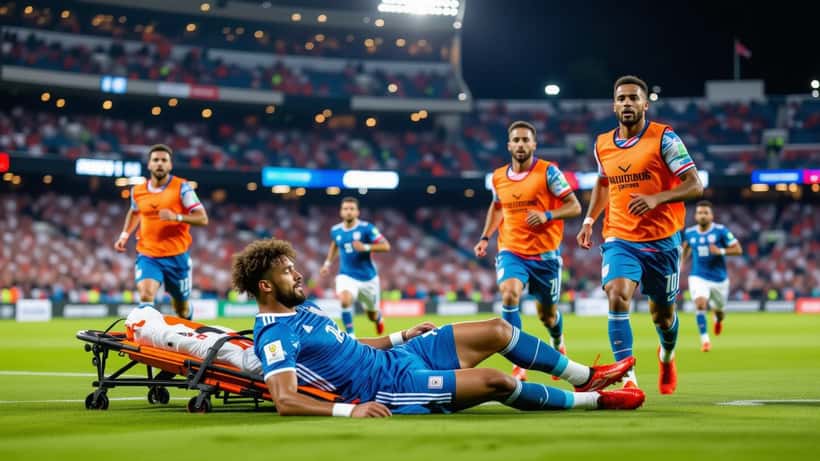
Jordan's group-stage heartbreak traces back to December 2025. Moussa Al-Naimat, widely regarded as the most dangerous attacker in Jordan's setup and a key figure in their historic qualification campaign, tore his anterior cruciate ligament (ACL) during the Arab Cup. He underwent surgery and was ruled out of the entire World Cup.
His absence loomed over every match Jordan played. Al-Naimat had scored seven goals during qualification and was expected to be the focal point of Jordan's attack against Argentina, Austria, and Algeria. Without him, the Chivalrous Ones showed heart — Al-Rashdan's first-half opener against Algeria was a moment of genuine quality — but lacked the cutting edge to hold on when it mattered most.
ACL injuries are among the most devastating setbacks in professional soccer. Average recovery timelines run from nine to twelve months, meaning Al-Naimat could return to club football by late 2026. But for his country, the window closed before he could step onto an American pitch.
What Is an ACL Injury and Why Does It Sideline Players for So Long?
The anterior cruciate ligament stabilizes the knee during the sudden pivots, jumps, and direction changes that define high-level soccer. When it ruptures — typically from a non-contact plant-and-twist or a hyperextension — athletes often describe hearing or feeling a distinct "pop," followed almost immediately by swelling and a sense that the joint has given way.
According to the American College of Sports Medicine, ACL injuries account for roughly 200,000 surgical interventions per year in the United States. What makes them particularly costly for athletes is not just the initial recovery time but the recurrence risk: studies show that between 15 and 25 percent of athletes who return to their sport suffer a second ACL event within two years, especially if they rush back without completing structured rehabilitation.
Al-Naimat's story is a reminder that even the most carefully managed injury — one surrounded by the resources of a national football program — can rewrite a tournament narrative.
5 Warning Signs Athletes Should Not Play Through
Whether you compete at a national level or in a weekend pick-up league, these five signs indicate it is time to see a sports medicine specialist before you return to the pitch:
1. A sharp "pop" or snap during a cut or landing The classic ACL injury presentation. Even if you walk away from the incident with minimal pain, the ligament may be partially or fully torn. Attempting to train through a suspected ACL event dramatically increases re-injury risk.
2. Rapid knee swelling within the first two to four hours Post-injury swelling that appears quickly and feels warm to the touch often signals bleeding within the joint cavity — a condition called hemarthrosis. This is not manageable with ice alone and requires imaging to rule out ligament or meniscal damage.
3. The knee "giving way" during everyday walking Buckling episodes outside of sport — on stairs, stepping off a curb, getting out of a car — point to compromised structural stability. Athletes frequently attribute this symptom to general weakness rather than injury, delaying diagnosis by weeks.
4. Pain that returns at the same intensity after rest Ordinary muscle soreness clears within 48 to 72 hours. Pain that disappears with rest but resurfaces with the same severity on resuming lateral movement is a classic sign of unresolved tissue damage. Rest does not heal a torn ligament.
5. Persistent loss of full range of motion Difficulty fully extending or bending the knee more than a week after an acute incident — even with stretching and physiotherapy — warrants an MRI and specialist consultation. Scar tissue formation during early healing can limit long-term mobility if not addressed promptly.
Important: This article provides general information for educational purposes only and does not constitute medical advice. Consult a licensed sports medicine physician or orthopedic specialist for assessment, diagnosis, and treatment of any injury.
What Jordan's Story Means for Athletes at Every Level
Al-Naimat's December ACL did not just sideline a footballer. It reshaped what Jordan could realistically achieve over the following seven months. One injury, one missed assessment window, one rushed return — the margins in high-performance sport are that small.
For recreational athletes, the calculus is different but the principle holds. A sports medicine consultation in the weeks following any of the warning signs above can mean a six-week recovery instead of a six-month one. Early imaging, a structured rehabilitation protocol, and a supervised return-to-play plan are the difference between watching next season's games and playing in them.
ExpertZoom connects you directly with certified sports medicine physicians and orthopedic consultants who can evaluate your symptoms, order appropriate imaging, and design a recovery timeline around your sport, your schedule, and your long-term goals.
Algeria's Amine Gouiri heads into the June 27 Austria clash knowing his 82nd-minute header bought his team one more chance to advance. For Jordan, the World Cup ends here — but the conversation about athlete health and injury prevention is just beginning.
For further context on how World Cup group standings work across all 16 groups in 2026, see our breakdown of WC2026 Group D: What Paraguay's Win Over Turkey Means.
