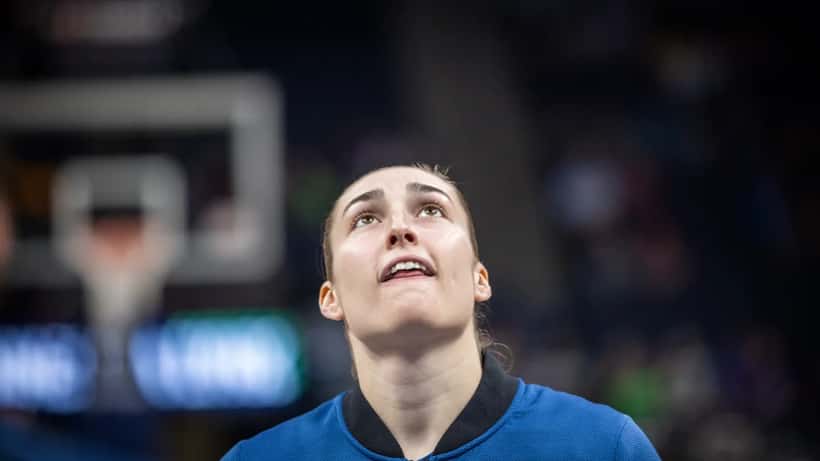
 Harper Brooks
A $2.05 million, two-year contract looked like a calculated bet in April 2026. Three months into the WNBA season, it already reads like one of the worst deals the league has ever seen — for Jessica Shepard. The Dallas Wings forward has recorded multiple triple-doubles, earned her first All-Star selection, and on July 22 set the WNBA record for the fastest triple-double in league history: 22 points, 11 rebounds, and 11 assists in just 21 minutes and 57 seconds against the Indiana Fever, in a 95-90 Wings victory. She is averaging 14.6 points per game, second on the team behind star guard Paige Bueckers. Sports analysts have started calling Shepard's contract the biggest bargain in professional women's basketball. The Wings got an extraordinary deal. Shepard got a paycheck. Those two things should not have been as far apart as they are.
What the Numbers Say
Shepard's 2026 statistics tell a story that her contract does not:
| Metric | Shepard's 2026 Season |
|---|---|
| Points per game | 14.6 |
| Triple-doubles (as of July 22, 2026) | 3 |
| Fastest WNBA triple-double ever | 21 min 57 sec vs. Indiana Fever |
| All-Star selections | 1 (first in career) |
| Annual contract value | ~$1.025 million |
For reference, WNBA players with six or more years of experience can command salaries well above Shepard's current rate under the league's collective bargaining structure. The gap between her April 2026 contract and her July 2026 market value is not a small rounding error. It is the product of a negotiating environment that consistently discounts uncertainty — and in comeback contracts, uncertainty is almost always priced against the athlete.
You can track how far Shepard's numbers have separated her from the rest of the league in the 2026 WNBA season standings and analysis, where she has become one of the defining storylines of the year.
How the Market Misjudged Her
Understanding Shepard's contract requires understanding what she looked like in April 2026 — not July.
She had missed the entire 2024 WNBA season due to injury. Before that, she had spent years as a dependable reserve with the Minnesota Lynx, never a primary option, never a franchise piece. When Dallas signed her in the offseason, the market priced in two compounding uncertainties: a history without starring roles, and a post-injury return with no recent proof of health. The $1.025 million annual figure reflected both.
The player who showed up in Dallas was not that player. Within weeks she had transformed into what analysts now describe as one of the league's best point forwards — a versatile big who can initiate offense, score from multiple spots, and collapse defenses in ways a traditional post player cannot. When the Wings beat the New York Liberty 88-77, Shepard logged 22 points, 12 rebounds, and 11 assists. Two weeks later, she did it again — faster than anyone in WNBA history.
The market mechanism that produced her April contract had no way to price this. But it also had no structural tools to correct for it mid-season. That is the part that a financial advisor would have flagged before the ink dried.
The Financial Architecture of a Comeback Contract
Shepard's situation illustrates a pattern that repeats every season across professional sports: a player returning from injury or obscurity signs a contract that prices in career risk, performs at an elite level, and watches their employer capture the surplus value they created.
This is not primarily a talent-discovery failure. It is a contract architecture failure. Comeback deals — signed under conditions of uncertainty, often with leverage tilted toward the team — routinely lack the provisions that could shift value back to the player as their performance is revealed.
Performance escalators, All-Star selection bonuses, statistical threshold clauses, and opt-out triggers tied to achievement are all standard tools in sports contract negotiation. According to the SEC's investor education resource, professional athletes represent one of the highest-risk demographics for long-term financial loss, precisely because high earnings arrive in a compressed window, often under conditions — like a comeback season — where the player has little negotiating leverage and inadequate financial counsel.
The tools exist. They are used unevenly. And the athletes who benefit from them most reliably are the ones who walk into contract negotiations with a wealth advisor and a sports attorney who have worked the same document together.
What $2.05 Million Actually Costs When You're Worth More
Here is the concrete scenario that Shepard's season makes visible.
A professional basketball player — returning from a knee injury that cost her the previous season — signs a two-year deal at $900,000 per year in April. The contract is flat: no performance bonuses, no escalators, no opt-out provisions.
She comes back at a level comparable to Shepard's 2026 season: 14-plus points per game, strong assist numbers, All-Star consideration. Based on that performance, her market value in a free-agency context would realistically sit at $1.4 million per year — a $500,000 annual premium over her current contract.
- If she signed with no performance incentives → she leaves $500,000 on the table in Year 1 alone. Over two years, the cumulative gap reaches $1 million.
- If her agent had negotiated an All-Star selection clause of $150,000, plus a statistical bonus of $100,000 triggered by averaging 12+ points per game → she recovers $250,000 of that gap in Year 1, with the same structure repeating in Year 2.
- If the contract included an opt-out triggered by an All-Star appearance → she could renegotiate entirely after Year 1, capturing close to full market value for Year 2 and eliminating the remaining $250,000 deficit.
The difference between these three scenarios is not the athlete's performance. That is identical in all three. The difference is whether a wealth advisor and sports attorney were in the room before the contract was signed.
For Shepard specifically, her earnings in 2026 are fixed. The lessons from her season apply to the next deal. They also apply right now to every athlete in every professional league who is preparing to sign a comeback contract without the professional support that turns a flat guarantee into a fair reflection of what they can actually do.
Three Steps Before You Sign That Comeback Deal
The financial gap in Shepard's contract is not recoverable mid-season. But the same gap is preventable for athletes who have not yet signed. Three immediate actions:
1. Request a market valuation before the offer expires. A wealth advisor with sports industry experience can benchmark your offer against comparable players at the same position, experience level, and performance tier. That baseline tells you exactly how far the offer deviates from market — and gives your agent a factual foundation for a counter.
2. Negotiate escalators, not just the base. Guaranteed money matters for floor protection. But if you believe in your own comeback, performance incentives — All-Star bonuses, statistical thresholds, post-season appearance clauses — are the mechanism that lets your salary track your actual output. A flat guarantee protects the team. Escalators protect you.
3. Plan for the tax spike before it arrives. An athlete moving from a $0 income year during injury to a $1 million income year faces a significant one-time tax event. A certified financial planner can model deferral arrangements, charitable giving structures, or income-timing strategies that reduce that burden substantially — but only if the conversation happens before the season starts, not after the checks arrive.
Jessica Shepard's 2026 season is one of the best comeback stories in recent WNBA history. The contract she is performing under does not reflect that story — and it cannot, midway through a two-year deal. For athletes who have not yet signed, the structure that would have changed Shepard's outcome is still available. A wealth management professional who understands sports contracts can model what performance incentives are worth before they are worth anything, which is the only moment they can actually be added.
At Expert Zoom, you can connect with a wealth management specialist who works with professional athletes on contract planning and long-term financial strategy. That conversation is easier to have in April than it is to have in July, when the numbers are already on the scoreboard and the contract is already signed.
This article is for informational purposes only and does not constitute financial or legal advice. Consult a licensed financial professional before making decisions about contracts or investments.
