 Cora Nelson
The New York Giants are banking on Jaxson Dart to deliver a breakout 2026 season. The 22-year-old quarterback enters his second year with a revamped supporting cast — including Odell Beckham Jr. and new head coach John Harbaugh — and has been named a top breakout candidate by NFL analysts nationwide. But behind the highlight reels and projection models lies a medical conversation that sports medicine professionals say deserves far more attention: what the physical toll of playing quarterback actually means for athletes at every level, from Dart's Giants to a high school field in Ohio.
The Anatomy of a Quarterback's Exposure
Playing quarterback in the modern NFL is not simply about throwing touchdowns. It is a sustained, high-contact athletic endeavor that subjects its participants to repeated physical stress across every practice rep, scramble, and sack — compounded over 17 regular season games, preseason, and playoffs.
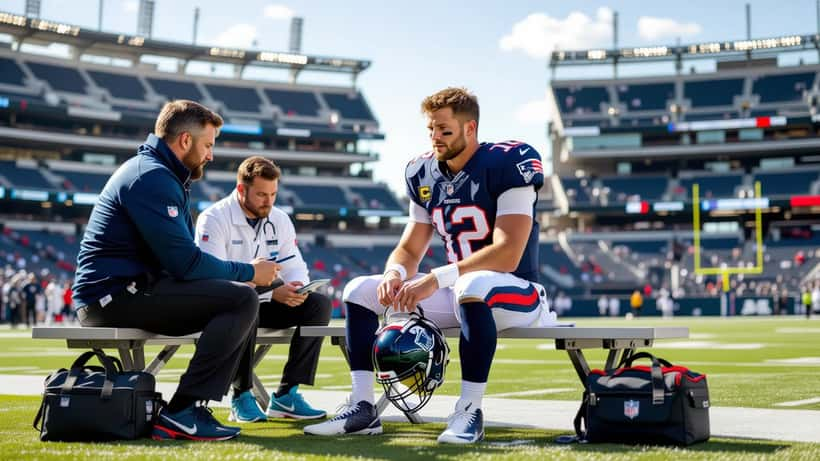
What distinguishes NFL franchises from every other level of competition is the density of their medical infrastructure. The Giants employ multiple orthopedic surgeons, neurologists, and certified athletic trainers who are present not just at game time but at every practice. Under the NFL's current protocol, any player who shows recognized neurological symptoms — confusion, blank staring, loss of coordination — is immediately evaluated by an independent neurological consultant, not a team employee.
That system is comprehensive, costly, and entirely unavailable to the estimated 5.8 million youth athletes who play organized tackle football in the United States, according to USA Football. For those athletes, the equivalent of Dart's medical team simply does not exist — and that gap is exactly where sports medicine experts say proactive consultation matters most.
What Research Says About Sub-Concussive Impact
Much of the public conversation about football and head health focuses on diagnosed concussions. But a growing body of peer-reviewed research — including work published in JAMA Neurology — has examined what happens at the sub-concussive level: repeated impacts below the threshold that trigger symptom-based protocols.
Studies using helmet accelerometer data have estimated that starting quarterbacks at the high school and college level accumulate hundreds of sub-concussive impacts over the course of a single season. Unlike diagnosed concussions, these exposures produce no obvious immediate symptoms — no dizziness, no on-field confusion, no missed plays. The concern among researchers at institutions including the Boston University CTE Center and the University of North Carolina's Sport Concussion Research Program is that cumulative exposure over multiple seasons may produce measurable changes in neurological function before any single impact triggers a clinical response.
This is precisely why sports medicine physicians recommend proactive baseline neurological testing for contact sport athletes — not a post-injury intervention, but a pre-season benchmark that allows clinicians to detect deviation if and when an impact does occur. In professional football, this assessment is mandatory. In youth sports, it remains largely voluntary and underutilized across most school districts.
The 3-Season Threshold: What Changes After 30 Games
Consider a 17-year-old high school quarterback who has played three consecutive varsity seasons — roughly 27 to 33 game appearances, plus hundreds of hours of contact practice. According to current guidelines from the American Academy of Neurology, any athlete who has competed for two or more seasons in a sport with documented head-impact risk should receive a formal neurological baseline evaluation.
Here is the critical if/then: if a youth athlete has completed two or more full seasons of contact sport AND has not received a baseline cognitive assessment, THEN scheduling one now costs between $95 and $280 at a sports medicine clinic — and produces a documented cognitive benchmark that remains valid for two to three years. Without that baseline, any future post-impact evaluation is working from zero.
The practical consequence is direct. A physician who evaluates a post-impact athlete with a documented pre-season baseline can detect changes as subtle as a 5-to-10-point shift in memory recall or a measurable slowing in reaction processing. Without a baseline, those same deviations are invisible — because there is no prior snapshot to compare against. For the Giants, this infrastructure surrounds Dart every week. For the young quarterback watching him from the bleachers, that $95 to $280 investment is the closest available equivalent.
The CDC's HEADS UP concussion program provides free guidance on concussion recognition, return-to-play protocols, and baseline testing resources for athletes, parents, and coaches at every level.
Red Flags That Warrant Immediate Consultation
While baseline evaluations are proactive, specific post-impact situations require immediate consultation with a neurologist or sports medicine physician:
- Any confusion or disorientation lasting more than a few minutes after a head impact, regardless of how the impact appeared from the sideline
- Headaches that persist beyond 48 hours following a hit, even if the athlete seemed fine in the immediate aftermath
- Any repeat concussion within a single season — a pattern associated with significantly prolonged recovery timelines and elevated long-term risk
- Symptoms that appear or worsen in the 24-to-72 hours after an initial impact, including memory difficulty, light sensitivity, and mood changes
Youth athletes face elevated risk from one specific consequence: second-impact syndrome, a rare but potentially serious condition that can occur when a second head impact happens before the brain has fully recovered from a first concussion. Young athletes' developing nervous systems recover more slowly than those of adults — a fact that pediatric neurologists consistently emphasize when advising return-to-play timelines. The medical consensus is clear: when doubt exists about an athlete's recovery status, that doubt should be resolved by a qualified physician, not a coaching staff.
From Dart's Sidelines to Yours: Three Steps to Protect Every Athlete
Dart's 2026 campaign will unfold in front of millions of viewers, many of whom have their own athletes — children, students, or themselves — participating in contact sports at some level. The Giants' medical resources cannot be replicated. But the underlying discipline can: treat head health as a proactive priority, not an emergency-only response.
For parents of youth contact sport athletes, three concrete actions apply immediately. First, request a baseline neurological evaluation before the season starts — not after an incident. Many pediatric sports medicine practices offer these as standalone appointments, and most take under an hour. Second, familiarize yourself with your state's athletic association return-to-play protocols: most follow the CDC's HEADS UP framework, which requires a medically supervised, step-by-step progression back to full contact. Third, if an athlete reports any of the red flag symptoms listed above after a hit — even a hit that appeared minor — consult a sports medicine physician before that athlete returns to any contact practice.
For adult recreational athletes in weekend football leagues, martial arts, or competitive cycling, the same logic applies. Adults over 35 who regularly participate in head-impact sports are an underserved group in concussion awareness. A sports medicine specialist can provide individualized guidance on appropriate exposure thresholds and long-term monitoring suited to recreational, not professional, participation levels.
Sports medicine physicians, neurologists, and pediatric health specialists available through consultation platforms can review an athlete's sport history, prior impacts, and current symptom profile to provide targeted guidance — often without requiring a full clinical visit as a first step. In many cases, that initial expert conversation clarifies whether in-person evaluation is urgently warranted or whether a structured monitoring approach is appropriate given the specific context.
Jaxson Dart has a full medical team watching over him every week of the 2026 season. For every athlete watching from the stands or the sidelines, that equivalent protection starts with a single conversation with a qualified health professional.
This article provides general health awareness information and does not constitute medical advice. Consult a licensed physician or sports medicine specialist for personalized guidance.
