 Cora Nelson
Jadarian Price's NFL debut ended with a question mark. The Seattle Seahawks' first-round pick — the No. 32 overall selection of the 2026 NFL Draft — left Sunday's 13-10 win over the New England Patriots with a chest injury late in the fourth quarter, just hours after commanding 48% of Seattle's offensive snaps in his professional debut. For a player carrying a four-year, $16.1 million rookie contract, every hit that keeps him sidelined is a reminder of a truth that extends far beyond the NFL: athletic injuries don't always reveal their full severity until you stop moving.
Price's on-field numbers were genuinely impressive. He rushed for 52 yards on 10 carries, averaging 5.2 yards per carry, and logged a 20% explosive run rate and 2.90 yards after contact per attempt — numbers that justified the Seahawks' faith in their first-round investment. But Price had already missed nearly ten days of training camp with lower body soreness before the regular season even began. His Week 1 chest injury added a second data point in a pattern that every athlete — at every level of competition — should recognize: contact sports produce injury accumulation, and the key question is always when accumulated damage requires expert medical evaluation.
Seattle's Week 1 Win and What It Cost the Rookie
The Seahawks opened 2026 with a hard-fought 13-10 victory over New England, secured by a 45-yard fourth-down catch from Jaxon Smith-Njigba and a late interception by cornerback Josh Jobe. Price was offensive coordinator Brian Fleury's clear choice at running back throughout the afternoon, recording 10 carries, 2 receptions, and 58 total yards on 12 touches.
Late in the fourth quarter, he absorbed a hard collision and was listed as questionable for return with a chest injury. He did not come back. The Seahawks have not disclosed the specific nature of the injury beyond confirming it is under evaluation.
His pre-season injury — lower body soreness that sidelined him for roughly 10 days in camp — had already drawn attention. Head coach Mike Macdonald described it at the time as "a minor issue" that would resolve "in a matter of days." It did. But two separate soft-tissue events in the first three months of Price's NFL career raise the question that haunts every serious contact athlete: are you getting the right medical advice when it actually counts?
Running Backs and the Physics of High-Impact Careers
Running backs absorb more collision events per play than any other position in professional football. On an average feature-back workload, a player takes 15 to 20 carries per game. Each carry involves contact. Each contact accumulates.
According to data tracked by the CDC Injury Center, sports-related injuries account for millions of emergency department visits annually in the United States, with musculoskeletal trauma forming a large share. At the contact-sport level, chest and rib injuries are among the most commonly underestimated — and critically, they range in severity from a bruised muscle requiring a few days of rest to a rib fracture that can threaten internal structures if not properly managed.
The NFL average career length for a running back historically sits around 2.5 to 3.5 years, shorter than any other skill position. For Price, whose guaranteed earnings under his first-round rookie deal total over $16 million, the pressure to play through minor pain and return quickly creates a genuine tension between medical caution and professional obligation.
Why Recreational Athletes Face More Risk Than NFL Players
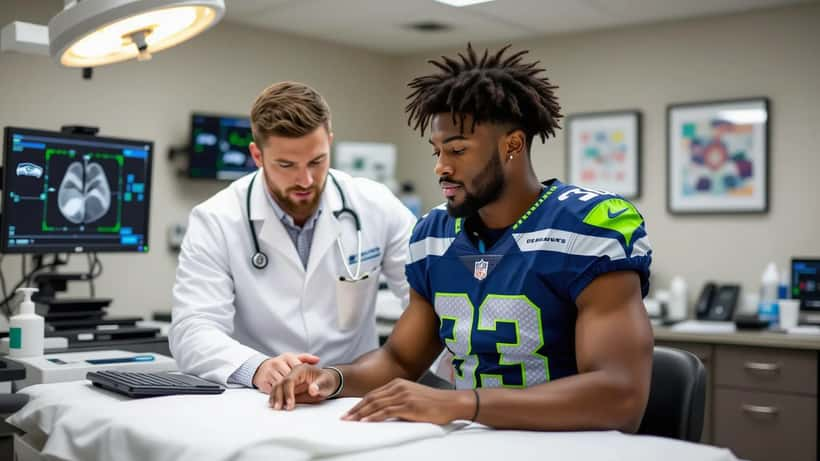
Here's the paradox: NFL players like Jadarian Price receive better sports medical care than most recreational athletes, even though they absorb far greater physical punishment. Every contact event Price experiences is evaluated by certified athletic trainers, team physicians, and — when warranted — outside specialists. He doesn't self-diagnose. He doesn't "wait and see" without imaging. When the Seahawks' medical staff determines he needs an X-ray or MRI, he gets one that afternoon.
The adult recreational athlete, high school player, or college club-sport competitor typically does not have that infrastructure. They make their own return-to-play decisions, often without the diagnostic information that would change those decisions.
This matters because chest injury presentations in contact sports can be deceptive. A rib contusion (bruising without fracture) and a non-displaced rib fracture can present with nearly identical pain profiles: sharp discomfort on impact, aching on deep breathing, sensitivity to direct pressure. The critical difference is what happens if you return to contact activity too soon.
A bruised rib tolerates it. A fractured rib can displace — and a displaced rib near the lung creates a medical emergency, not an inconvenience.
Sports medicine specialists — board-certified physicians with training in musculoskeletal injury, imaging interpretation, and return-to-activity protocols — provide the bridge between "it hurts" and "here's what the evidence says you can safely do." That bridge is not exclusive to the NFL.
The Concrete Case: A High School Running Back Takes a Hit
Consider this specific scenario, played out in thousands of youth and adult leagues every fall season. A 16-year-old running back takes a helmet-to-chest collision in the third quarter of a Friday night game. He finishes the quarter, then tells his coach his ribs hurt "but it's fine." By Saturday morning, he rates his pain at 6 out of 10. By Sunday, it's down to a 4, and it only hurts when he takes a full breath or twists sharply.
His parents face a decision with no clear roadmap. Here's the if/then logic that a sports medicine specialist applies — and that families without specialist access typically have no way to access:
If this is a Grade 1 rib contusion — the most common outcome in similar presentations, accounting for roughly 60-70% of cases — conservative management (rest, ice, anti-inflammatories, gradual return over 7-10 days) is appropriate. He can probably practice by Thursday and play the following Friday with minimal risk.
If this is a non-displaced rib fracture — which accounts for an estimated 25-30% of clinically similar presentations — returning to full contact activity within one week creates real displacement risk. If he contacts a sports medicine physician within 48 hours and gets a targeted X-ray or focused ultrasound, the fracture is identified, a 3-to-4-week non-contact period is recommended, and he returns safely at Week 5. If he skips evaluation and goes back to full contact on Thursday, the fracture can displace on the next significant impact. That outcome can require emergency intervention — a very different outcome from the "rest and recover" path.
The cost difference between those two roads is one 30-minute sports medicine consultation versus a potential emergency visit and weeks of additional recovery. The trigger for seeking evaluation is not dramatic: localized rib pain reproducible on direct pressure, difficulty completing a full breath without sharp pain, or symptoms that fail to show meaningful improvement within 72 hours post-injury.
Five Signs Your Sports Injury Needs a Specialist — Not Just Rest
Regardless of athletic level, these signs after a contact injury to the chest, ribs, or upper body warrant a sports medicine evaluation rather than self-managed home care:
- Pain worsens after 48 hours instead of gradually improving with rest and ice
- Localized tenderness at a specific point on the rib cage rather than diffuse soreness across a broad area
- Difficulty completing a full breath without sharp or stabbing pain
- A popping, cracking, or grinding sensation that occurred at the time of impact
- Swelling or visible asymmetry of the chest wall area
Any single flag on this list warrants a timely sports medicine consultation — within 24 to 48 hours, not a weeks-long wait. These are not emergency indicators on their own (seek emergency care for chest pain at rest, significant shortness of breath without movement, or any suspected cardiac event). But they are the signals that separate a case best managed by a professional from one that genuinely will resolve with ice and time.
For more complex presentations — multiple signs, a direct high-energy collision, a prior history of rib injury — even a teleconsultation with a sports medicine specialist can provide immediate, evidence-based return-to-activity guidance that athletes and families simply cannot generate on their own.
What Price's Story Means for Everyday Athletes
Jadarian Price has resources most athletes will never access: a full NFL medical staff, on-site imaging equipment, and a team of specialists whose entire professional mandate is his physical durability. His franchise's playoff hopes depend on getting those calls right. So does his $16 million contract.
For the 34-year-old who still plays competitive flag football on Saturdays, the 16-year-old high school linebacker, or the college club rugby player who took a shoulder-to-chest collision last weekend, the same quality of clinical decision-making is available — but it requires proactively connecting with the right medical expert, rather than defaulting to athlete stoicism and hoping the injury sorts itself out.
Sports medicine specialists serve athletes at every level. The evaluation Price gets on Monday after a chest injury is the same type of evaluation available to anyone willing to book a consultation. The athletes who stay active and perform well for decades are typically the ones who treat their injury evaluations as seriously as their training programs.
Price is expected to be cleared for Week 2 following medical review. The lesson from his early injury history isn't that professional football is dangerous — it's that the athletes who perform at the highest level for the longest time are the ones who take the clinical question seriously, every single time.
Disclaimer: This article is for informational purposes only and does not constitute medical advice. Seek emergency medical attention for chest pain at rest, difficulty breathing unrelated to movement, or any suspected cardiac event. For sports injury evaluation and return-to-play guidance, consult a board-certified sports medicine physician or licensed athletic trainer.
