 David Miller
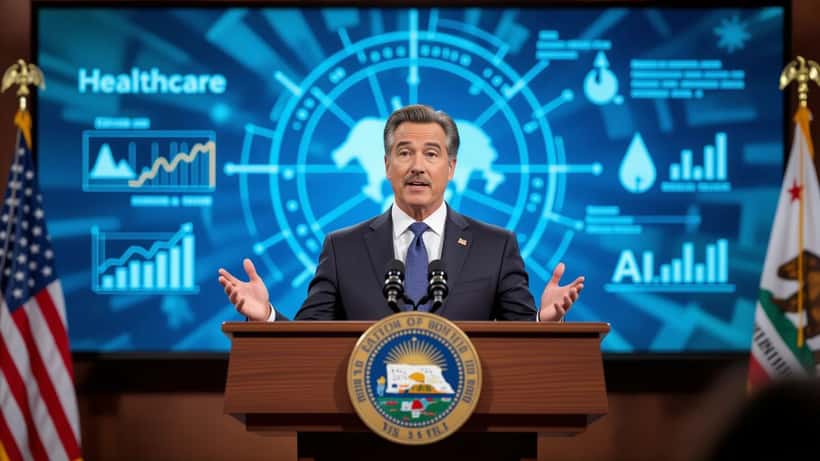
California Governor Gavin Newsom entered 2026 as one of the most watched political figures in the United States, and not only because he leads the nation’s most populous state. With the presidential election behind the country and the next cycle already shaping donor conversations, Newsom’s policy choices are being read as a proxy for where the Democratic Party might head—and where businesses, legal advisors, and policy consultants should place their bets. His recent moves on healthcare cost controls, artificial-intelligence guardrails, and climate enforcement are creating immediate demand for expert interpretation.
For operators of an expert consultation marketplace, the Newsom moment is a case study in regulatory velocity. A single executive order or budget proposal from Sacramento can ripple through multiple industries within weeks, forcing companies to locate specialists who understand both the letter of the rule and the political intent behind it. In 2026, that velocity appears to be accelerating.
Newsom’s office has spent the early months of the year promoting a package of healthcare reforms designed to cap out-of-network surprise billing and increase transparency in hospital pricing. The proposals borrow from federal frameworks but add California-specific reporting requirements that could affect insurers, provider networks, and employers sponsoring self-funded plans. Legal and compliance consultants who follow the state’s Department of Managed Health Care say the draft language leaves room for interpretation, which is exactly where expert guidance becomes valuable.
Mid-sized employers outside California may assume the changes do not apply to them, yet many self-funded plans cover employees nationwide and must reconcile California mandates with ERISA preemption questions. That overlap creates fertile ground for benefits attorneys and compliance consultants who can map state requirements against federal benefits law. The uncertainty is not a temporary nuisance; it is the kind of friction that can last for multiple plan years.
The healthcare angle is not isolated. Newsom has also tied his climate agenda more directly to corporate disclosure, signaling that large California-based employers may face expanded reporting on supply-chain emissions and water use. The state’s Air Resources Board has opened a public comment period on updated disclosure templates, and law firms are already fielding questions from clients who need to model compliance costs. For companies without in-house sustainability counsel, the search for external expertise is intensifying.
Artificial intelligence is another frontier. Newsom signed a 2025 executive order requiring state agencies to evaluate generative-AI procurement risks, and the legislature is now considering bills that would extend similar accountability to private-sector deployments in high-stakes domains such as hiring, lending, and healthcare diagnostics. The proposed standards emphasize human oversight, algorithmic audits, and documentation trails. Technology consultants and legal experts who can translate those requirements into engineering specs are suddenly in short supply.
The political overlay matters because Newsom is widely seen as positioning himself for a national role. His speeches have become more explicit about contrast, framing California as a laboratory for policies that a future administration could scale. Whether that strategy succeeds depends on many variables, but the policy output is already real. Businesses that treat Newsom’s 2026 agenda as a distant political story risk missing the compliance deadlines and procurement shifts that follow from it.
A useful comparison can be found in the way other ambitious Democratic figures are building national profiles through specific issue ownership. The governor’s team appears to have chosen healthcare transparency, climate enforcement, and AI accountability as signature areas, in part because each touches voters directly and in part because each creates a demand for credible expert voices. Companies that can match those voices with decision-makers will be better prepared when rules are finalized.
The pattern is not accidental. Successful statewide officials often use policy detail as a credentialing device: by mastering complex regulatory terrain, they demonstrate executive competence to a national audience. For consultants and subject-matter experts, that dynamic turns each new proposal into both a market opportunity and a knowledge-management challenge. Staying current means reading proposed regulations, tracking committee hearings, and anticipating how implementation guidance will narrow or broaden a rule’s reach.
The implications for expert networks are clear. First, generalists are less useful than specialists who can combine sector knowledge with California regulatory fluency. A lawyer who understands federal healthcare law but not the state’s Knox-Keene Act, for example, will struggle to advise a health plan operating in California. Second, speed matters. The gap between a policy announcement and its effective date is shrinking, which rewards marketplaces that can surface vetted experts within days rather than weeks.
Organizations should consider three immediate steps. They should audit their existing consultant roster for California-specific credentials, identify the regulatory arenas most likely to affect their revenue, and establish relationships with experts before a crisis forces a rushed hire. Waiting until a rule is final often means paying a premium for scarce talent.
The broader lesson is that political news in 2026 is no longer just a Beltway story. A governor’s press conference can reshape procurement, hiring, data governance, and capital allocation across the country. Expert consultation platforms that treat policy signals as lead indicators will outperform those that treat them as background noise. Newsom’s policy trajectory is one of the clearest signals on the board right now, and the market for informed interpretation is only getting louder.
For individual professionals, the trend suggests deepening a narrow specialty rather than chasing every headline. A consultant who can explain how a Newsom-era AI disclosure rule affects healthcare triage algorithms will be more valuable than one who offers generic commentary on the governor’s political future. Depth, jurisdiction-specific fluency, and the ability to communicate uncertainty are the assets that expert marketplaces should cultivate and buyers should prioritize in 2026.
