 William Reed
Formula 1's most technically radical season in over a decade reached its pivotal race on June 14, 2026: the Barcelona-Catalunya Grand Prix at Circuit de Catalunya. For the first time in F1 history, electric motors and combustion engines share equal power output — and that shift carries real lessons for anyone who owns a modern car.
The 2026 F1 Technical Revolution, Briefly Explained
This season brought F1's most sweeping regulatory overhaul since 2014. The new power units split output roughly 50/50 between a 1.6-litre turbocharged V6 and a dramatically more powerful electric motor — the MGU-K now delivers 350 kilowatts, nearly triple its predecessor's output. Active aerodynamics replaced the old DRS system. Cars continuously adjust wing angles on straights, requiring precise calibration before every session.
George Russell secured pole position for Mercedes in qualifying, with championship leader Kimi Antonelli entering the race as the dominant force of the 2026 season. Add fully sustainable fuel to the mix, and the 2026 F1 car is a machine that would be unrecognizable to engineers from five years ago.
According to Formula 1's official 2026 regulations overview, the new MGU-K system is designed for extreme energy recovery under braking — storing power and deploying it in fractions of a second. Managing this cycle demands precision maintenance that F1 teams obsess over. The same challenges, scaled differently, affect every modern hybrid on American roads.
What F1 Engineers Know About Hybrid Systems That Most Drivers Don't
When F1 teams commit to a 50/50 electric-combustion split, they become methodical about battery health and heat management. Millions of hybrid and electric vehicles now on US roads face the same core physics.
Most owners never think about their hybrid battery pack until something fails. F1 mechanics think about it every single lap — monitoring cell temperature, charge cycles, and energy delivery precision in real time. The gap between that discipline and typical American car ownership is enormous, and it creates risk.
5 Car Maintenance Lessons From F1's 2026 Season
1. Hybrid batteries have a thermal limit — and so does yours.
F1 teams keep battery cells within narrow thermal windows. Heat kills lithium-ion cells. If you drive a Toyota Camry Hybrid, Ford Escape Hybrid, or any plug-in vehicle, parking in direct sunlight all day during June is degrading your pack faster than driving ever will. A certified mechanic can run a battery management system diagnostic to detect early thermal stress before it becomes a costly replacement.
2. Tire wear reveals the full story of your chassis.
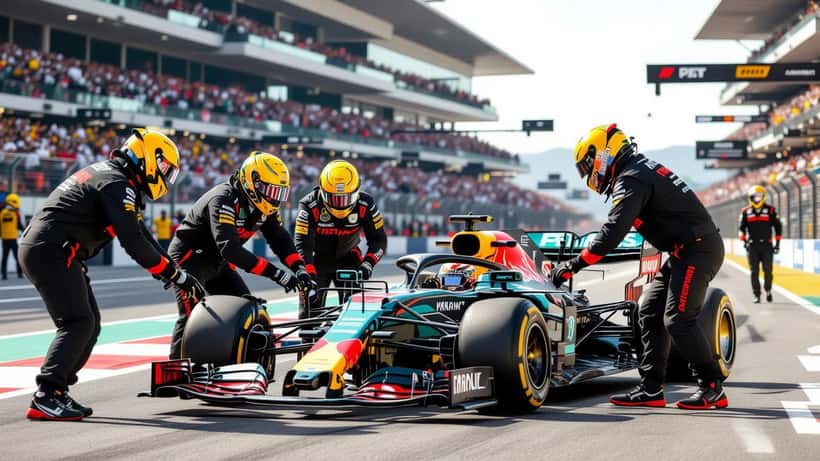
In Barcelona, teams analyze tire wear after every session to diagnose suspension alignment, brake bias, and cornering load distribution. On road cars, uneven tire wear is one of the most reliable indicators of alignment, suspension, or steering problems — all of which can go undetected until a tire fails without warning. The wear pattern across all four tires tells an experienced mechanic exactly where to look.
3. Software controls your car more than you realize.
The 2026 F1 cars rely on sophisticated energy deployment software to manage when and how the electric motor engages. Modern road vehicles — especially those built after 2020 — depend on dozens of onboard control units for fuel injection, battery management, and traction control. Many generate fault codes without triggering a dashboard warning light. A 15-minute OBD diagnostic scan at your mechanic can surface issues months before they become expensive failures.
4. Sustainable fuel compatibility matters for older engines.
F1 mandated sustainable fuels for 2026, requiring intensive testing of fuel system seals and injectors for compatibility with the new compounds. In the US, ethanol blend levels are gradually increasing at the pump — E15 is now common at many stations. Vehicles built before 2012 may experience seal degradation or injector fouling over time with higher-ethanol blends. If your car predates the modern flex-fuel era, it's worth asking a mechanic to verify your fuel system's compatibility.
5. Active systems need periodic recalibration.
F1 teams recalibrate active aerodynamic systems between every practice session. On road cars, adaptive suspension, stability control, and lane-assist systems rely on sensors that drift over time. Brake sensors, steering angle sensors, and wheel-speed sensors all have calibration tolerances that slip after significant impacts — including pothole strikes common on American roads. An annual calibration check, especially after a hard impact, is money well spent.
When Is the Right Time to See a Mechanic?
Most Americans visit a mechanic reactively — when something fails or a warning light illuminates. F1 operates on the opposite model: every system is inspected and logged after every event, regardless of visible problems.
Applying that logic to road car ownership means scheduling a full-system check at the start of summer, particularly before long highway trips in peak heat. For hybrid owners, that means a battery health assessment. For all drivers, it means a tire inspection, alignment check, and diagnostic scan before temperatures peak in July and August.
ExpertZoom's certified mechanics offer pre-summer vehicle inspections and hybrid maintenance consultations — the same systematic, proactive approach F1 teams apply at circuits like Barcelona, adapted for your everyday car.
The Bigger Picture: F1 Innovation Reaches Your Driveway
The 2026 F1 season is a reminder that automotive technology evolves faster than most drivers recognize. Three years ago, the 350kW electric motor in today's F1 cars was largely theoretical. Variants of that technology now appear in production vehicles from Porsche, BMW, and Ford. The gap between cutting-edge motorsport and road cars continues to close.
For now, the practical takeaway is straightforward: modern cars are more complex than ever, maintenance intervals are shorter, and the cost of neglect is higher. What F1 mechanics manage on pit lane this Sunday at Circuit de Catalunya will influence the cars rolling off assembly lines by 2028.
If you're unsure where to start, a certified mechanic available on ExpertZoom can walk you through a full vehicle assessment — covering hybrid battery health, tire wear analysis, software diagnostics, and fuel system inspection — tailored to your specific model, driving habits, and local conditions.
