 Sarah Miller
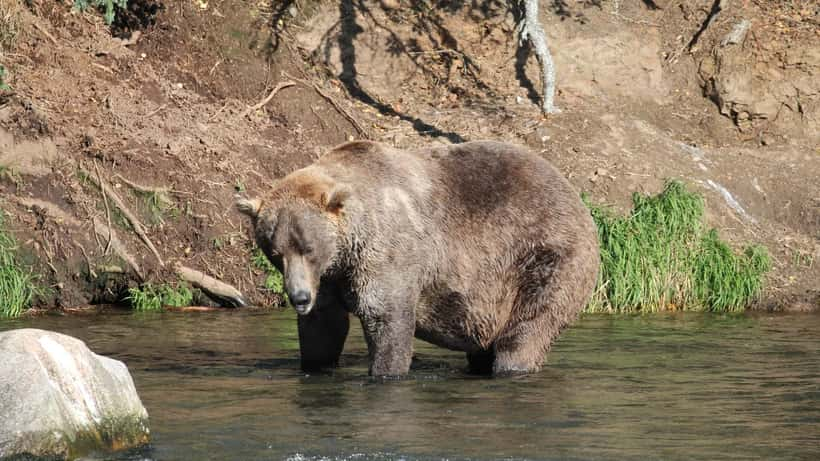
Every September, tens of millions of Americans vote online for the fattest bear on the planet — and this year Fat Bear Week returns to Katmai National Park, Alaska, September 22–29, 2026, with its largest-ever bracket of 16 competing brown bears. Defending champion 32 Chunk, who captured last year's title despite recovering from a broken jaw, and fan favorite 164 Bucky Dent are among the formidable contenders fattening up for glory. But while the internet celebrates these magnificent animals packing on pounds before hibernation, veterinarians across the United States are pointing to a quieter, more urgent story: the same cultural enthusiasm Americans have for chunky bears is making it harder to talk honestly about the obesity crisis in their own pets.
The Bears Are Built for This — Your Pet Is Not
Katmai's brown bears are engineering marvels. During hyperphagia — their biologically programmed pre-hibernation feeding frenzy — they can consume up to 20,000 calories daily and gain approximately three pounds per day, according to the National Park Service. By the time the Fat Bear Week bracket closes on September 29, the winning bear may have added 200 to 400 pounds since early summer. Every ounce of that weight serves a single, precise biological purpose: fueling five to seven months of winter dormancy without a single meal.
This is not what is happening to your Golden Retriever.
According to a 2022 survey by the Association for Pet Obesity Prevention, 59% of U.S. dogs and 60% of U.S. cats are overweight or obese. Unlike bears, domestic pets have no hibernation on the other side of that weight gain — no metabolic program that burns it all off by spring. Instead, those extra pounds compound over months and years into joint disease, type 2 diabetes in cats, shortened lifespans, and chronic pain that animals cannot report.
The 2026 Fat Bear Week bracket, the heaviest in the competition's twelve-year history, is going to produce spectacular images. Veterinarians are using the moment to reframe what viewers actually see.
What Vets See When Fat Bear Week Goes Viral
The "chubby equals healthy equals loved" conflation is the single most common obstacle veterinary professionals report in weight management consultations. When Fat Bear Week images circulate in late September and early October, clinics nationally report clients arriving with overweight animals who genuinely believe the extra weight is endearing rather than medically significant.
The expert response begins with a standardized diagnostic tool that most pet owners have never heard of: the Body Condition Score (BCS). This 9-point scale, recommended by the FDA for routine weight assessment, evaluates three visual and tactile markers — rib visibility, waist definition from above, and abdominal tuck from the side. A BCS of 4 to 5 is ideal for most dogs and cats. A BCS of 7 or above indicates clinical obesity. A BCS of 8 to 9 — the range that might look like a bear contender to an untrained eye — is associated with a measurable reduction in lifespan of up to 2.5 years in dogs, according to a long-term study published by Purina.
The veterinary reaction to Fat Bear Week's cultural moment is not to dismiss the joy of watching bears compete. It is to redirect that same enthusiasm toward a check-in that costs one appointment and potentially adds years to a pet's life.
For context on how weight and health intersect across animal species, our earlier coverage of BLM's 2026 mustang roundups showed how veterinary screening shapes welfare outcomes at population scale. At the household level, the same principles apply one pet at a time.
When Eight Extra Pounds Becomes a Veterinary Emergency: A Concrete Case
Consider the case of a 5-year-old female Labrador Retriever, 78 pounds, brought in for a routine October 2026 checkup the week after Fat Bear Week concludes. Her owner reports that the dog gained about eight pounds since her October 2025 exam but attributes it to "fall eating" — seasonal appetite increase she assumed was normal.
The vet records a BCS of 7/9. The breed standard for an adult female Labrador is 55 to 70 pounds; at 78 pounds this dog is carrying 8 to 23 pounds of excess weight, roughly 11 to 33% above the upper end of her healthy range.
Here is the if/then calculation that changes the conversation:
If this dog had remained at 70 pounds (the upper healthy weight for her breed), her daily caloric maintenance requirement would have been approximately 1,200 calories per day. At 78 pounds, her owner has been feeding her an estimated 1,400 to 1,500 calories daily — an unintentional excess of 200 to 300 calories every single day. Over 365 days, that surplus represents roughly 73,000 to 109,500 excess calories consumed.
Joint load impact: The standard veterinary calculation applies roughly 4× body weight to the force a dog's joints absorb per step. At 70 pounds, that is 280 pounds of joint stress per stride. At 78 pounds, it rises to 312 pounds — an additional 32 pounds of compressive force on hips, knees, and elbows with every step of every walk. Labradors have a genetic predisposition to hip dysplasia; this excess load meaningfully accelerates the onset of clinical arthritis.
Safe weight loss timeline: Dogs should lose no more than 1 to 2% of body weight per week — the clinically safe rate confirmed by the Association for Pet Obesity Prevention. For this 78-pound Labrador, that means 0.78 to 1.56 pounds per week. Reaching 65 pounds (mid-range healthy weight) will require 8 to 17 weeks of consistent dietary change and increased exercise under veterinary supervision.
If the owner waits another full year without acting: at the same rate of gain, the dog reaches 86 pounds by October 2027, pushing her BCS toward 8/9. At that point, the safe weight-loss timeline extends to 4 to 8 months, the joint damage becomes partially irreversible, and the risk of developing clinical diabetes (particularly relevant in dogs fed high-carbohydrate diets) rises meaningfully. An intervention that was simple and short in October 2026 becomes complex, expensive, and less effective in 2027.
This is the math that does not appear in the Fat Bear Week bracket.
Five Actions to Take Before the Final Bear Vote on September 29
Veterinarians recommend using Fat Bear Week as an annual behavioral trigger — the same way New Year's prompts health resolutions for humans — to run a basic weight check on your pet before winter increases their indoor sedentary time.
1. The rib test, right now. Place both hands along your pet's ribcage without pressing hard. Individual ribs should be easily palpable without being visibly prominent. If you must apply firm pressure to locate ribs, or cannot feel them at all, that is a BCS above 5 — worth a vet conversation.
2. The overhead silhouette check. Looking straight down at your dog or cat, you should see a clear waist narrowing behind the last rib. A uniform or widening silhouette from shoulder to hip suggests excess abdominal fat.
3. Book a BCS assessment — not just a vaccine visit. Most annual pet exams focus on vaccinations, parasite prevention, and dental checks. Ask your veterinarian explicitly to calculate a Body Condition Score and a precise daily caloric target matched to your animal's age, breed, sterilization status, and activity level. This takes five minutes and costs nothing beyond the standard exam fee.
4. Switch from estimating to measuring food. An unmeasured scoop of dry kibble can range from 150 to 400 calories depending on cup size and technique. At 300 calories per scoop, three scoops per day for a dog whose target is 900 calories represents a 33% daily caloric surplus. A measuring cup and a food scale are the most impactful tools in pet weight management.
5. Cap treats at 10% of daily calories. A standard medium-sized dog biscuit runs 40 to 100 calories. For a dog whose daily target is 900 calories, that is a budget of 90 calories from treats — roughly one to two biscuits. During Fat Bear Week, when the cultural impulse to celebrate animal heft is at its annual peak, count the treats.
Important: weight loss plans for cats require direct veterinary supervision. Rapid caloric restriction in cats can trigger hepatic lipidosis, a potentially fatal liver condition. Never put a cat on a calorie-restricted plan without professional guidance on rate and duration.
One Expert Visit Can Rewrite the Calculation
What makes the Katmai brown bears worth celebrating is not simply that they are large — it is that every pound is purposeful, precisely calibrated to a biological imperative that has evolved over millions of years. They gain what they need, burn what they gained, and emerge each spring at exactly the right weight to start again.
Your dog and cat have no such self-correcting system. They depend entirely on the choices you make at feeding time, and on the annual exam where a veterinarian translates "a little chubby" into a specific number, a specific risk, and a specific, manageable plan.
As 32 Chunk and 164 Bucky Dent compete for the 2026 crown this week, book the appointment that puts your own animal's weight into the same clear focus — before the bears head into their dens and the problem quietly gets heavier.
