 Grace Lee
Dylan Harper is having one of the most impressive rookie seasons in the NBA this year. The San Antonio Spurs guard — taken in the top-5 of the 2025 draft out of Rutgers University — has scored in double figures in seven consecutive games as April 2026 winds toward the playoffs. Against the Golden State Warriors on April 2, he posted 13 points and 5 assists. Against the Los Angeles Clippers on April 3, he scored 19 points on an outstanding 8-for-12 shooting. He is doing this while coming off the bench for a Spurs team with the second-best record in the league.
What makes Harper's story particularly compelling is not just his basketball ability. It is how he got there — and what it reveals about expert development for young athletes.
The Rutgers Path: Why College Coaching Matters
Harper chose Rutgers University over more prominent basketball programs. Rutgers is not traditionally a basketball powerhouse — but it offers something that top-tier programs often don't: the attention of coaching staff focused entirely on developing their players rather than managing roster politics.
His Rutgers coach, Steve Pikiell, has built a reputation for player development rooted in one-on-one work, detailed film review, and individualized skill programs. Harper arrived at college as a strong athletic prospect. He left as a disciplined, basketball-intelligent player who could execute in complex NBA systems as a rookie.
This pattern — choosing the right expert over the most famous name — is one that applies far beyond professional basketball.
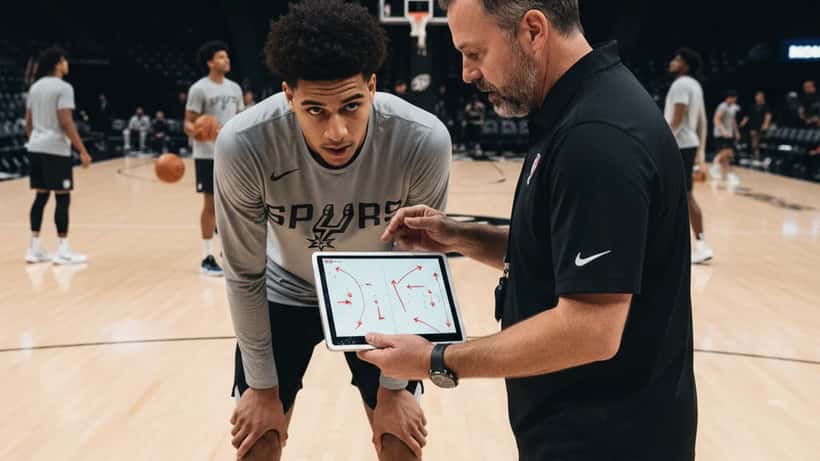
What Expert Coaching Does That Talent Alone Cannot
Young athletes who train under the right coach at the right time frequently outperform more naturally gifted peers who do not receive that focused attention. This is not a sports myth. It is supported by decades of research in skill acquisition and deliberate practice.
The psychologist Anders Ericsson studied elite performers across multiple domains — from chess grandmasters to concert musicians to elite athletes — and consistently found that the quality of coaching during developmental years was the single most reliable predictor of exceptional performance. Raw talent mattered less than expert-guided practice.
For young athletes, expert coaching does several things that self-guided practice cannot:
Identifies non-obvious patterns. A student practicing alone tends to reinforce what they already do well. A skilled coach identifies the inefficiencies that the athlete cannot see — the slight hip rotation that costs power in a swim stroke, the ball-handling habit that telegraphs a pass, the study technique that creates false confidence without retention.
Structures progressive challenge. Learning stalls when difficulty is too low (boredom) or too high (anxiety). Expert tutors and coaches calibrate challenge levels continuously, keeping the learner in the productive zone where real development happens.
Provides honest, specific feedback. Generic praise or criticism has almost no effect on performance. Specific, actionable feedback — "when you pivot left, drop your shoulder earlier" or "reread this paragraph before answering the comprehension question" — produces measurable improvement. Skilled coaches deliver this consistently and without ego.
Creates accountability structures. Young people perform better when someone they respect is watching and measuring. The regularity of coaching sessions creates a cadence of preparation that self-motivated practice rarely sustains over months.
The Academic Side of the Student-Athlete Challenge
Harper's success at Rutgers came while he was balancing a full academic schedule. The NCAA requires all Division I athletes to maintain academic eligibility — which means maintaining grade point averages, completing required coursework, and often managing extraordinarily demanding schedules during basketball season.
This is where academic tutoring intersects directly with athletic development. Young athletes who fall behind academically face restrictions on practice time, eligibility risks, and the kind of mental burden that compromises athletic performance. Many elite programs now invest heavily in academic support structures specifically because they recognize the connection between classroom success and on-court results.
According to the U.S. Department of Education, student-athletes who receive structured academic support during high school are significantly more likely to maintain eligibility and graduate within four years. The support does not need to come from a full-time athletic department — private tutoring from qualified specialists produces comparable outcomes.
Applying the Harper Model at the Youth Level
Most young athletes will not be drafted in the top-5 of the NBA Draft. But the developmental principles that shaped Dylan Harper's trajectory apply at every level of play — and far beyond sports.
Choose coaches and tutors for their method, not their résumé. A coach who played professionally is not automatically a better teacher than one who did not. What matters is whether they have a systematic approach to identifying weaknesses, designing practice, and delivering feedback. Ask to observe a session before committing.
Invest in specialization early in skill, not early in competition. Young athletes who develop strong fundamental skills in a low-pressure environment consistently outperform those who are pushed into high-stakes competition before their technique is solid. The same logic applies to academic subjects — a student who understands mathematical reasoning will adapt to different problem formats; one who has memorized answers will not.
Use academic tutoring as a complement to athletic development, not a fallback. The best young athletes treat academic excellence as part of their athlete identity, not as an obligation that competes with training. A private tutor who understands the demands of an athlete's schedule can structure sessions that are efficient and high-impact.
ExpertZoom connects young athletes and their families with qualified tutors and academic coaches across the U.S. who understand the specific challenges of student-athletes — from managing training schedules and academic load to preparing for college eligibility requirements.
Dylan Harper's April 2026 scoring streak is the result of years of intentional development. The same intentionality — applied to academic support and skill-specific coaching — is available to young athletes at every level. The question is whether families treat it as a priority or wait until a crisis forces the issue.
Note: This article references publicly reported statistics from NBA game logs for the 2025-26 season. For full player statistics, see official NBA records.
