 Cora Nelson
Milwaukee Brewers shortstop Cooper Pratt, 22, was placed on the 10-day injured list on August 9, 2026, after an MRI confirmed a right hamstring strain suffered during a game against the Minnesota Twins. He had been one of Milwaukee's most exciting young players — hitting .272/.352/.368 with a 102 wRC+ across 44 games since his June debut — but now he's rehabbing with High-A Wisconsin, targeting a late-August return as the Brewers chase a Wild Card berth.
What the fantasy baseball headlines skip over is the clinical reality behind his timeline: the same muscle, the same injury mechanism, and the same dangerous window for premature return affect millions of recreational athletes in the United States every year. A sports medicine specialist looking at Pratt's situation would recognize an all-too-common story — and would have the same warning for the weekend runner who "feels fine" four days after pulling their hamstring.
Behind the Numbers: What Pratt's Injury Actually Means
When the Brewers announced a hamstring strain and a 10-day IL stint, they were describing a grade I or mild grade II tear — the most common hamstring injury in professional baseball. An MRI was performed the night of August 9, and the results shaped the conservative decision to pull Pratt from the roster immediately rather than attempt to manage him game-to-game.
That decision reflects everything sports medicine practitioners know about the danger zone for this injury. Grade I strains — micro-tears in the muscle fibers — typically resolve in one to three weeks with structured management. Grade II, involving a partial tear of the muscle belly, requires three to six weeks of progressive rehabilitation before the tissue has the tensile strength to withstand full-speed acceleration and deceleration.
Pratt signed an eight-year, $50 million extension with Milwaukee earlier this season. That contract makes cautious hamstring management not just a medical imperative but a financial one. Every day of premature loading risks a re-injury that, according to published sports medicine data, occurs at rates as high as 34% within the first year when athletes return before tissue repair is complete.
What a Sports Medicine Expert Would Say Right Now
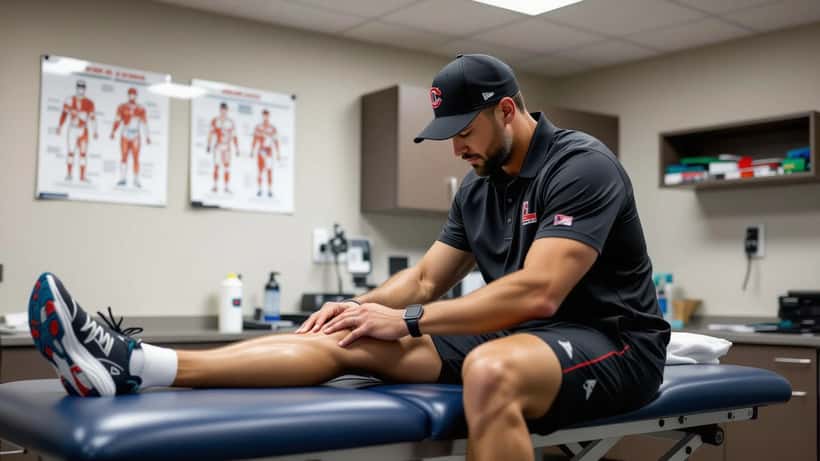
A sports medicine physician evaluating any hamstring strain — from a major league shortstop to a recreational runner — would apply the same framework in the first 72 hours: RICE (rest, ice, compression, elevation) to limit hemorrhage and secondary inflammation, followed by clinical grading of the injury, and then a structured return-to-activity protocol built on eccentric loading.
The specific exercises matter. Nordic hamstring curls — slow, controlled lengthening movements under load — are the most evidence-backed rehabilitation tool for hamstring strains, with multiple randomized controlled trials showing they reduce both recovery time and re-injury risk compared to rest-only approaches. They typically begin around day 5–7 for grade I injuries and week 2–3 for grade II, progressing in intensity as pain and range of motion improve.
The most critical window is weeks two through three of recovery. This is when athletes feel well enough to push — pain has dropped to a 2 or 3 out of 10, range of motion has mostly returned — but the structural repair inside the muscle has not finished. The scar tissue that initially bridges the tear is mechanically weaker than the original muscle fiber. Asking it to handle sprint-speed forces before it matures is exactly how a two-week injury becomes a six-week one.
Pratt has a full Brewers medical staff managing every variable. Most people who strain their hamstrings this summer do not.
The Concrete Case: When "It's Probably Fine" Becomes an Eight-Week Problem
Here is the scenario that plays out in orthopedic and urgent care clinics across the country every August.
A 35-year-old recreational runner — active, healthy, training for a fall half-marathon — pulls her left hamstring at mile 5 of a long run. She feels a sharp pull in the back of her thigh, slows to a walk, and finishes the last half mile carefully. It hurts at a 5 out of 10. She ices it at home, takes ibuprofen, and by day 3 the pain is down to a 2. She can walk without a limp. She assumes it was minor.
She runs again on day 8.
At mile 2, the same hamstring tears — this time more extensively. A subsequent MRI confirms a grade II partial tear. Her recovery window has jumped from two to three weeks to five to six weeks. She will miss her target fall race and carry elevated re-injury risk through the following spring.
If/then benchmark: if you feel a sharp, sudden pain in the posterior thigh during a high-intensity effort AND pain remains above a 3 out of 10 when walking 24 hours after the incident, you are looking at a grade I or II hamstring strain — the same clinical category Cooper Pratt is managing right now. A specialist evaluation within 72 hours costs roughly $150–$300 with most insurance plans and is the only way to establish the actual tear grade and build a safe return protocol. Without that assessment, returning to activity is a guess — and the average cost of guessing wrong is four additional weeks of downtime, not two.
The rule Pratt's medical team is following is the same one any sports medicine or musculoskeletal specialist would apply to your situation: match return timing to tissue integrity, not to how the injury feels.
Five Warning Signs That Mean "See a Specialist Today"
Not every hamstring strain requires immediate imaging. But certain clinical presentations indicate that rest-and-hope is not enough:
An audible pop or snap at the moment of injury. This is a consistent indicator of grade II or III involvement. Grade I micro-tears are typically silent.
Significant bruising in the back of the thigh within 24 hours. Blood tracking visibly under the skin suggests internal hemorrhage consistent with a structural tear, not minor micro-damage.
Inability to walk normally after 24 hours. A persistent limp the day after injury is inconsistent with grade I. You need grading, not just rest.
Pain localized at the sitting bone (ischial tuberosity). High hamstring strains — proximal avulsions or insertional tears near the pelvis — are frequently mismanaged as lower-grade mid-belly injuries. They require distinct rehabilitation and sometimes surgical consultation.
Prior hamstring injury on the same leg. Scar tissue from a previous strain alters the mechanical behavior of the muscle. A "mild-feeling" injury on a previously torn hamstring can behave clinically like a moderate one — and recovery timelines shift accordingly.
If any of these apply, the appropriate next step is not another 48 hours of ice. It is a same-week appointment with a sports medicine physician or orthopedic specialist.
Why Early Intervention Changes Everything
The American healthcare system makes delayed treatment easy to rationalize. Specialist appointments can take weeks, urgent care visits feel like overkill for a muscle pull, and insurance navigation is its own project. When pain is tolerable, the temptation is to wait and see.
The clinical data argues otherwise. According to the National Library of Medicine's MedlinePlus resource on hamstring injuries, most grade I strains resolve with structured home management. Grade II injuries consistently benefit from supervised physical therapy, and early intervention — within the first five days of injury — shortens total recovery time and reduces re-injury rates. For a recreational athlete with a fall race or a return-to-sport deadline, those extra days matter.
Cooper Pratt will almost certainly be back on a major league diamond before the end of August. He has advantages most athletes do not: daily physiotherapy, on-site imaging, and a medical staff whose entire job is optimizing his return. What he does not have that the rest of us do is a choice about whether to take the injury seriously — the Brewers made that call for him on August 9.
For the weekend soccer player, the morning runner, or the recreational softball catcher who felt something pop last week and has been convincing themselves it is fine: you have the same choice to make. Getting the grade right now saves you from a worse injury in two weeks.
This article is for informational purposes only and does not constitute medical advice. If you believe you have sustained a musculoskeletal injury, consult a licensed healthcare provider for a proper diagnosis and treatment plan.
