 Charles Jackson
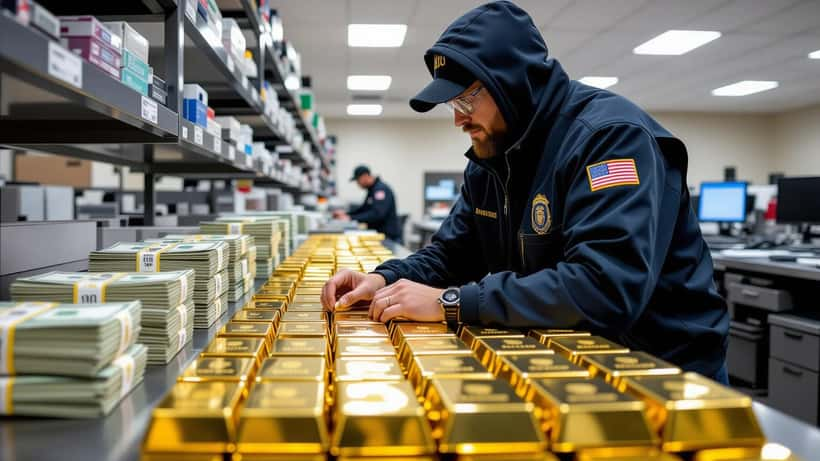
A former senior CIA officer faces federal prosecution after FBI agents discovered 303 one-kilogram gold bars — worth more than $40 million — stashed inside his Ashburn, Virginia home in May 2026. As of October 7, 2026, the U.S. Attorney's Office for the Eastern District of Virginia and David J. Rush's defense counsel are racing to finalize a plea deal before a court-imposed October 8 indictment deadline, with both sides eager to avoid a trial that could expose classified intelligence operations.
The case has gripped federal employees and legal observers across the country: how does a government official accumulate tens of millions in gold bars and luxury watches — and what are your legal rights when the FBI comes knocking at your door?
The Charges: Far More Than Just Gold Bars
While the gold bars grabbed national headlines, Rush's formal charges center on salary fraud. Federal prosecutors allege he falsely claimed 744 hours of military leave on government timecards after being honorably discharged from the Navy in 2015. He also allegedly inflated his CIA pay grade by listing false degrees from Clemson University and Rensselaer Polytechnic Institute on federal employment forms — credentials investigators say he never earned.
The 303 gold bars, approximately $2 million in cash, and more than 30 luxury Rolex watches were seized under a separate federal theft-of-public-money charge. According to the FBI affidavit, Rush requested the gold through official CIA channels for purported work-related expenses between November 2025 and March 2026, then kept the assets for personal use. Some of the gold was found in a storage space near his CIA office; the rest was recovered at his residential property.
The potential charges span multiple federal statutes: 18 U.S.C. § 641 (theft of government property), salary fraud, and making false statements on federal employment applications — each carrying separate sentencing exposure.
Why Federal Salary Fraud Is More Serious Than Most People Realize
The Rush case is extreme in scale, but federal salary fraud — inflating credentials to secure a higher pay grade, claiming hours not worked, or manipulating benefit calculations — is more prevalent in federal employment than most Americans recognize.
According to the Government Accountability Office, improper payments in federal programs exceeded $236 billion in fiscal year 2023, a category that includes salary overpayments, fraudulent claims, and credential misrepresentation. The U.S. Office of Personnel Management investigates thousands of credential-verification complaints annually.
What makes federal salary fraud especially serious is that it generates both criminal and civil exposure simultaneously:
- Criminal penalties under 18 U.S.C. § 641 can reach 10 years in federal prison per count for thefts exceeding $1,000
- Civil penalties under the False Claims Act allow the government to recover three times the amount fraudulently obtained
- Career consequences include automatic termination, lifetime federal employment bars, and revocation of security clearances
Unlike state-level employment disputes, federal salary fraud cases are prosecuted with the full resources of a U.S. Attorney's Office. According to data from the U.S. Sentencing Commission, federal conviction rates across all offense types historically exceed 90% — making early legal intervention, not reactive defense, the only realistic strategy.
What If You Were in David Rush's Position?
Consider a less dramatic but legally identical situation: Marcus is a 48-year-old federal IT contractor in Northern Virginia who, in 2020, listed a false Project Management Professional (PMP) certification when accepting a GS-13 position. That credential bumped his annual salary from $95,000 (GS-12 Step 5) to $112,000 (GS-13 Step 1). He has continued working at that grade for six years, never correcting the record.
In September 2026, his agency's inspector general opens an investigation after a routine HR audit flags a credential discrepancy.
Scenario A — No lawyer, no early action: Marcus believes the matter is administrative and waits until he receives a formal target letter before consulting an attorney. By then, federal investigators have already gathered six years of timecards, email records, and HR files. Here is what his exposure looks like:
- Salary differential over 6 years: approximately $102,000 above GS-12 rate
- Civil liability under the False Claims Act: $102,000 × 3 (treble damages) = $306,000
- Criminal exposure: up to 10 years per count; sentencing guidelines suggest 12–18 months for first-time offenders at this scale
- He loses his job, his security clearance, and his federal pension eligibility
- Total financial exposure: $306,000 in civil damages + $85,000 in forfeited pension value = $391,000 out-of-pocket, plus potential prison time
Scenario B — Defense attorney engaged within 30 days of investigation opening: A federal criminal defense attorney contacts the U.S. Attorney's Office before charges are filed, proactively negotiates a deferred prosecution agreement, and facilitates voluntary repayment of the salary differential. Here is the outcome:
- Civil liability: $102,000 repaid as part of the deferred agreement (no trebling applies under a pre-charge settlement)
- No criminal charges filed; prosecution deferred pending two years of compliance
- Marcus is demoted to GS-12 but retains federal employment and pension eligibility
- Legal fees: approximately $15,000–$25,000
- Total financial cost: $127,000, versus $391,000 — a $264,000 difference
The Rush case shows this same math at a staggering scale. The tentative plea deal almost certainly eliminates the risk of a multi-year classified-material trial, potentially reducing a sentence of 10 or more years to supervised release in exchange for cooperation and asset forfeiture — an outcome that would be nearly impossible to negotiate without sophisticated federal criminal defense counsel engaged before the indictment clock expired.
What Federal Employees and Contractors Must Understand
The Rush case carries specific relevance for the 2.9 million civilian federal employees and 3.5 million federal contractor personnel currently working across the United States.
Your rights when you become the subject of a federal investigation:
Remain silent in agency HR proceedings. Many federal employees unknowingly waive Fifth Amendment rights by cooperating with agency HR investigators without realizing those statements can be referred to parallel criminal proceedings. You are not legally required to speak without counsel present.
Inspector General interviews are not routine HR conversations. An IG investigator is a federal law enforcement officer. You have the right to request that an attorney be present before any IG interview takes place. Treating that meeting as a casual HR discussion is one of the most consequential mistakes federal employees make.
The False Claims Act voluntary disclosure window matters enormously. If you come forward before the government opens a formal investigation, civil penalties can be dramatically reduced or waived entirely. Once an investigation is opened, that window closes — permanently.
Security clearance holders face compounding jeopardy. A federal criminal charge, even absent a conviction, triggers a clearance suspension under Guideline J (criminal conduct) and Guideline E (personal conduct) of the National Security Adjudicative Guidelines. Loss of a clearance often means loss of the job, the income stream, and — for contractors — the entire career.
When to Consult a Federal Criminal Defense Lawyer
The David Rush case will be resolved in the next 24 hours. For anyone who suspects they may be under federal scrutiny — regardless of the amounts involved — the calculus is straightforward: the earlier a federal criminal defense attorney is engaged, the more options remain available.
Key warning signs that warrant immediate consultation:
- You receive a letter identifying you as a "subject" or "target" of a federal grand jury investigation
- FBI or federal agents contact you for a "voluntary" interview
- Your agency's Office of Inspector General schedules an interview
- A federal audit is reviewing your salary history, credentials, or expense claims
- Colleagues are being asked about your work history or qualifications
A federal defense attorney can assess your actual exposure, engage with prosecutors before charges are formally filed, negotiate deferred prosecution or plea agreements, and — in cases involving classified information — manage the extraordinary complexity of a national security prosecution.
Whether the discrepancy involves 303 gold bars worth $40 million or a pay grade inflated by a single certification claim, the federal criminal process operates on a timeline that favors the government. Expert legal guidance, engaged early, remains the most effective way to change that equation.
This article is for informational purposes only and does not constitute legal advice. If you believe you may be the subject of a federal investigation, consult a licensed federal criminal defense attorney immediately.
