 Emily Wang
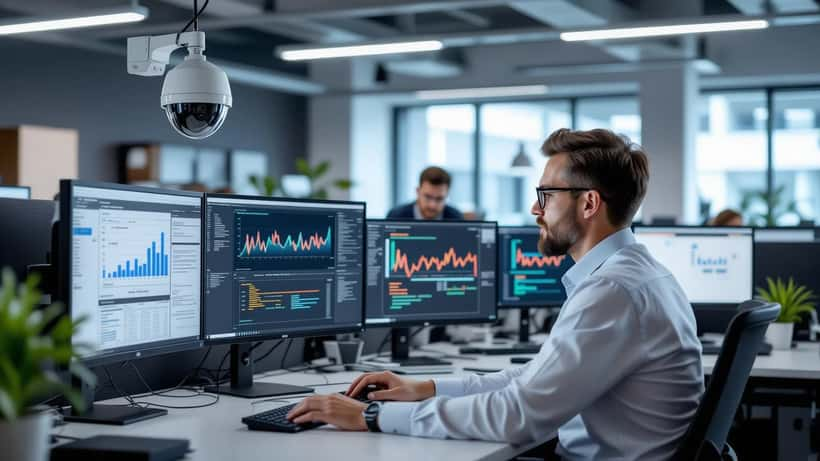
Every August, millions of Americans tune into CBS's Big Brother, obsessing over who's watching whom inside the house. But in 2026, the real surveillance drama isn't playing out on television — it's unfolding in offices, warehouses, and remote workstations across the country. Employers are watching workers more closely than ever, and most employees have no idea what their rights actually are.
The Surveillance Boom: What's Happening in American Workplaces
The numbers tell a jarring story. According to workforce analytics research compiled in 2026, 74% of U.S. employers now actively monitor employees — and 78% use online monitoring tools including real-time screen capture, keystroke logging, and web browsing logs. Perhaps most striking: only 22% of employees know they are being monitored, according to data from WorkTime, even as nearly three in four employers are doing exactly that.
Remote work normalized surveillance. What began as a pandemic-era response — managers wanting to verify that home-based workers were actually working — has calcified into permanent policy at companies like Amazon, Wells Fargo, and Barclays, all of which have faced public scrutiny over their monitoring practices in recent years. In Amazon's warehouse network, productivity is tracked by the minute, with workers reporting that extended breaks trigger algorithmic alerts.
The 2026 landscape has added a troubling new layer: AI behavioral analysis. According to Hubstaff's 2026 employee monitoring report, 61% of U.S. companies now use AI-powered analytics to measure employee productivity or behavior — software that analyzes Slack messages, email patterns, and video call sentiment before any human manager reviews the data. Vendors like Teramind, ActivTrak, and Hubstaff market these tools directly to small businesses, not just large enterprises. The barrier to entry for continuous employee surveillance has never been lower.
And the consequences are real: 56% of employees report stress and anxiety caused by workplace surveillance, and 49% say they would consider leaving if their employer increased monitoring, according to the same research.
Why This Matters for Your Legal Rights
Here's what most workers don't know: federal law offers almost no protection against employer surveillance of company devices. The Electronic Communications Privacy Act of 1986 — passed before the smartphone existed — generally permits employers to monitor communications on their own systems. The key phrase is "reasonable expectation of privacy," and courts have consistently ruled that employees have very little of it when using employer-owned equipment.
However, several layers of state law create critical exceptions. As of 2026, only three states have statutes specifically requiring employers to notify employees of electronic monitoring:
- Connecticut (Conn. Gen. Stat. § 31-48d): Employers must give prior written notice describing the types of monitoring and post it in a conspicuous workplace location. A 2026 amendment adds a plain-language statement requirement for employees hired after October 1, 2026. Penalties run $500 for a first offense, $1,000 for a second, and $3,000 for subsequent violations.
- Delaware: Employers must provide written notice before monitoring email, internet access, or telephone usage, and obtain acknowledgment from each employee. Violations carry civil penalties up to $100 per incident.
- New York (SB S2628): Employers must provide written notice upon hire and display it conspicuously when monitoring phone calls, email, or internet activity.
Beyond these three, California (Labor Code § 980) prohibits employers from requiring access to personal social media accounts and applies the state's broad constitutional privacy protections to some workplace contexts. New York City (Local Law 144, effective 2023) requires employers using automated employment decision tools to conduct bias audits and notify affected employees — with fines beginning at $500 per day for non-compliance.
The National Labor Relations Act (NLRA) applies everywhere: monitoring specifically designed to surveil union organizing activity — reading protected communications about wages or collective action — is illegal regardless of state law.
The patchwork is so complex that even employment law specialists regularly encounter edge cases. A worker in Texas has dramatically fewer protections than an identical worker in San Francisco doing the same job for the same company.
A Real-World Monitoring Dispute: What Actually Happens
Here's a specific scenario that employment attorneys are seeing with increasing frequency in 2026.
Marcus is a project manager at a logistics company in Columbus, Ohio, working remotely three days a week. In March 2026, his employer rolled out ActivTrak monitoring software on all company laptops — capturing screenshots every 10 minutes and measuring "active time" versus "idle time." Marcus was not notified. Last month, he received a performance improvement plan (PIP) stating his average activity score was 54%, well below the company's 70% threshold, despite consistently delivering projects on time and under budget.
If Marcus is in Ohio — where there is no state notification law — here's what the law actually says:
The monitoring itself is almost certainly legal under federal law, provided it runs on company equipment. However, three issues create real legal exposure for the employer:
Disclosure gap: If Marcus's employment agreement or handbook makes no mention of monitoring software, he may argue the PIP contradicts the performance standards he was explicitly hired under. Courts in the Sixth Circuit have found that material changes to performance evaluation criteria without notice can constitute a breach of the implied covenant of good faith.
Disparate impact: If the 54% activity threshold disproportionately flags employees with documented disabilities (ADHD, chronic pain conditions that require movement breaks, anxiety disorders requiring brief resets) at a higher rate than neurotypical employees, the employer may face an ADA disparate impact claim. Under the ADA, an employer must provide a reasonable accommodation before acting on productivity data that the disability itself affects.
Retaliation risk: If Marcus recently complained to HR about anything — overtime pay, a safety concern, or a colleague's conduct — and the PIP follows within 90 days, employment attorneys will evaluate it as potential retaliation under FLSA, OSHA, or Title VII depending on the underlying complaint.
The practical stakes: corrective action based on flawed algorithmic scoring, when successfully challenged, has resulted in settlements ranging from reinstatement with back pay to negotiated severance. The employer's cost to litigate such a claim to summary judgment often exceeds the cost of a reasonable settlement — which is why demand letters in these cases frequently produce results. Marcus's first move should be preserving all project deliverables, client communications, and performance records that exist independently of the monitoring software's dashboard.
What You Should Do Starting Today
Whether you're an employee suspicious of monitoring or an employer trying to stay compliant, the legal landscape is jurisdiction-specific enough that generic advice has real limits. Here's a grounded starting point:
For employees:
- Review your employment contract and all onboarding documents for any reference to "electronic monitoring," "network usage," or "company systems." Consent buried in a 40-page handbook still counts in most states.
- Never use company devices for personal banking, healthcare portals, or other sensitive logins — monitoring software doesn't distinguish between work activity and personal data.
- If you're in Connecticut, Delaware, or New York, you have the right to written disclosure of any monitoring in use. Request it in writing if you haven't received it.
- Build your own record of work output — saved deliverables, timestamped emails, completed task logs — separate from any employer dashboard. Algorithmic productivity scores are not the only measure of performance, and courts recognize that.
- If monitoring seems to target protected activity (disability, union organizing, a recent complaint), consult an employment attorney before the situation escalates. Evidence preservation in the first few days matters enormously.
For employers:
- A written, signed monitoring policy with employee acknowledgment is your primary legal protection. Update it annually as state laws evolve.
- Before deploying AI behavioral tools, audit the thresholds for disparate impact across demographic groups. The EEOC's 2026 guidance on algorithmic employment decisions signals increasing federal scrutiny.
- Consult an employment attorney before monitoring personal devices, even under a BYOD policy. The exposure is significant and widely underestimated by HR teams working from generic templates.
The laws governing workplace surveillance are evolving faster than most HR departments can track. The National Labor Relations Board's guide to employee rights provides a federal baseline on NLRA protections — though state law almost always offers broader protections that matter more in practice.
If you're an employee facing a PIP or termination based on monitoring data, or an employer building a compliant surveillance policy, consulting an employment attorney on Expert Zoom can clarify your specific exposure and options under your state's rules.
Note: This article provides general legal information, not legal advice. Employment law varies significantly by state and individual circumstance. Consult a licensed attorney for guidance specific to your situation.
