 Evelyn Carter
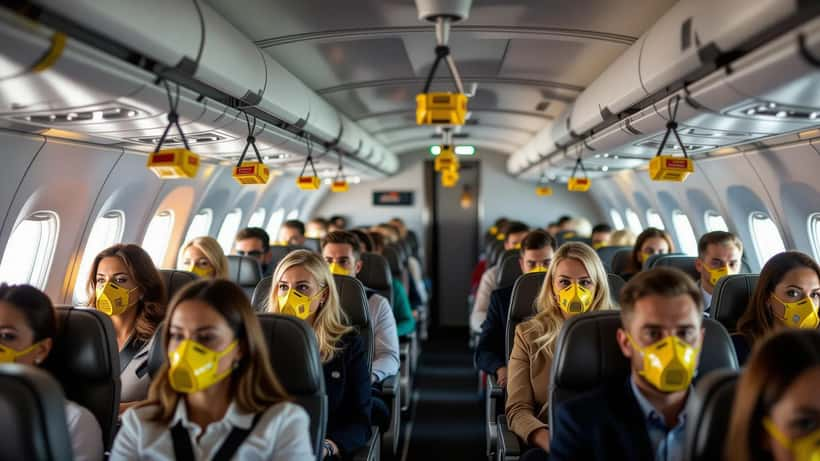
When a Ryanair Boeing 737 flying from Thessaloniki, Greece, to Memmingen, Germany, lost a cabin window on July 17, 2026, a 61-year-old passenger was partially pulled through the opening and held back only by his seatbelt and the hands of nearby travelers. Oxygen masks dropped, the aircraft descended fast, and the crew limped back to Thessaloniki on a single engine. The U.S. National Transportation Safety Board is now leading the probe. For the millions of Americans boarding flights this summer, the frightening incident raises a practical question that has nothing to do with fault or blame: what actually happens to your body when cabin pressure disappears in seconds — and how do you know when a rough flight has left you needing a doctor?
What rapid decompression does to the body
Modern jets cruise near 35,000 feet, where the outside air holds far too little oxygen to keep a person conscious. Cabins are pressurized to feel like roughly 6,000 to 8,000 feet — breathable, if a little thin. When a window or door seal fails, that artificial atmosphere vents into the sky almost instantly. The Federal Aviation Administration warns that at cruising altitude a person has only a short window — often 15 to 30 seconds of "time of useful consciousness" — before hypoxia clouds judgment and coordination. That is precisely why crews drill passengers to fix their own oxygen mask before helping others.
Hypoxia, or oxygen starvation, is the first and most dangerous threat. Early signs include lightheadedness, tingling fingers, a bluish tint to the lips or nails, confusion, and a strange sense of euphoria that can stop victims from reaching for the mask that would save them. Because the brain is affected first, people experiencing hypoxia often do not realize how impaired they are.
The pressure injuries most passengers overlook
Even travelers who keep their oxygen and never leave their seat can be hurt by the pressure swing itself. Doctors call it barotrauma — tissue damage caused when trapped air in the body expands or contracts faster than it can escape.
The ears are the most common casualty. A sudden pressure drop can rupture an eardrum, leaving ringing, muffled hearing, sharp pain, or even bleeding. The sinuses can be forced in the same way, producing intense facial pain. Gas in the stomach and intestines expands too, and in rare cases air can be pushed into the lungs' delicate tissue. Passengers with recent surgery, a chest cold, or a scuba dive in the previous 24 hours face higher risk because they already carry trapped gas.
Then there is the blunt trauma. The man on the Ryanair flight suffered severe neck and arm injuries from being wrenched against the fuselage, his wife told reporters. Flying debris, a violent descent, and the scramble of an emergency can throw unbelted passengers into seats and bulkheads — the reason cabin crews insist on keeping belts fastened even when the sign is off.
Warning signs you should never wave off
A frightening flight does not automatically mean injury. But some symptoms deserve prompt medical attention rather than a "wait and see" drive home. According to guidance from aviation-medicine specialists, watch for:
- Persistent ear pain, drainage, or sudden hearing loss — possible ruptured eardrum.
- Shortness of breath, chest pain, or coughing up blood after the flight — possible lung barotrauma.
- Ongoing dizziness, confusion, severe headache, or fainting — signs the brain may not have gotten enough oxygen.
- Neck, back, or joint pain following a jolt, especially with numbness or weakness.
- Vision changes or a spreading bruise that appears hours later.
Symptoms of decompression injury can be delayed. A traveler may feel shaky but "fine" at the gate and then develop hearing problems or breathing trouble that evening. When in doubt, an in-person exam beats guesswork.
When to consult a specialist
For most nervous flyers, a same-day telehealth call or a visit to a primary-care doctor is enough to rule out an eardrum injury or lingering hypoxia. But specific complaints route to specific experts. An ear, nose, and throat physician evaluates suspected eardrum and sinus damage and can test whether hearing loss is temporary or permanent. A pulmonologist assesses breathing complaints and any suspected air leak in the chest. Persistent neurological symptoms — memory gaps, coordination problems, or severe headaches — warrant a neurologist. Passengers with heart or lung conditions should ask their own physician before their next flight whether they need supplemental precautions.
If you are unsure which type of expert fits your symptoms, a general medical consultant can review your history and point you to the right specialty before you spend time and money in the wrong waiting room. Describing the exact sequence — the bang, the mask, the descent, and what you felt afterward — helps any clinician gauge how much force your body absorbed.
The bigger picture for summer travelers
Events like the July 17 window failure are extraordinarily rare, and NTSB investigators will spend months determining exactly how engine debris reached the cabin window, as Ryanair executives have suggested. Air travel remains one of the safest ways to move, and modern aircraft are built with redundant pressurization systems precisely to prevent these scenarios.
Still, the incident is a useful reminder that the human body is finely tuned to sea-level pressure. Keeping your seatbelt fastened low and tight, following crew oxygen instructions without hesitation, and equalizing your ears during climb and descent are simple habits that protect you far more than luck. And if a flight leaves you with more than frazzled nerves — a ringing ear, a tight chest, a pounding head that will not fade — treat it as a medical event worth checking, not a story to shrug off.
This article is for general information only and is not a substitute for professional medical advice. If you experience serious symptoms after a flight, seek care from a qualified healthcare provider without delay.
For related coverage of aircraft window failures and what investigators look for, see our report on the Ryanair window crack mid-flight investigation. Official guidance on hypoxia and cabin oxygen is published by the Federal Aviation Administration.
