
Rhode Island may be the smallest state in the Union, but its employment law framework is among the most protective in New England. With a $15.00 minimum wage, mandatory paid sick leave for most workers, and strict rules on overtime and final paychecks, Rhode Island sets clear expectations for both employers and employees. Yet many workers don't realize they have stronger protections than federal law provides — and many employers inadvertently expose themselves to penalties by following only federal minimums.
This dossier covers the six areas of Rhode Island labor law that generate the most wage claims, HR disputes, and employment litigation: overtime calculation, final paycheck timing, non-compete enforceability, meal and rest breaks, paid sick leave, and the state's current minimum wage schedule. Each section draws on the Rhode Island General Laws, Department of Labor and Training (DLT) guidance, and 2026 enforcement data.
Rhode Island's Labor Law Framework: Who Administers It and Why It Matters
Rhode Island's labor law system operates on two tracks. The Rhode Island Department of Labor and Training (DLT) enforces wage and hour rules, including minimum wage, overtime, and final paycheck requirements, under Rhode Island General Laws (RIGL) Title 28. The Rhode Island Commission for Human Rights (RICHR) handles discrimination, harassment, and retaliation claims. When an employer violates either set of rules, workers may recover back wages, liquidated damages equal to the unpaid amount, and attorney's fees — a meaningful deterrent that makes compliance the cheaper option.
Rhode Island is also an "at-will" employment state under RIGL § 28-14-4, meaning most workers can be terminated without cause. However, that doctrine has significant carve-outs: termination for exercising protected rights (taking sick leave, filing a wage complaint, participating in a union) is illegal. Understanding where at-will employment ends and legal protection begins is central to navigating this dossier.
The laws discussed here apply to private-sector employers operating in Rhode Island unless otherwise specified. Certain industries — hospitality, healthcare, and retail — face additional sector-specific rules not covered in this overview. State and municipal employers are governed by RIGL Title 36 and collective bargaining agreements, which are beyond this dossier's scope.
À retenir: Rhode Island DLT enforces most wage-and-hour violations with a 2-year statute of limitations (3 years for willful violations). Filing a wage claim is free and does not require an attorney.
Overtime and Wages: Rhode Island Goes Beyond Federal Minimums
Rhode Island follows the federal overtime standard — 1.5 times the regular rate for all hours worked beyond 40 in a single workweek — but the state has its own minimum wage floor that exceeds the federal $7.25. As of January 1, 2025, the Rhode Island minimum wage stands at $15.00 per hour under RIGL § 28-12-3. The state legislature has approved further increases through 2026, making Rhode Island's base wage among the highest in the Northeast outside Massachusetts and Connecticut.
For tipped employees, the tip credit rules are particularly important. Rhode Island allows employers to pay a subminimum cash wage of $3.89 per hour, provided tips bring the total hourly compensation to at least $15.00. If tips fall short, the employer must make up the difference — a rule the DLT enforces aggressively in the restaurant and hospitality sectors.
Overtime exemptions mirror federal Fair Labor Standards Act (FLSA) categories: executive, administrative, and professional employees earning above the federal salary threshold of $684/week are generally exempt. However, Rhode Island does not have a higher state-level salary threshold, so the federal floor applies. Misclassification of employees as exempt is the most common overtime violation DLT investigators encounter.

Rhode Island Overtime Laws: The Complete 2026 Guide for Workers and Employers
15 minFinal Paychecks and Non-Compete Clauses: The Exit Conditions Every RI Worker Should Know
When employment ends — whether by resignation, termination, or layoff — Rhode Island law determines exactly when the final paycheck must arrive and whether a non-compete agreement can legally restrict the worker's next job.
Under RIGL § 28-14-4, Rhode Island employers must deliver the final paycheck by the next regular payday after separation, regardless of whether the employee quit or was fired. Unlike states such as California, which mandate same-day payment for terminated employees, Rhode Island uses a single standard tied to the payroll schedule. Failure to pay on time triggers a civil penalty of up to $50 per day per affected employee, in addition to the unpaid wages themselves.
Non-compete agreements present a more contested landscape. Rhode Island has not enacted a blanket ban, but courts apply a three-part reasonableness test: the restriction must protect a legitimate business interest, be no broader than necessary, and not impose an undue hardship on the employee. A 2022 Rhode Island Superior Court ruling in Baker Industries v. Crespo reaffirmed that courts will blue-pencil — rewrite — overly broad non-compete clauses rather than void them entirely. Workers in the healthcare, financial services, and technology sectors should review any non-compete before signing, as enforceability varies significantly by role and duration.

Rhode Island Non-Compete Agreements: RI vs. New England State Comparison 2026
7 min
Paid Sick Leave and Break Requirements: Rhode Island's Worker Protections
Rhode Island's Healthy and Safe Families and Workplaces Act, enacted in 2017 and effective January 1, 2018, established mandatory paid sick and safe leave for employees of businesses with 18 or more workers. Covered employees accrue one hour of paid leave for every 35 hours worked, up to a maximum of 40 hours per calendar year. Workers may use this leave for their own illness, the illness of a family member, or to address domestic violence, sexual assault, or stalking — the "safe" component of the law.
Employers with fewer than 18 employees must still provide sick leave, but it may be unpaid. All covered employers must display the DLT's official sick leave poster and provide a written notice to employees at time of hire. Retaliation against an employee for using or requesting sick leave is prohibited under RIGL § 28-57-12 and can result in triple damages plus attorney's fees.
On breaks: Rhode Island mandates a 20-minute meal period for any employee working a shift of six hours or more, under RIGL § 28-3-14. The state does not separately mandate short rest breaks, though federal OSHA guidance recommends them and the FLSA requires that any break of 20 minutes or less be paid. Rhode Island's meal break rule applies to most private-sector employees; retail establishments are subject to additional Sunday work rules.

Rhode Island Sick Leave Law: 9 Questions Workers and HR Managers Ask Most
5 min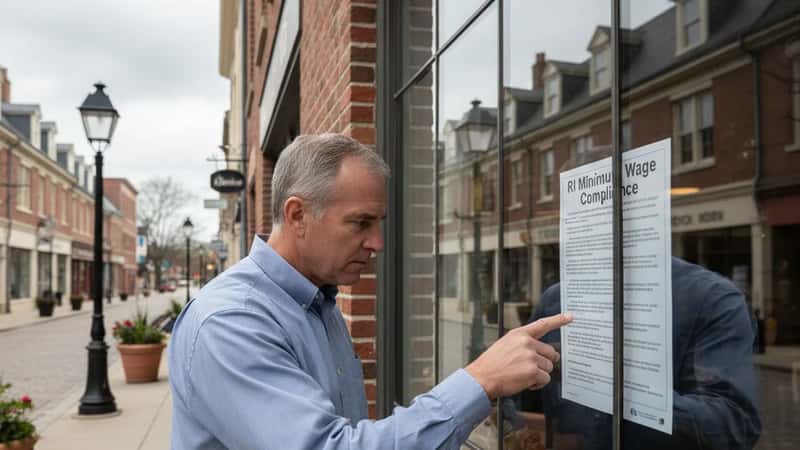
Rhode Island's Minimum Wage in 2026: Where It Stands and What's Next
Rhode Island has steadily increased its minimum wage through legislated annual steps. After reaching $15.00 per hour on January 1, 2025, the state's wage schedule under RIGL § 28-12-3 provides for additional increases indexed to the Consumer Price Index (CPI) starting in 2026. The Rhode Island Department of Labor and Training announces the exact 2026 rate each fall based on CPI data from the preceding year.
For small businesses, the wage increases have prompted a quiet restructuring of labor costs. According to a 2025 report by the Rhode Island Public Expenditure Council, roughly 68,000 Rhode Island workers — approximately 12% of the private-sector workforce — earned at or near the minimum wage before the 2025 increase. The same report found that average hours worked in accommodation and food services declined slightly in the months following the increase, a pattern consistent with national research on phased wage increases.
Rhode Island's approach contrasts with neighboring Massachusetts, which set its $15.00 minimum in 2023 and is now negotiating a further increase, and Connecticut, which reached $16.35 in 2024. For employers operating across state lines, the variation in wage floors creates a compliance matrix that requires state-by-state tracking. Rhode Island workers near the state border with Massachusetts should verify which state law applies to their employment — generally, the law of the state where work is performed governs.
Rhode Island's labor laws interact with each other in practice. An employer who misclassifies a worker, fails to pay overtime, and terminates them without paying on the next scheduled payday can face simultaneous claims from three separate DLT enforcement teams. Understanding each rule in isolation is the starting point; recognizing how they combine in real scenarios is what separates compliant employers from defendants in wage tribunal proceedings.
For workers seeking guidance, the RI DLT Labor Standards Unit at dlt.ri.gov accepts wage claims online and by phone. For employers, the DLT's free compliance webinars — held quarterly — offer practical Q&A with enforcement staff. Consulting an employment attorney is advisable for complex situations, including non-compete drafting, policy audits, and responses to formal DLT investigations.
How This Dossier Is Organized: What to Read First
This dossier is designed for three audiences — employees, HR managers, and employment lawyers — each of whom can navigate it differently.
Employees who believe they have been underpaid should start with the overtime guide (which covers the exemption categories most misapplied) and the final paycheck article (which details penalty mechanisms available if payment was delayed). Workers considering a new job that includes a non-compete should read the non-compete comparison before signing.
HR managers managing a Rhode Island workforce of 10 or more employees will find the sick leave and meal break articles most immediately actionable: both contain employer compliance checklists. The minimum wage piece provides the 2026 rate and required poster update timeline.
Employment lawyers advising Rhode Island clients will find the non-compete comparison article — which benchmarks Rhode Island against Massachusetts, Connecticut, and Maine — the most analytically dense entry in the dossier. The overtime pillar covers the key Uriciuoli v. NFO Management line of cases that have shaped RI exemption interpretation.
Rhode Island labor law changes frequently through legislative session. The general law citations in this dossier are current as of May 2026. For the most recent enacted amendments, consult the Rhode Island General Assembly's official site and the DLT's employer guidance library at dlt.ri.gov/labor-standards.
Key takeaway: Rhode Island employees enjoy stronger protections than federal minimums in three areas — minimum wage, paid sick leave, and meal breaks. Employers who benchmark only against federal law are operating with an incomplete compliance picture.
This dossier links to companion dossiers covering New Hampshire Labor Law, Maine Labor Law, and Delaware Labor Law for readers tracking New England and mid-Atlantic employment law trends.
Disclaimer: The information in this dossier is provided for general informational purposes only and does not constitute legal advice. Rhode Island employment law is complex and fact-specific. Consult a licensed Rhode Island employment attorney for advice tailored to your situation.
Rhode Island in Context: A Small State with an Active Labor Regulatory Environment
Rhode Island ranks among the top 10 states in labor law activity per capita. The DLT's Labor Standards Unit processed 1,247 wage claims in fiscal year 2025, recovering approximately $3.2 million in back wages for Rhode Island workers — a figure that represents only the fraction of workers who formally file [RI DLT Annual Report, 2025]. The most frequent violations were overtime miscalculation (38% of resolved claims), late final paychecks (27%), and minimum wage underpayment in the tipped-employee sector (21%).
Rhode Island's small geographic footprint — 1,212 square miles — means that many workers cross state lines for employment, particularly between Providence and southeastern Massachusetts or the Connecticut shoreline. For those workers, determining which state's wage-and-hour law applies requires analysis of where work is physically performed and, in cases involving multi-state employers, which state's substantive law governs via choice-of-law provisions in the employment agreement.
The state also has one of New England's more active union environments: approximately 14.5% of Rhode Island workers are union members [U.S. Bureau of Labor Statistics, 2025], well above the national average of 10.1%. Collective bargaining agreements in healthcare, public transit, and construction frequently provide for better-than-statutory wage and leave terms. This dossier addresses statutory minimums; workers covered by a CBA should review their agreement for more favorable terms that may supersede the baseline rules discussed here.
