 Isabella Torres
Georgia employers have no legal obligation to provide meal breaks or rest breaks to adult workers. That single fact — which surprises most employees who assume break periods are federally mandated — shapes every workplace break policy in the state. Here are 7 things Georgia workers and HR managers need to know about break law in 2026.
1. Georgia Has No Adult Break Mandate
Neither Georgia state law nor the federal Fair Labor Standards Act (FLSA) requires employers to provide meal breaks or rest breaks for adult employees. O.C.G.A. § 34-1-1 et seq. does not include a break provision for workers 18 and older. The FLSA similarly contains no meal or rest break requirement for adults in private employment.
This distinguishes Georgia from states like California (which mandates a 30-minute meal break after 5 hours and 10-minute rest breaks every 4 hours), New York, and Oregon. In Georgia, a 10-hour shift without a single break is legally permissible for adult workers — provided the employer's own written policy or employment contract does not promise otherwise.
À retenir: If your Georgia employer offers breaks, they do so by policy choice, not legal mandate. The content of that policy is what governs your break rights.
2. Short Breaks That Are Provided Must Be Paid
Here is where federal law does apply. If a Georgia employer voluntarily provides a rest break of 20 minutes or less, that break is compensable time under the FLSA — it must be counted as hours worked and paid accordingly. [29 C.F.R. § 785.18]
The rule: compensability is determined by duration, not by whether the employee is free to use the time as they choose. A 15-minute break during which the employee can walk around, check their phone, or step outside is still compensable time because it is short enough that the employee has not been effectively "off duty."
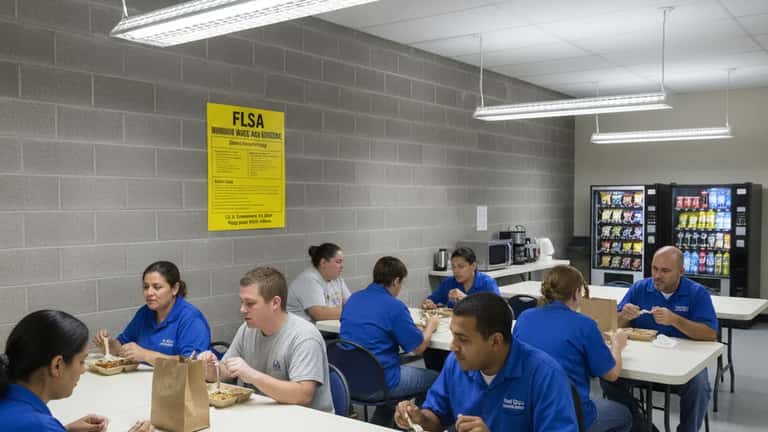
Bona fide meal periods, by contrast, are generally not compensable — but only if the employee is completely relieved of all duties for at least 30 minutes. A Georgia employer who provides a "30-minute lunch break" but requires the employee to stay at their desk and answer the phone has transformed it into compensable time under the FLSA's [29 C.F.R. § 785.19] standard.
3. Minors Under 16 Get a Statutory Break Right
The one break protection in Georgia state law covers youth workers. Under O.C.G.A. § 39-2-18, minors under 16 years of age must receive at least a 30-minute rest period when they work more than 5 consecutive hours. This is Georgia's only mandatory break provision for private-sector workers.
Employers who hire workers under 16 — common in retail, food service, and seasonal agriculture — must factor this break entitlement into scheduling. Failing to provide the break is a violation of Georgia's child labor law, enforced by the Georgia Department of Labor.

4. Nursing Mothers Have Federal Break Protections
The FLSA's Break Time for Nursing Mothers provision (29 U.S.C. § 207(r)) requires employers with 50 or more employees to provide reasonable break time for employees to express breast milk for their nursing child, for up to 1 year after the child's birth. These breaks do not need to be paid unless the employer provides paid breaks to other employees (in which case the nursing break must receive the same treatment).
Employers with fewer than 50 employees may be exempt from this requirement if compliance would impose an undue hardship — though the undue hardship threshold is high. A private space (not a bathroom) must be provided.
Georgia's own Equal Pay Act and anti-discrimination provisions do not add materially to federal nursing break protections, but the Georgia Equal Opportunity for Persons with Disabilities Act may require reasonable accommodations for pregnancy-related conditions in some circumstances.
5. Your Employer's Policy Becomes Contractually Binding
What Georgia law does not mandate, your employer's own written policies may. If an employee handbook states "all full-time employees receive a 30-minute unpaid meal break and two 10-minute paid rest breaks per shift," that language creates a contractual obligation — the employer cannot unilaterally eliminate those breaks without modifying the policy and providing adequate notice.
Georgia courts have consistently held that employee handbook provisions establishing break schedules, if communicated to employees as benefits, create enforceable expectations. Workers who are denied breaks that their employer's own policy promises may have a breach of contract claim.
Practical advice for workers: Review your employee handbook for the specific break language. If the handbook is silent on breaks, the employer has maximum flexibility. If it commits to specific breaks, those terms are binding.
The Maryland Meal and Rest Break Laws guide covers a state that mandates a 30-minute shift break for most employees after a certain number of hours — a contrast with Georgia's policy-based approach.

6. Break Policies Are Common Grounds for Wage Disputes
Disputes about breaks in Georgia often arise not from the absence of a break but from how breaks are classified. Common scenarios:
- An employee takes a 20-minute break but is called back to their station halfway through — the entire 20 minutes must be paid
- A supervisor tells an employee to "eat at your desk" and continue answering emails — the meal period is compensable time
- A retail employee's break is reduced without notice during peak season — if the break was promised in policy, a pay dispute may follow
7. Break Reductions Can Trigger FLSA and State Wage Claims
When employers change break schedules — eliminating paid breaks that employees have been receiving — workers may have both federal and state claims depending on the circumstances.
If the change results in employees working through what were previously paid breaks without compensation, those uncompensated minutes accumulate into an FLSA claim. A worker who loses a daily 15-minute paid break five days per week, 50 weeks per year, loses approximately 62.5 hours of paid time annually — a wage theft claim that grows significantly with overtime implications for weeks already over 40 hours.
The New Jersey Meal and Rest Break Laws guide illustrates how a mandatory break state handles violations — enforcement is through a different mechanism than Georgia's policy-and-contract approach, but the underlying wage recovery principles are similar.
For Georgia employers considering break policy changes:
- Document the change in writing and have employees acknowledge receipt
- Check whether the change affects overtime calculations for any employees already at 40 hours
- Verify that eliminating a break does not effectively require employees to work through time that should be compensated under the FLSA
Legal disclaimer: Georgia break law depends on your employment status, employer size, and the specific terms of your employment contract or handbook. This article provides general information only. For advice specific to your workplace situation, consult an employment attorney or contact the U.S. Department of Labor's Wage and Hour Division at dol.gov/agencies/whd.