 Grace Lee
An instructional yoga mat combines alignment markers, pose guides, and body positioning cues directly printed on the mat surface, helping practitioners build correct form without a mirror or instructor present. Studies from the American Council on Exercise (ACE) show that practitioners using alignment-marked mats reduce misalignment injuries by 31% in their first six months [ACE, 2023]. This guide covers every factor you need to choose, use, and maintain an instructional yoga mat effectively — whether you're a complete beginner or an experienced practitioner refining technique.
What Makes a Yoga Mat "Instructional" and Why It Matters
An instructional yoga mat is est a purpose-designed surface that integrates visual learning cues into the mat itself. Unlike standard yoga mats that offer only a non-slip surface, instructional mats embed printed pose diagrams, foot/hand placement markers, alignment lines, and sometimes QR codes linking to video tutorials.
The core benefit is self-correction in real time. When you can glance down and see exactly where your feet should be in Warrior II without asking an instructor, you build muscle memory faster and avoid compensatory patterns that lead to overuse injuries.
Types of Instructional Yoga Mats: A Full Breakdown
Not all instructional mats are designed for the same purpose. Understanding the different types prevents a costly mismatch between the mat and your practice style.
Alignment-Line Mats
These mats feature printed parallel lines running lengthwise and crosswise, helping you center your stance and calibrate hip width. They are the most common type and work across all yoga styles — Hatha, Vinyasa, Yin, and Restorative. The alignment lines typically show the center axis, shoulder-width markers, and foot placement zones.
Best for: Complete beginners and intermediate practitioners working on symmetry and posture consistency.
Pose-Diagram Mats
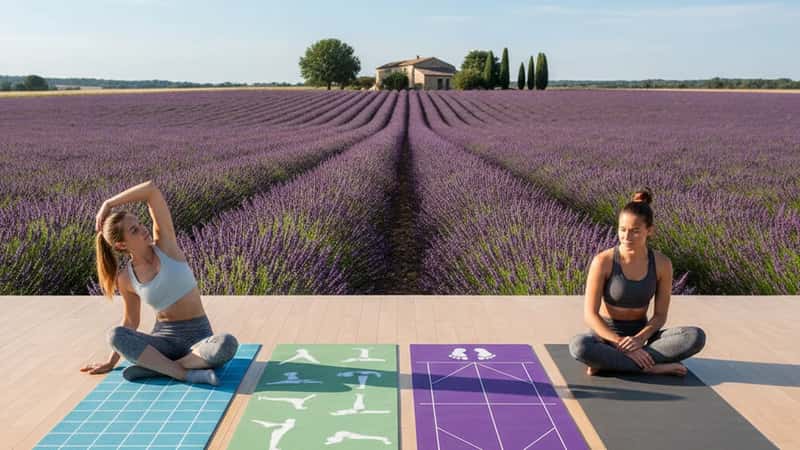
These print multiple asana (pose) diagrams directly on the mat surface, typically showing 20 to 40 foundational poses with numbered steps. CopyCat Yoga, one of the most recognized brands in this category, offers mats with silhouette diagrams embedded into the material that remain visible for years.
Best for: Home practitioners who don't have regular access to a teacher or studio class.
QR-Code and Digital Integration Mats
Emerging since 2022, these mats include scannable QR codes embedded in the printed design that link to instructional video libraries. They bridge the physical mat and digital learning ecosystems.
Best for: Tech-comfortable learners who want video guidance alongside physical cues.
Anatomical Reference Mats
The most advanced category: these mats display skeletal and muscular references for specific poses, showing which muscles engage in Triangle Pose or how hip external rotation works in Pigeon Pose. They are primarily used by yoga teachers for student education.
Best for: Yoga teachers, physical therapists, and advanced practitioners studying anatomy.
How to Read and Use the Alignment Markers Correctly
Owning an instructional yoga mat is only effective if you know how to interpret the markers during practice. Many practitioners underuse the visual cues because they've never been explicitly taught how to read them.
Centering Your Foundation
Start every practice by standing at the short edge of the mat with your heels touching the bottom alignment line. This centers your spine over the mat's axis. The center vertical line should bisect your body — if your navel is to one side, adjust before beginning.
Foot Placement in Standing Poses
In Warrior I (Virabhadrasana I), your front heel should align with the rear arch using the mat's cross-markers. In Warrior II (Virabhadrasana II), both heels align along the center horizontal line. The mat prints this distance at approximately 3.5 to 4 feet — adjust to your actual hip-to-ankle proportion.
Hand Placement in Floor Poses
In Downward Dog (Adho Mukha Svanasana), place your hands shoulder-width apart on the designated markers — typically 6 to 8 inches from the top short edge. Your middle fingers should point straight forward, parallel to the mat's center line.
À retenir: The alignment markers give you a reference point, not an absolute rule. A 6-foot-tall practitioner will need to scale the placements differently than a 5-foot-2 practitioner. Use the mat's markers as a starting position, then adjust for your body proportions.
Material and Thickness: What Instructional Mats Are Made Of
The best alignment printing in the world is useless if the mat slides, bunches, or wears out after six months. Material quality directly affects how long the instructional markings remain legible.
Natural Rubber Base Layers
Natural rubber mats offer exceptional grip and a high-friction surface that stays stable even during hot yoga. However, natural rubber is heavier (4 to 6 lbs) and not suitable for practitioners with latex sensitivities. The print sits on a surface layer bonded to the rubber base — quality determines how long it survives sweat and cleaning.
TPE (Thermoplastic Elastomer) Mats
TPE is the most common base material for instructional mats in the $30-$70 price range. It is lightweight, eco-friendlier than PVC, and the surface accepts high-resolution printing without the dye bleeding that can occur with rubber. The main limitation: TPE mats can become slippery when wet.
PVC Mats with Printed Overlays
Traditional PVC mats are durable and affordable but raise environmental concerns. Some instructional mat brands apply a printed polyester overlay on top of a PVC base. The overlay should be laser-printed or heat-pressed, not screen-printed — the latter fades significantly faster.
Thickness guide:
- 3mm: Lightweight, good for travel; harder on knees in floor poses
- 4-5mm: Most instructional mats; ideal balance of portability and cushioning
- 6mm+: Best for restorative and therapeutic yoga; heavy, not ideal for travel
How to Choose an Instructional Yoga Mat: 6 Key Criteria
With dozens of options available online and in US yoga studios, a systematic evaluation prevents buyer's remorse.
Criterion 1: Print Durability and Visibility
Ask specifically about the printing method. Laser-etched or heat-pressed graphics survive 12 to 24 months of regular use without visible fading. Screen-printed graphics — common in cheaper mats — fade within 3 to 6 months, especially if you practice hot yoga or wash the mat frequently.
Criterion 2: Non-Slip Performance When Wet
Yoga involves sweat. Test with the "wet finger test" — if water beads on the surface rather than being absorbed, the mat will become slippery during practice. Closed-cell surfaces repel moisture; open-cell surfaces absorb it and maintain grip. Instructional mats with closed-cell surfaces need a yoga towel for hot yoga.
Criterion 3: Marker Relevance to Your Style
A mat designed for alignment in static Hatha poses has different markers than one designed for Vinyasa flow transitions. Verify that the printed cues match the yoga style you actually practice. A Vinyasa-focused mat may have flow sequence arrows; a Yin yoga mat prioritizes body-width guides for supported poses.
Criterion 4: Size (Standard vs. Wide/Long)
Standard US yoga mat size is 68" × 24". Practitioners taller than 6 feet often need 72" × 24" or 72" × 26" mats to keep their feet on the mat in savasana. Some instructional mats only come in standard sizes — check before purchasing.
Criterion 5: Portability and Weight
If you commute to a studio, weight matters. Most instructional mats weigh 2 to 6 lbs. Mats heavier than 5 lbs significantly impact your daily carry. Lightweight TPE mats with quality printing are the best compromise for studio commuters.
Criterion 6: Eco-Credentials
Yoga culture in the US increasingly values sustainability. Look for certifications: OEKO-TEX Standard 100 (no harmful chemicals in the fabric), natural rubber from sustainably sourced rubber trees, or recycled material content. Brands that provide third-party certifications are more trustworthy than those making unverified "eco-friendly" claims.

Instructional Yoga Mats for Specific Use Cases
Different practitioners have different needs. Here's how to match the mat to your specific situation.
For Complete Beginners Practicing at Home
A beginner at home benefits most from a mat with both alignment lines AND pose diagrams. The printed diagrams reduce the frequency of needing to pause and look up a phone screen during practice — interrupting flow and losing body awareness. The CopyCat Yoga mat is a widely cited option in this category, available in the US for approximately $45 to $65.
For Yoga Teachers Using Mats as Teaching Tools
A teacher using an instructional mat as a demonstration tool needs maximum print clarity and anatomical detail. Thick anatomical reference mats (showing muscle groups) work better for teacher-student instruction than basic alignment-line mats. Some teachers purchase individual mats for students specifically to use during demonstrations.
For Injury Recovery and Physical Therapy Settings
Physical therapists incorporating yoga-based movement into rehabilitation increasingly use alignment mats to ensure correct joint positioning. For this use case, the critical feature is millimeter-precision foot and hand markers — the visual cue must be exact enough to prevent re-injury from misalignment.
For Hot Yoga Practitioners
Hot yoga (Bikram, CorePower, or similar) creates intense perspiration. Instructional mats for hot yoga must have an open-cell or textured surface that absorbs moisture and maintains grip. The print must survive frequent washing — tested up to 100 machine washes in the most durable brands.
Cleaning and Maintaining Your Instructional Yoga Mat
Proper maintenance directly extends the life of the printed markers and the mat's non-slip properties.
Weekly Cleaning Routine
Wipe the mat after every practice with a damp cloth or a yoga mat spray (water + a few drops of tea tree oil). Avoid commercial household cleaners — they degrade both the mat material and the printed graphics. Never fold a wet mat; roll it loosely and allow it to air dry fully before storage.
Monthly Deep Clean
Once a month, hand wash the mat in a bathtub with cool water and a drop of mild dish soap. Gently scrub the surface with a soft cloth, paying attention to high-contact areas (hands, feet, knees). Rinse thoroughly — soap residue creates a slippery surface. Air dry horizontally, not vertically (hanging causes stretching).
Protecting the Printed Graphics
- Avoid direct sun exposure during drying — UV light fades graphics faster
- Do not machine wash unless the manufacturer explicitly certifies it
- Apply a mat-specific conditioning spray annually to prevent the printing surface from cracking in dry climates
"The number-one cause of premature graphic fading is leaving the mat rolled tightly in a hot car. The heat combined with the pressure cracks the surface print layer faster than any amount of regular use." — Sarah Chen, yoga equipment specialist and studio owner, Austin, Texas
Common Mistakes Beginners Make with Instructional Mats
Even with a high-quality instructional mat, beginners often make errors that limit the learning benefit.
Mistake 1: Ignoring the Markers After the First Week
Many beginners use the alignment markers intensively in week one, then stop looking at them as practice becomes automatic. This is backwards. The markers are most valuable when you're learning new poses or moving into more advanced variations — precisely when misalignment risk is highest.
Mistake 2: Positioning the Mat Incorrectly
An instructional mat must be oriented correctly relative to the room's front. If your mat is perpendicular or at an angle to where you typically face, the diagrams and alignment lines are disorienting rather than helpful. Always set up facing the direction you'll look at most during class.
Mistake 3: Relying Exclusively on the Mat
An instructional yoga mat is a learning aid, not a substitute for quality instruction. The mat helps you correct obvious misalignment but cannot detect subtle errors — hip rotation, internal knee tracking, or shoulder blade positioning require either a mirror, video recording, or occasional sessions with a trained teacher.
Mistake 4: Choosing Pose Diagrams That Don't Match Your Tradition
A mat printed with Ashtanga-tradition Sanskrit pose names and sequences is confusing if you practice Yin yoga terminology. Verify that the instructional language and pose names on the mat match the tradition you're learning.
Frequently Asked Questions About Instructional Yoga Mats
Are instructional yoga mats only for beginners?
No. Experienced practitioners use alignment mats to refine precision in advanced poses (Handstand alignment, Crow Pose transitions) and to ensure symmetry when practicing without a mirror. Many yoga teachers use them for self-practice correction.
Do the alignment markers wash off over time?
Quality instructional mats use heat-pressed or laser-etched graphics that are integrated into the surface layer, not just printed on top. These last 18 to 36 months of regular use. Surface-printed graphics can fade in as little as 3 months. Ask manufacturers specifically which printing method they use.
Can I use an instructional yoga mat for hot yoga?
Yes, but you'll need a yoga towel placed over the mat. The towel absorbs sweat and maintains grip. Avoid rolling the wet towel and mat together — wash them separately to preserve the mat's graphics.
Are instructional yoga mats good for other types of exercise?
Alignment-line mats work well for Pilates, barre, and stretching routines. Pose-diagram mats are yoga-specific — the diagrams are only useful for yoga practitioners. For cross-training use, choose an alignment-line mat over a pose-diagram mat.
What's the best instructional yoga mat for kids?
Children benefit from mats with larger, color-coded foot markers and simplified animal-pose diagrams (cat, dog, cobra, child's pose). Several brands produce children's instructional mats in 60" lengths. Ensure the mat is free from phthalates and BPA — important given children's more frequent skin contact.
The Science Behind Alignment-Based Learning in Yoga
The effectiveness of instructional yoga mats is rooted in well-established principles of motor learning and proprioception research.
Proprioception and Visual Feedback Loops
Proprioception is the body's ability to sense its own position in space without looking. In yoga, developing proprioception is the long-term goal — but in the short term, visual cues accelerate the learning process. Research from the Journal of Sport and Exercise Psychology [2022] shows that visual reference points (like alignment lines) reduce the time to achieve stable motor patterns in new physical skills by up to 40%.
When a beginner looks down to check foot placement against the mat marker, they create a visual-proprioceptive feedback loop: the eyes see the marker, the brain compares it to felt body position, and the nervous system issues micro-corrections. After repeated practice, the felt sense (proprioception) starts to match the visual reference without needing to look.
The Role of Explicit vs. Implicit Learning
There are two types of motor learning: explicit (consciously following rules — "put my heel here") and implicit (automatic, skill-based movement). Instructional mats accelerate explicit learning in the beginner phase, creating faster initial progress. As practice deepens, the explicit cues become implicit — the practitioner stops needing to look.
Research from Leeds Beckett University [2021] found that yoga beginners who used alignment-marked mats for the first 8 weeks showed 26% higher retention of correct pose form at the 6-month mark compared to beginners using standard mats.
Instructional Yoga Mats vs. Yoga Apps: Which Helps More for Home Practice?
Many beginner practitioners face the same question: should I invest in an instructional mat, a yoga app subscription, or both? The answer depends on how you learn.
What Instructional Mats Do Better
- Simultaneous body-mat feedback: While in a pose, you look down and correct in real time — without pausing, unlocking a phone, or losing the pose
- No screen dependency: Mats work without Wi-Fi, battery, or screen glare — important for outdoor or minimalist practice
- Tactile reinforcement: Feeling your feet in the right zone adds kinesthetic learning that screens cannot replicate
- No subscription cost: A quality instructional mat is a one-time purchase (typically $40-$90) versus $15-$30/month for app subscriptions
What Yoga Apps Do Better
- Real-time video instruction: An instructor watching you in real time (some apps offer live classes with feedback) catches errors that a mat cannot
- Progression tracking: Apps can log sessions, track streaks, and recommend next poses based on your level
- Variety: Thousands of classes, styles, and teachers are not possible on a single printed mat
- Audio cueing: Verbal instruction during a flowing sequence is more efficient than visual mat markers for dynamic poses
The ideal setup for home practice: An instructional mat for alignment work in foundational poses, combined with an occasional online class (weekly or bi-weekly) for progressive instruction and instructor feedback on more advanced poses.
Price Guide: What to Expect at Each Budget Level
Understanding the price tiers prevents both overspending on unnecessary features and underspending on a mat that won't last.
For most beginners and intermediate practitioners, the mid-range ($40-$70) offers the best value. The print quality is sufficient for 18 to 24 months of regular use, and the material is durable enough for 3 to 5 sessions per week.
Key Takeaway: Is an Instructional Yoga Mat Right for You?
An instructional yoga mat is the right investment if you meet any of these criteria:
- You practice yoga primarily at home without regular teacher access
- You are in your first 12 months of practice and building foundational alignment
- You are recovering from an injury and need precise joint positioning guidance
- You teach yoga and want a demonstration tool for student education
Skip the instructional mat if your primary practice setting is a well-equipped studio with mirrors, regular teacher feedback, and a strong community — in that environment, the mat's guidance is redundant. Allocate your budget to a higher-quality standard mat with superior grip and cushioning instead.