 Grace Davies
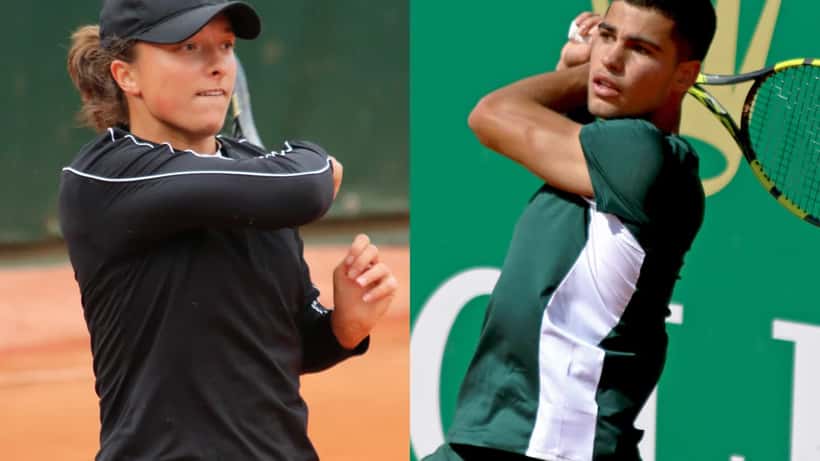
On 27 May 2026, Iga Świątek defeated Sara Bejlek 6-2, 6-3 to advance to Roland Garros's third round — maintaining her remarkable career record of 42 wins and 3 losses on Parisian clay. Yet analysts watching the four-time champion closely have flagged a worrying trend: her serve is under statistical pressure in ways that tell a story beyond scorelines, and it is one every regular tennis player should understand.
The Statistics Behind Świątek's Serve Pressure
Opta Analyst data from the 2026 French Open season shows a clear pattern. Against top-10 opponents, Świątek wins 67.0% of points on her first serve — significantly lower than her 70.2% rate against the rest of the draw. Her break-point save rate has fallen by 14.2% in elite matchups compared to matches against lower-ranked players. She averages the fewest points won on first serve of any current WTA top-20 player when facing top-10 opposition.
Most strikingly, at the Rome Open semifinal in May 2026, Elina Svitolina won 63.3% of points on Świątek's second serve — the highest figure recorded by any player against her this season. For professional analysts, these numbers signal that a mechanical or physical issue is affecting her serve delivery when it counts most. For recreational players, the story offers a direct lesson: the serve is tennis's most physically demanding stroke, and usually the first to show strain when the body is not recovering adequately.
Why the Serve Places Unique Demands on Your Shoulder
The tennis serve is a compound movement engaging the rotator cuff, glenohumeral joint, elbow extensors, and forearm flexors in a precise, high-speed sequence. At professional level, the shoulder generates force through internal rotation speeds that rival baseball pitching. For club players serving at 90 to 130 km/h, the mechanics are identical — and the cumulative joint load per session can be far higher than most players realise.
According to the NHS, rotator cuff disorders — including tendinopathy, partial tears, and impingement syndrome — are among the most common causes of persistent shoulder pain in adults who perform regular overhead activity. Tennis serves, especially when performed repeatedly without sufficient rest or technique correction, place exactly this kind of sustained overhead load on a joint whose wide range of motion comes at the cost of structural stability.
The rotator cuff — four small muscles stabilising the shoulder — can accumulate micro-damage across weeks of play before symptoms feel significant. By the time pain is obvious, early-stage tissue changes that could have been managed with simple physiotherapy have often progressed to something more serious.
The Overuse Pattern That Affects Players at All Levels
Świątek arrived at Roland Garros 2026 having retired from the Madrid Open in late April due to illness. Physical resources, once depleted, take time to restore — and the serve, which requires precise neuromuscular control alongside raw power, typically reveals deficits before ground strokes do.
This pattern mirrors what sports medicine professionals see in recreational tennis every week. Players who compete through fatigue, who increase match or training volume without corresponding recovery time, and who dismiss minor shoulder discomfort until it becomes unavoidable are on the same continuum as elite players managing a long competitive season without adequate rest.
Most club players serve between 60 and 120 times per session — often without the post-match physiotherapy, strength conditioning, or sleep protocols that professional athletes access daily. Weekend players in particular tend to compress their tennis into one or two high-intensity sessions without the gradual loading professional schedules are built around.
A 2023 review published in the British Journal of Sports Medicine found that shoulder injuries account for approximately 24% of all tennis-related musculoskeletal complaints, with the rotator cuff the most commonly affected structure. The majority of shoulder injuries in recreational tennis are overuse-based, developing across weeks or months rather than from a single traumatic event.
Warning Signs That Warrant a Specialist Assessment
If you play regular tennis, these symptoms after a session should not be normalised or managed indefinitely with painkillers:
- Shoulder pain lasting more than 48 hours after playing
- A noticeable drop in serve pace or accuracy that persists across multiple sessions
- Pain reaching overhead or behind your back in daily activities off the court
- Night pain or discomfort that disturbs sleep
- Clicking, catching, or a grinding sensation inside the joint during arm movements
Symptom persistence is the key signal. Normal post-match soreness typically resolves within a day. Pain that returns every session, progressively worsens, or changes the way you serve is a sign the shoulder is accumulating load it cannot repair between matches.
Amanda Anisimova's return to Roland Garros 2026 after a wrist injury offers a useful reference point: rebuilding after a tennis injury requires careful, specialist-supervised progression — not pushing through discomfort in the hope it resolves. Her experience of working step by step back to match fitness is described in our recent article on her Roland Garros comeback.
When to Book a Sports Medicine Assessment
A sports physiotherapist or sports medicine consultant can evaluate your shoulder mechanics, distinguish between muscular soreness and structural strain, and design a loading plan that keeps you on court safely. The NHS recommends seeking professional assessment for shoulder pain that has not improved after two to three weeks of rest and conservative management.
Waiting until the shoulder fails completely — the recreational equivalent of retiring mid-match — produces longer recovery timelines and a meaningfully higher risk of chronic impairment. Early assessment, even for a serve that "just feels slightly off", is consistently the most efficient path back to pain-free tennis.
Świątek's serve will likely recover as she progresses through Roland Garros with the support of a full professional medical team. Club players rarely have that infrastructure around them — which makes proactive assessment all the more important. ExpertZoom connects you with qualified sports physiotherapists and sports medicine specialists for in-person or online consultations across the UK.
Health notice: This article provides general information about sports injuries. It is not a substitute for individual medical advice. If you are experiencing shoulder pain, please consult a qualified healthcare professional.
