 Daniel Davies
An Arctic storm system swept across the UK in March 2026, bringing hailstones, 70mph winds and plummeting temperatures to large parts of England, Scotland and Wales. According to the Met Office, the sudden cold snap — arriving weeks after unseasonably warm conditions — sent thousands of homeowners scrambling to assess roof tiles, gutters and external structures. Insurance call centres reported a sharp spike in enquiries. If you live in an affected area, there are five categories of damage you need to check before your insurer can process a valid claim — and some of them are far less obvious than a cracked roof tile.
1. Roof tiles and ridge caps: the most common and most urgent
Hailstones large enough to cause impact damage — typically from 2cm diameter upwards — can crack or dislodge roof tiles without leaving obvious signs from street level. A tile that appears intact from below may have developed a hairline fracture that will let in water during the next rain shower.
Check your loft for daylight or water stains on the rafters, as these are the earliest indicators of tile damage. For properties with flat roofs or bitumen membranes, the impact of heavy hail on a cold membrane can cause micro-splits that are invisible until water ingress begins.
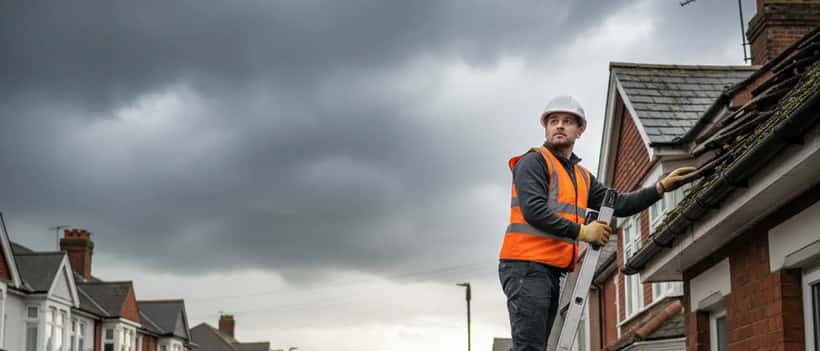
A qualified roofer should inspect the roof within 48 to 72 hours of the storm, not only to document damage for your insurer, but to apply temporary protection if needed. Most major insurers require a professional inspection report — a smartphone photograph alone is rarely sufficient for a claim.
2. Gutters and downpipes: blockage leads to structural damage
Hail and high winds combine to fill gutters with debris — broken branches, displaced ridge caps and dislodged pointing mortar — that can cause overflow within a single heavy rainfall. Blocked gutters force water against the fascia board, into the roof void, and — in older properties — down cavity walls.
Check that gutters are securely fastened to the fascia and that all joints are sealed. Look for signs of sagging or pulling away from the wall. A standard gutter clearance costs between £60 and £120 depending on roof height and is almost always cheaper than the damp remediation that follows a blocked gutter left unattended through spring.
3. Windows, glazing and frames: a priority for insurance documentation
Hailstones and windborne debris are a common cause of cracked double-glazing units. Even where the outer pane remains intact, the impact can compromise the insulating gas seal, leading to condensation between panes within weeks. This type of damage can be invisible for up to a month.
Check all window frames — particularly UPVC frames on north-facing walls — for visible impact marks, hairline cracks along the frame joints, and any new draughts around the edges. Document everything photographically with a timestamp before making repairs: any repair made before your insurer assesses the damage may reduce your payout.
According to the Association of British Insurers, storm-related claims must typically be reported within 180 days of the event, but insurers expect notification "as soon as reasonably practicable." Waiting more than two weeks without notification can be used to contest a claim.
4. External walls and pointing: underestimated storm damage
In areas where hail was accompanied by driving rain, water can penetrate through cracked pointing (the mortar between bricks) and cause spalling — where the surface layer of brickwork flakes away. This type of damage is less common in newer builds but widespread in properties built before 1970.
Run your hand along the external brick courses from ground level: loose mortar, crumbling pointing, or bricks with dark damp patches after 24 dry hours are all warning signs. Repointing is relatively low cost if addressed promptly; left untreated, water ingress into the wall cavity leads to damp, mould and — in the worst cases — structural movement.
If your property is rendered rather than brick-faced, look for hairline cracks in the render surface that were not present before the storm. These need to be sealed quickly to prevent water tracking behind the render sheet.
5. Garden structures and boundaries: liability you may not have considered
Fencing, garden walls, sheds and outbuildings often suffer the most visible storm damage — but they also carry the least-considered legal liability. If your fence or wall collapses onto a neighbour's property or vehicle, or into a public right of way, you may be liable for damages even if the collapse was storm-related.
The key question is whether your structure was in a reasonable state of repair before the storm. Insurers and courts apply a "but for" test: would the structure have survived the storm had it been properly maintained? A fence with rotted posts that collapses in 40mph winds may not be covered under storm damage provisions if a surveyor determines it was already defective.
Review your buildings and contents insurance policy for the definition of "storm damage." Most policies require wind speeds of at least 55mph (Beaufort scale 10) or an official storm designation from the Met Office. The March 2026 event should satisfy this threshold in most affected areas, but the specific terms vary by insurer.
Your next steps: claim timeline and what to expect
Once you have documented all damage, report to your insurer as soon as possible. In the current claims environment, an average storm claim takes 4 to 8 weeks to settle, according to Which? consumer research from early 2026. Larger structural claims involving scaffolding or specialist contractors can run to three to four months.
A professional tradesperson — whether a roofer, bricklayer or general builder — can provide a written quote that doubles as evidence for your claim. Be cautious of unsolicited callers offering rapid repairs after a storm: a number of door-to-door traders have been reported operating in storm-affected areas in March 2026, quoting inflated prices for unnecessary work. Always verify credentials through TrustMark or the Federation of Master Builders before accepting a quote.
Disclaimer: This article is for informational purposes only. For advice specific to your property, building regulations, or insurance policy, consult a qualified professional.
