 Amelia Ward
Eberechi Eze has been ruled out of the Carabao Cup final against Manchester City after an ankle injury sustained on March 17, 2026 during Arsenal's Champions League victory over Bayer Leverkusen proved more serious than initially thought.
From "I'll be okay" to cup final doubt in five days
When Eze was substituted in the 69th minute of Arsenal's Champions League win over Leverkusen, he seemed confident. "Yeah, I'm alright. I'll be okay," he told reporters after the game. Five days later, BBC Sport confirmed he is a major doubt for the Carabao Cup final on March 22, 2026 at Wembley.
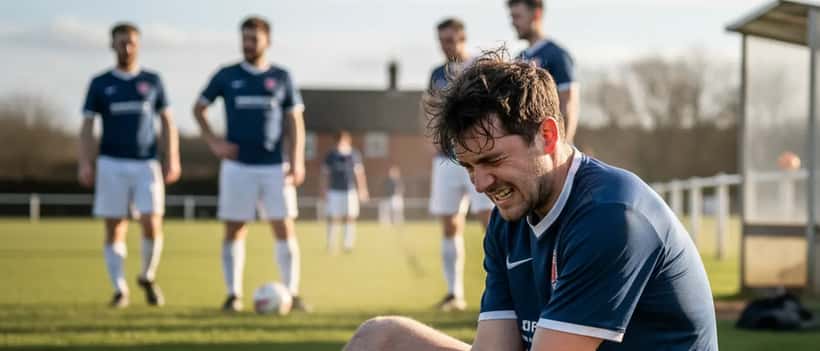
The progression from downplayed knock to ruled out is a familiar story in football — and in amateur sport. Ankle injuries are notoriously difficult to self-assess in the immediate aftermath of the incident, when adrenaline masks true severity.
Arsenal are chasing an unprecedented quadruple this season — Premier League, Champions League, FA Cup and Carabao Cup. Eze's absence, if confirmed, would be a significant blow to manager Mikel Arteta's plans against City.
Why ankle sprains are so easy to misread
The ankle is one of the most complex joints in the body, involving three bones, multiple ligaments, and a network of tendons. When an injury occurs, initial pain levels are not always a reliable guide to severity.
There are three grades of ankle sprain:
- Grade 1 (mild): Stretching or minor tearing of ligament fibres. Minor swelling, full weight-bearing possible. Recovery: 1–2 weeks.
- Grade 2 (moderate): Partial ligament tear. Noticeable swelling and bruising, limited range of movement. Recovery: 3–6 weeks.
- Grade 3 (severe): Complete rupture of one or more ligaments. Significant instability, often requiring immobilisation or surgery. Recovery: 3–6 months.
Eze's situation — initially downplayed, then worsening over days — is consistent with a Grade 2 injury where swelling and inflammation build after the adrenaline of competition subsides.
According to the British Journal of Sports Medicine, ankle sprains account for approximately 15% of all sports injuries in the United Kingdom, making them the most common acute sporting injury. Yet an estimated 40–70% of patients who sprain an ankle develop chronic instability if not treated appropriately.
What amateur footballers should do immediately after an ankle injury
Most amateur footballers in Sunday leagues and five-a-side games don't have physiotherapists on the touchline. Here's what sports doctors recommend:
In the first 24–72 hours:
- Stop playing immediately — continuing to play on a sprained ankle risks turning a minor injury into a serious one
- Apply the PEACE & LOVE protocol: Protection, Elevation, Avoid anti-inflammatory modalities in early phase, Compression, Education; followed by Load, Optimism, Vascularisation, Exercise
- Apply ice or a cold pack for 15–20 minutes every 2 hours to reduce swelling
- Elevate the ankle above heart level when resting
- Avoid heat, alcohol and massage in the first 48 hours — all increase swelling
When to see a sports doctor urgently:
- You cannot bear weight at all within 24 hours
- There is significant bruising or swelling that extends beyond the outer ankle
- You felt or heard a "pop" at the moment of injury
- Pain does not improve after 48 hours of rest
The cost of playing through it
The temptation to dismiss ankle injuries and return to play quickly is strong — especially in amateur sport, where team needs, social pressure and simple stubbornness all play a role. But pushing through an inadequately treated ankle sprain creates long-term risks.
Research published in the British Journal of Sports Medicine shows that individuals who experience one ankle sprain are 70% more likely to sustain a second sprain within the following year if rehabilitation is incomplete. Repeated ligament stress causes a loss of proprioception — the body's sense of joint position — that increases fall risk and makes re-injury almost inevitable during quick-change-of-direction sports like football.
Eze, with an elite medical team behind him, will receive world-class rehabilitation. Amateur footballers rarely have that luxury — but they do have access to specialist sports doctors who can assess, advise on imaging, and design targeted rehabilitation programmes.
After the injury: returning to football safely
A return-to-sport protocol for ankle sprain includes progressive stages:
- Pain-free walking without any limp
- Balance and proprioception exercises on an unstable surface (balance board, wobble cushion)
- Jogging in a straight line without discomfort
- Change of direction drills at increasing speed
- Sport-specific movements including kicking, jumping, and reactive cutting
- Return to training with the full team
- Return to competition
Each stage should be cleared by a sports medicine professional before progression. Attempting to shortcut this process — as many amateur athletes do — is the primary reason ankle sprains become chronic problems.
Getting expert advice without waiting weeks
A sports medicine consultation can make the difference between a two-week recovery and a six-month setback. On Expert Zoom, sports doctors and physiotherapy specialists are available for remote consultations — allowing you to describe your symptoms, understand your injury grade, and receive a clear rehabilitation plan without waiting weeks for an NHS appointment.
Whether you're a Sunday league centre-forward or a midweek five-a-side regular, your ankle deserves the same attention Eze's will get this week.
Disclaimer: This article is for general informational purposes only. If you cannot bear weight on an injured ankle or suspect a fracture, seek emergency medical attention immediately.
Sources: BBC Sport (March 22, 2026), Tribuna.com (March 17 & 22, 2026), British Journal of Sports Medicine
