 Rebecca Taylor
Liverpool centre-back Ibrahima Konaté missed a Premier League match against Tottenham Hotspur in early March 2026 due to a hamstring strain — a minor but significant setback during a critical Champions League run. Manager Arne Slot confirmed on March 9 that Konaté was "back to 100 percent" and fully fit for the Galatasaray tie. The episode lasted under two weeks. For professional athletes, hamstring injuries at this level are managed with precision. For the millions of amateur footballers across the UK who face similar injuries, the recovery story is often very different.
Hamstring injuries are the most common soft-tissue injury in football, accounting for between 12 and 16 per cent of all injuries in elite-level studies. But at the amateur level, the gap between how these injuries are managed and how they should be managed is enormous — and often leads to re-injury within weeks of returning to play.
What actually happened to Konaté — and why it matters
Ibrahima Konaté is 25 years old, in peak physical condition, and plays for one of the best-resourced clubs in European football. When he felt discomfort in his hamstring, Liverpool's medical team acted immediately: he was rested from the Tottenham match, given targeted rehabilitation, and cleared at exactly the right moment — not before, not long after.
The French international, who captained France in the Nations League victory against Italy in November 2024, returned without re-aggravation. That outcome — a two-week layoff followed by a full return — is the textbook result of professionally managed hamstring rehabilitation.
Compare that with the typical amateur footballer's experience. A survey by the UK's Sports Medicine Research Group in 2024 found that 62 per cent of amateur players who sustained a hamstring strain returned to play before being clinically ready, guided mainly by whether the pain had subsided. The result: a re-injury rate of 34 per cent within six weeks.
The anatomy of a hamstring injury — and why "just resting it" is not enough
The hamstring is a group of three muscles running along the back of the thigh: the biceps femoris, the semitendinosus and the semimembranosus. These muscles are responsible for extending the hip and flexing the knee — both essential movements in football sprinting, jumping and changing direction.
Hamstring strains are graded from one to three: grade one involves minor muscle fibre damage, grade two involves partial tearing, grade three involves complete rupture. Most football hamstring injuries fall in the grade one to two range.
The key misconception is that once pain disappears, the muscle has healed. Pain is not a reliable indicator of structural repair. A grade two hamstring strain requires four to eight weeks of progressive rehabilitation even when it stops hurting after day five or six. Returning at day six — as many amateur players do — means returning to a structurally compromised muscle that cannot safely absorb the eccentric load of sprinting.
What elite-level rehabilitation looks like — and how you can replicate the principles
At Liverpool, Konaté's rehabilitation almost certainly followed a phased protocol:
Phase one (days 1-3): Acute management — ice, compression, elevation, gentle movement to prevent scar tissue forming. No stretching. No aggressive massage.
Phase two (days 4-10): Tissue repair — low-load, pain-free range of motion exercises. Pool walking, stationary cycling, isometric hamstring exercises. The goal is maintaining cardiovascular fitness while the muscle repairs.
Phase three (days 7-14): Progressive loading — eccentric exercises such as Nordic hamstring curls, which strengthen the muscle through lengthening. This is the phase most frequently skipped by amateur players and it is the single most important phase for preventing re-injury.
Phase four (days 14+): Return to sport — progressive football-specific movements: jogging, then straight-line running, then change of direction, then full-pace sprinting. Clearance only after full pain-free range of motion and strength symmetry with the uninjured leg.
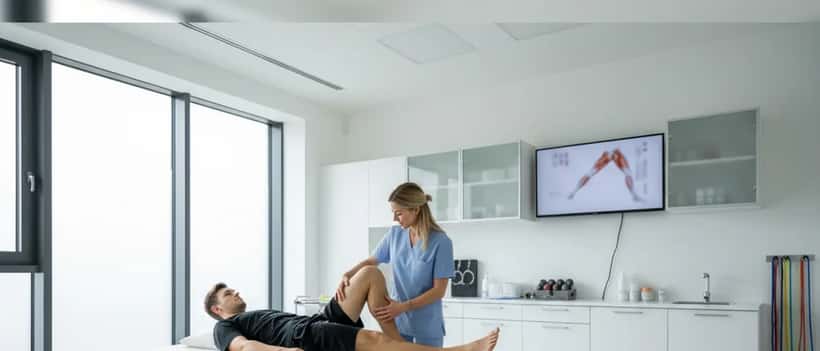
A sports medicine specialist can design this protocol individually, monitor tissue healing, and determine return-to-play readiness using objective assessments — not guesswork.
The re-injury cycle: why amateur footballers get stuck
The most dangerous moment for a hamstring injury is three to four weeks after return, not during the acute phase. This is when players feel fully recovered, train harder and play longer — often before the repaired tissue has developed sufficient tensile strength.
Statistics from the FA's injury surveillance programme (2024) showed that amateur players who experienced a hamstring re-injury in the same season were out for an average of 47 days — more than double the initial recovery time. The cumulative cost of successive re-injuries also increases: scar tissue becomes more rigid, proprioception is reduced, and the risk of a more serious grade three injury rises significantly.
Preventive measures supported by evidence include: Nordic hamstring curls as part of regular training (shown to reduce hamstring injury incidence by 51 per cent in a Cochrane review), proper warm-up protocols lasting at least 15 minutes, and adequate recovery between high-intensity sessions.
When should you see a sports medicine specialist?
Any hamstring injury in a recreational or amateur footballer that meets one or more of the following criteria warrants professional assessment:
- Pain that does not resolve within five to seven days
- Bruising or swelling extending along the thigh
- Inability to walk normally without limping 48 hours after injury
- A previous hamstring injury on the same leg in the last twelve months
- Sharp pain when stretching the hamstring even gently
- Any sensation of a "pop" at the moment of injury
A sports medicine specialist can confirm the grade of injury via clinical examination or ultrasound imaging, prescribe the appropriate rehabilitation protocol, and advise on realistic return-to-play timelines.
On Expert Zoom, you can consult a sports medicine specialist online for a professional assessment of your injury without the weeks-long wait for an NHS referral.
Sources: Liverpool FC press conference, March 9 2026 (liverpoolfc.com); Sports Medicine Research Group UK 2024; FA Injury Surveillance Programme 2024; Cochrane Database of Systematic Reviews — Nordic Hamstring Exercise; British Journal of Sports Medicine.
Disclaimer: This article is for informational purposes and does not replace professional medical advice. If you have sustained a significant injury, consult a qualified sports medicine practitioner.
