 Clara Thompson
Soliman vs Club Africain: What the Match Tells Us About Sports Injuries and When to See a Doctor
The football match between Soliman and Club Africain draws passionate attention from the Tunisian-Canadian community. But beyond the rivalry and the goals, high-intensity competitive football also raises an important health topic: injuries. Whether you play professionally in Tunisia or in a community league in Montreal or Toronto, knowing when a sports injury needs medical attention could be the difference between a quick recovery and a long-term complication.
High-Intensity Football and Injury Risk
Football is among the most physically demanding team sports. According to a 2024 study published in the British Journal of Sports Medicine, professional footballers sustain an average of 2.5 injuries per 1,000 hours of training and up to 25 injuries per 1,000 hours of match play. For amateur players — who often lack proper warm-up routines, physiotherapy access, and recovery facilities — the risk can be even higher.
In Canada, soccer is the country's most popular youth sport and one of the fastest-growing community sports for adults. Health Canada estimates that sports-related injuries account for over 20 per cent of emergency department visits for Canadians aged 10 to 34 each year.
The Most Common Football Injuries
Whether watching Soliman face Club Africain on a livestream or playing a weekend match yourself, the following injuries are most frequently seen:
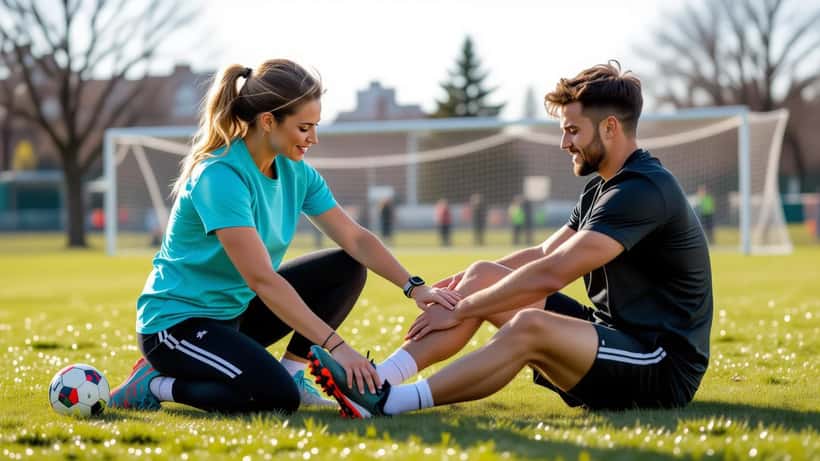
1. Ankle sprains Accounting for roughly 20 per cent of all football injuries, ankle sprains occur when the ligaments are stretched beyond their normal range. Mild sprains may resolve within days; severe sprains involving ligament tears can require immobilization and physiotherapy over several weeks.
2. Knee ligament injuries The ACL (anterior cruciate ligament) is one of the most feared injuries in football. An ACL tear typically requires surgery and 6 to 12 months of rehabilitation. MCL and PCL injuries are less severe but still require professional assessment.
3. Hamstring and quadriceps strains Explosive sprinting and sudden changes of direction frequently overload the muscle fibres in the back and front of the thigh. Grade 1 strains may heal within 10 days; Grade 3 strains involving complete muscle tears can take months.
4. Head injuries and concussions Headers, collisions, and falls can cause concussions. Symptoms include headache, dizziness, confusion, and sensitivity to light. Concussion protocol in community sport is often poorly followed — which can lead to serious long-term consequences if a player returns to play before full recovery.
5. Fractures and dislocations Tackles and collisions can cause fractures of the metatarsals (foot bones) or dislocations of the shoulder or finger. These always require imaging and professional evaluation.
When Is It "Just a Bruise" vs. When to See a Doctor?
Many Canadians delay medical attention after a sports injury, hoping it will "go away on its own." Here is a clear guide to when you should seek medical advice:
See a doctor within 24-48 hours if:
- You cannot bear weight on the injured limb
- There is significant swelling, deformity, or bruising within 30 minutes of the injury
- You felt or heard a pop at the moment of injury
- You have numbness or tingling in the injured area
- The pain is not improving after 48-72 hours of rest and ice
Seek emergency care immediately if:
- You lost consciousness, even briefly
- You are experiencing confusion, severe headache, or repeated vomiting after a head impact
- A bone is visibly deformed or protruding through the skin
- You cannot move a joint at all
In Canada, your family physician or a walk-in clinic is the appropriate first step for most sports injuries. For specialized assessment, a sports medicine physician or orthopaedic surgeon can provide imaging, diagnosis, and referrals to physiotherapy.
Protecting Yourself in Community Football
Whether you play in a Tunisian-Canadian community league or a municipal league, these evidence-based preventive strategies significantly reduce injury risk:
- Warm up with the FIFA 11+ program — a structured 20-minute warm-up protocol developed specifically for football that has been shown to reduce injury risk by up to 50 per cent
- Wear appropriate footwear — cleats suited to the playing surface (firm ground, artificial turf, or indoor) reduce ankle and knee injury risk
- Stay hydrated — dehydration impairs muscle function and increases injury risk
- Follow concussion protocols — any suspected concussion should result in immediate removal from play; return-to-play must follow provincial concussion guidelines
Find a Sports Medicine Specialist via ExpertZoom
If you have sustained a football injury and are not sure whether to see a doctor, ExpertZoom connects you with qualified health professionals across Canada — including family physicians, sports medicine doctors, and physiotherapists available for online consultations. Getting a professional opinion quickly can speed your recovery and prevent a minor injury from becoming chronic.
According to the Government of Canada's injury prevention resources, the best injury management always begins with proper professional assessment.
Conclusion
Matches like Soliman vs Club Africain inspire thousands of Canadians to play football themselves. That passion is worth celebrating — and protecting. Knowing when a sports injury needs medical attention, following proper warm-up protocols, and having access to quality healthcare are the cornerstones of a long and enjoyable playing career at any level.
This article provides general health information and is not a substitute for medical advice. Consult a qualified healthcare professional for any injury or health concern.
