 Dimitri
 A single-engine light aircraft crashed on the runway at Montréal Métropolitain Airport in Longueuil, Quebec, in the late afternoon of July 16, 2026, arriving from Mont-Joli in the Bas-Saint-Laurent region. The pilot walked away with minor injuries, and the small fire that broke out on impact was quickly extinguished. The Transportation Safety Board of Canada (TSB) has opened an investigation. It is the second aviation occurrence at a Montreal-area airport in a week, after an Air Canada Boeing 737 MAX rolled off the taxiway at Montréal-Trudeau on July 9.
For the roughly 36,000 general aviation aircraft on Canada's civil register, incidents like Thursday's are a reminder of an uncomfortable truth: most light-aircraft accidents are not caused by dramatic mid-air failures, but by issues that a disciplined maintenance routine is designed to catch first. Here is what an aircraft maintenance expert looks at when a small plane comes down — and why the same logic protects anyone who depends on a machine to stay running.
What investigators check first after a light-aircraft crash
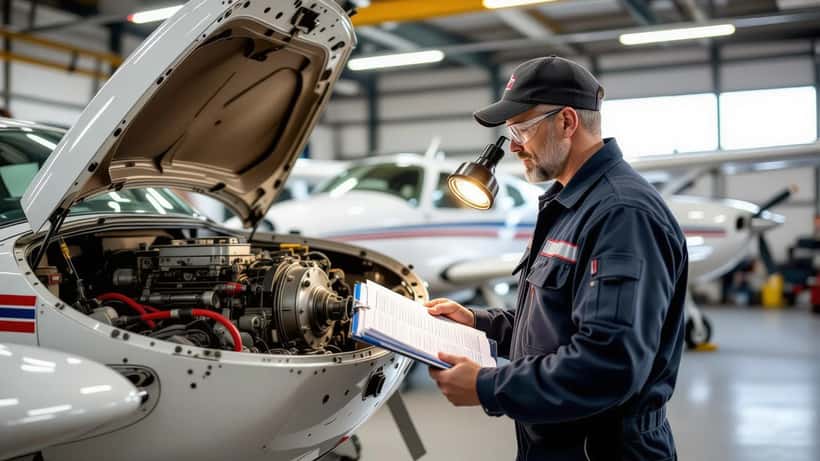
When the TSB arrives at a wreck site, it does not start with the pilot. It starts with the airframe and the engine. Investigators — many of whom are certified aircraft maintenance engineers themselves — reconstruct the aircraft's recent maintenance history, pull the engine logbook, and examine the powerplant for the signatures of failure: scored cylinder walls, a fractured crankshaft, contaminated fuel, or a seized component.
Light single-engine aircraft, the workhorses of flight schools and private owners, are mechanically simpler than airliners, but that simplicity cuts both ways. There is no second engine to carry the aircraft if the first quits. A partial power loss on climb-out — the most demanding phase of flight — leaves a pilot only seconds to react. That is why the pre-flight inspection and the scheduled maintenance cycle are not bureaucratic box-ticking. They are the primary defence.
The failures that a good inspection catches
Investigators and maintenance engineers consistently point to a short list of mechanical culprits behind general aviation power-loss events. Fuel contamination or fuel starvation — water in the tanks, a blocked vent, or simply running a tank dry — remains one of the most common. Carburettor icing can choke an engine even on a warm summer day. Worn magnetos, cracked exhaust systems, and deteriorating fuel and oil lines announce themselves during inspection long before they fail in the air.
None of these are exotic. Every one of them is detectable on the ground by a qualified technician working through a checklist. The mandatory annual inspection and the 100-hour inspection required for commercially operated aircraft exist precisely to force that examination on a fixed schedule, rather than leaving it to chance or to an owner's optimism.
Why the "annual" is the moment that matters
Canada's airworthiness framework requires that maintenance on certified aircraft be performed and signed off by a licensed aircraft maintenance engineer, and that the work be recorded in the aircraft's technical logs. The Transportation Safety Board publishes its investigation findings and safety recommendations openly, and its reviews have repeatedly traced accidents back to maintenance that was deferred, improperly performed, or documented but never actually completed. Readers can consult the board's aviation investigation reports and safety data directly through the Transportation Safety Board of Canada.
The lesson is not limited to aircraft owners. Anyone who relies on an engine — a boat, a generator, a work vehicle, a piece of equipment their livelihood depends on — faces a milder version of the same risk. A machine gives warning signs. Vibration, a change in sound, a small fluid leak, a rough start: these are the ground-level equivalents of the discrepancies an inspector logs during an annual. The difference between a minor repair and a catastrophic failure is usually whether someone qualified looked at the problem while it was still small.
When to call a certified technician — not a hunch
The temptation to defer a mechanical concern is strong, especially when a machine still starts and runs. But the pattern across aviation and every other mechanical domain is the same: failures escalate. A worn part rarely fixes itself, and the cost of an unplanned breakdown — measured in money, downtime, or worse — dwarfs the cost of a timely inspection.
A qualified mechanic or maintenance technician does three things an owner usually cannot. They diagnose against a manufacturer's specification rather than a guess. They have the tools to test components under load instead of just looking at them. And they document the work, so the machine's history is verifiable rather than remembered. On ExpertZoom, you can consult a certified mechanic or repair specialist to interpret a warning sign, review a maintenance schedule, or get a second opinion before deciding whether a repair can wait — the same disciplined approach that keeps aircraft in the air applied to the machines you rely on every day.
What happens next in Longueuil
The TSB's investigation into Thursday's crash will take months, following the same methodical path seen in other recent aviation crash investigations. Investigators will examine the recovered engine, review the aircraft's logs, interview the pilot, and eventually publish their findings. Whether the cause turns out to be mechanical, environmental, or human, the process itself reflects a principle worth borrowing: when a machine fails, you do not guess — you inspect, you document, and you let a qualified expert tell you what the evidence shows. For the pilot who walked away on July 16, and for the general aviation community watching, that discipline is the difference between a hard lesson and a fatal one.
