 Chloé Dubois
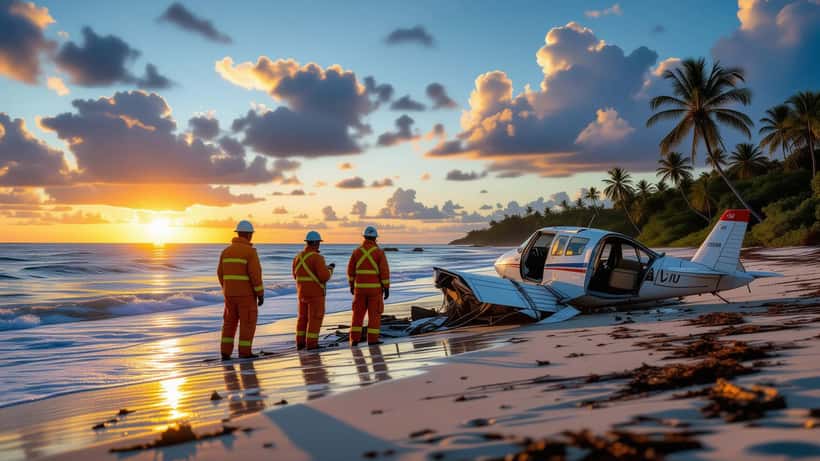
A 2026 aviation incident involving a commercial aircraft near the Bahamas has placed the region's air-safety framework under renewed international scrutiny. Preliminary reports indicate that the aircraft, which was operating a route frequented by tourists and business travelers, encountered difficulties during descent, resulting in a crash that claimed multiple lives and injured several others. Emergency crews from Nassau and surrounding islands responded within hours, but the full scope of the tragedy is still unfolding as recovery operations continue and investigators begin the painstaking work of determining what went wrong.
The Bahamas, an archipelago of more than 700 islands, relies heavily on aviation to connect its population centers and to support a tourism sector that accounts for a substantial share of national income. That dependence makes any major aviation accident not only a human tragedy but also an economic and regulatory shockwave. When an aircraft fails in Bahamian airspace, the ripple effects reach airlines, insurers, tour operators, airport authorities, and the families of victims spread across multiple countries. For these stakeholders, the immediate aftermath is rarely just about grief; it is also about assigning responsibility and understanding whether the disaster could have been prevented.
Aviation accident investigations are among the most technically demanding inquiries in modern transportation. They typically require a multi-disciplinary team that includes metallurgists, engine specialists, meteorologists, human-factors experts, and representatives from the airline and manufacturer. In the case of the Bahamas crash, local civil-aviation authorities will almost certainly coordinate with international counterparts, because the aircraft, crew, or passengers may be linked to jurisdictions outside the islands. Evidence from the flight-data recorder, cockpit-voice recorder, maintenance logs, and air-traffic-control transcripts will need to be synchronized before investigators can publish even a preliminary finding.
That complexity is precisely why families, attorneys, and companies affected by such an event often turn to independent aviation experts early in the process. A victim's family in Canada or the United States, for example, may not know how Bahamian tort law interacts with the Montreal Convention or with the airline's country of registration. An aviation lawyer can explain where a claim can be filed, which damages may be recoverable, and how jurisdictional limits could affect compensation. An accident-reconstruction specialist can review publicly released evidence and flag inconsistencies that warrant closer legal attention. A safety consultant can help other operators determine whether similar risks exist in their own fleets.
Early indicators suggest that weather, mechanical failure, and crew decision-making will all be examined as potential contributing factors. The Bahamas sits in a region where tropical storms and rapidly changing wind patterns can challenge even experienced flight crews. Investigators will review whether forecast information was accurate, whether the crew received timely updates, and whether operational pressures played any role in the sequence of events. At the same time, maintenance records will be scrutinized to see whether a component failure or deferred repair contributed to the loss of control. Each of these threads can take months or years to resolve, and interim reports may raise as many questions as they answer.
For passengers and their families, the waiting period can be agonizing. Airlines and insurers usually move quickly to manage reputational and financial exposure, while families are often still absorbing the shock of the loss. Legal deadlines, known as statutes of limitations, can begin to run even before an official cause is determined. That asymmetry of information and urgency makes independent expert advice especially valuable. A qualified aviation attorney can preserve evidence requests, monitor the official investigation, and ensure that a family does not inadvertently waive rights by accepting an early settlement.
The crash also has implications for businesses beyond the immediate victims. Tour operators that charter flights between Florida and the Bahamas may face cancellations or renewed safety questions from customers. Aircraft lessors and insurers will reassess risk models for routes over the Caribbean. Corporate travel managers may revisit policies that rely on smaller regional carriers. In each case, external expertise can help decision-makers separate reasonable caution from panic and identify concrete steps to mitigate risk.
Regulatory oversight in the Bahamas is carried out by the Civil Aviation Department, which operates under standards set by the International Civil Aviation Organization. While these standards are broadly aligned with global best practices, enforcement capacity and resources can vary across smaller states. International experts who have worked in comparable jurisdictions often note that the quality of an investigation depends not only on the rules on paper but also on access to laboratories, trained personnel, and political independence. Any perception that an inquiry has been rushed or influenced can undermine public confidence and complicate later legal proceedings.
In the weeks ahead, attention will focus on the recovery of wreckage and the download of black-box data. Those technical steps will shape the narrative, but they will not resolve the broader questions of accountability and prevention. For anyone directly affected by the Bahamas crash, whether as a family member, a business owner, or an aviation professional, the most prudent course is to seek expert guidance before making irreversible decisions. The investigation will unfold on its own timetable, but the rights and options of those involved do not have to wait.
Plane crashes remind the public that air travel, despite its remarkable safety record, remains a system dependent on human judgment, mechanical integrity, and regulatory vigilance. They also illustrate how quickly a single event can draw in multiple legal systems, corporate interests, and grieving families. In that environment, expert consultation is not a luxury; it is a practical necessity for understanding risk, protecting rights, and pursuing accountability under often-confusing international rules.
