 Patrick Roy
Strong winds knocked out power to more than 10,000 customers across central and northern Alberta on Wednesday, October 14, 2026, according to outage maps from Fortis Alberta and ATCO cited by regional media. Around Athabasca, roughly 135 kilometres north of Edmonton, about 6,250 Fortis customers were in the dark, and close to 2,000 more were offline near Boyle and Lac La Biche.
The outages were not a quirk of one rural grid. Gusts of 80 to 95 km/h were recorded just outside Edmonton, and a blackout even closed advance polling at two rural Alberta locations for part of the afternoon. Environment and Climate Change Canada expected the winds to ease overnight, but many households are now asking the same practical questions.
What do you actually do in the first hour without power?
Treat the outage as a home-systems event, not just an inconvenience. Start by unplugging sensitive electronics, because the restoration moment is when voltage spikes are most likely. Leave one lamp switched on so you can see when power returns.
Keep fridge and freezer doors shut. Food-safety guidance from Health Canada generally says a closed fridge keeps food cold for about four hours, and a full freezer holds for roughly 48 hours. For a deeper look at spoilage rules, our earlier piece on Edmonton storm power outage safety tips covers the checklist step by step.
Then check the basics: is the outage street-wide or only your house? A tripped main breaker looks identical from the inside. If your neighbours' lights are on, call an electrician rather than reporting it to the utility.
Why do high winds cause outages in the first place?
Wind itself rarely snaps a modern power line. The usual culprits are trees and branches falling onto conductors, and debris tossed into equipment. In the shoulder season, many trees still hold leaves, which makes them catch more wind and fall more easily.
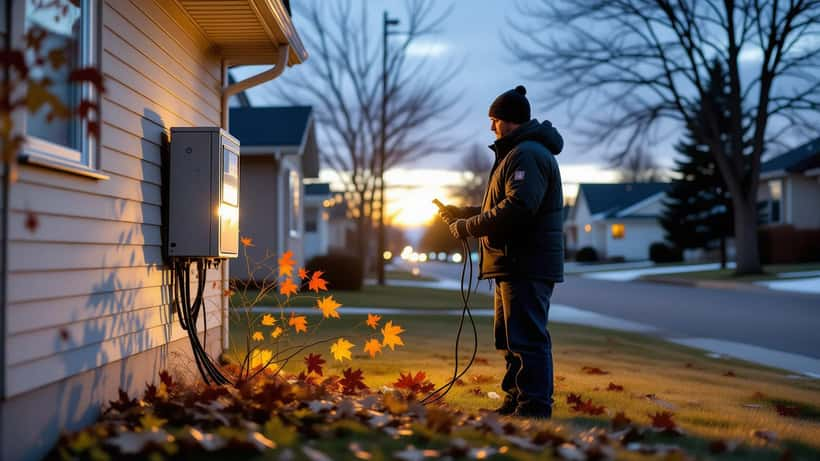
That matters for homeowners because the line from the pole to your house, called the service drop, belongs to a different party than the wiring inside your walls. Utilities generally handle the pole-side equipment, while the service mast and meter base on your home are the owner's responsibility. If wind has bent your mast or pulled the meter base loose, the utility will typically require a licensed electrician to repair it before reconnecting you.
Is a backup generator worth it for an Alberta home?
For many households, a short outage is a nuisance. For others, such as someone running a sump pump, a medical device, or a home-based business, it is a real risk. A portable generator is the cheaper route, and a permanently installed standby unit is the more expensive, more convenient one.
The safety rules are non-negotiable. Run a portable generator outdoors, well away from windows, doors and vents, because carbon monoxide builds up fast in garages and enclosed spaces. Never plug a generator into a wall outlet to power the house, since that can send electricity back onto the grid and endanger line crews. A licensed electrician can install a transfer switch or an interlock kit that prevents this.
A concrete case: one household, a six-hour outage
Consider a family in a detached home near Sherwood Park with a finished basement and a sump pump. The wind takes out power at 2 p.m. on October 14, and it is restored at about 8 p.m., a six-hour outage. The family has no backup power.
Here is how the numbers play out. A typical sump pump draws somewhere between 600 and 1,000 watts when running, so a small portable generator of 2,000 to 3,000 watts could cover it along with a fridge and a few lights. If the family had owned one, the cost might have been in the range of $800 to $1,500 for the unit plus roughly $500 to $1,200 for a professionally installed interlock or transfer switch, depending on the electrician and the panel.
Now apply if/then logic. If the outage lasts under four hours and the weather is dry, the sump pump probably never matters and the fridge stays safe, so the main risk is a surge when power returns. A plug-in surge protector costing $30 to $80, or a whole-home surge protective device costing a few hundred dollars installed, covers that. If the outage runs past eight hours during heavy rain or snowmelt, the pump stops, the pit can fill, and basement flooding becomes a real possibility. Water damage claims often run into the thousands of dollars, and many standard policies exclude sewer backup unless you added a rider. That makes the electrician's visit and the insurance rider look cheap by comparison.
In this household's case, the six-hour outage was dry, so nothing flooded, but it exposed the gap. The practical decision is to price a transfer switch now, while the weather is calm, rather than during the next storm when electricians are booked solid.
What should you ask an electrician after a wind event?
If your power flickered, surged, or came back with dim or buzzing lights, do not assume everything is fine. Ask a licensed electrician to check four things:
- Service mast and meter base: look for bending, cracked sealant, or loose conduit after high winds.
- Main panel: confirm breakers are not tripping repeatedly and that there are no scorch marks.
- Surge protection: ask whether a whole-home device suits your panel and what it covers.
- Grounding and bonding: a proper ground helps protect equipment from voltage spikes.
Electrical work is regulated in Alberta, and permits are generally required for panel upgrades and generator connections. A reputable contractor will pull the permit and arrange the inspection, which also protects you if you later file an insurance claim.
How should you prepare before the next wind warning?
Preparation is mostly small and cheap. Charge phones and power banks as soon as a wind warning is issued, and keep a battery lantern where everyone can find it, since candles raise fire risk in a dark house. Trim branches that overhang your service drop, but never touch anything near a line yourself: call the utility or a certified arborist. Store a few days of drinking water, and note where your garage door's manual release is, because electric openers fail when the power does. These steps take an afternoon and make the next outage far less stressful.
Can you get compensation from the utility?
Usually not for the outage itself. Utilities typically are not liable for weather-driven interruptions, and most households must absorb the cost of spoiled food or lost hours. Your home insurance may respond to spoiled food or to damage from an insured peril, but policies differ, and deductibles often exceed small food losses. For disputes or questions about billing and service, the Utilities Consumer Advocate at ucahelps.alberta.ca explains what rights Alberta consumers have and how to complain.
What to do now
Write down the date, start and end times of this outage, and photograph any damage before you clean up. Keep receipts for hotel stays, generator fuel, and repairs. Then book a licensed electrician for a post-storm inspection and ask for a quote on surge protection and a generator interlock before winter arrives.
This article is general information, not electrical, legal or insurance advice. For work on your panel or wiring, always use a licensed professional. If you want a vetted specialist to look over your home's electrical system and backup-power options, ExpertZoom's Home Improvement experts can help you get a clear quote and a safe plan before the next storm.
