 Michael Young
Wildfire smoke pushed Ottawa's air quality into the high-risk zone again in July 2026, and the fixes that matter most are not medical — they are structural. Environment Canada issued a special air quality statement for the Ottawa-Gatineau region on July 11, 2026, as smoke from Quebec forest fires settled over the capital, then lifted the warning on the afternoon of July 12 (as reported by CTV News and CBC). Days later, smoke drifting in from northwestern Ontario dropped the Air Quality Health Index back to poor across eastern Ontario. Between these episodes, the readers who fared best were the ones whose homes were sealed and filtered before the alert arrived.
That is a home-improvement problem, not just a health one. A house is only as clean inside as its weakest seal and its cheapest filter. Ottawa homeowners who wait until the sky turns orange to shop for supplies are already too late — hardware stores sell out of quality filters within hours of a smoke event. Here is what contractors and HVAC specialists recommend you do now, before the next plume rolls in.
Why your standard furnace filter is not enough
The particle that makes wildfire smoke dangerous is PM2.5 — fine particulate matter small enough to slip deep into your lungs. Most homes ship with a cheap MERV 8 furnace filter designed to protect the equipment, not your air. It lets the majority of smoke particles pass straight through.
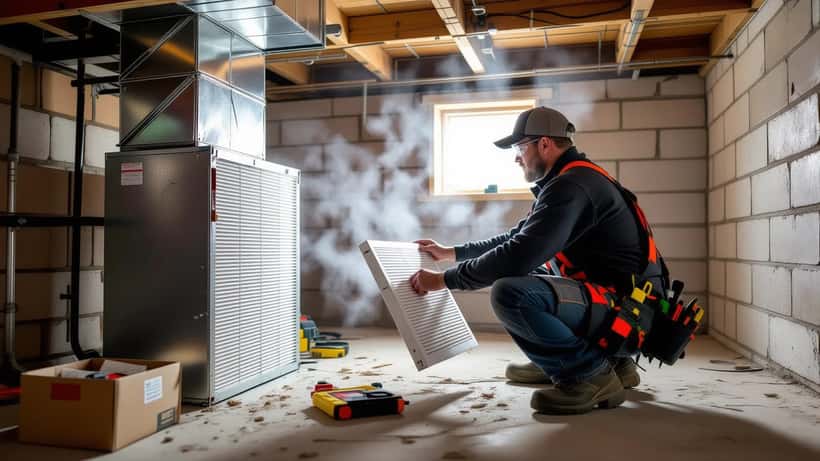
Health Canada's guidance for cleaner air spaces during wildfire smoke events recommends a filter rated MERV 13 or higher, which captures far more PM2.5 while still allowing enough airflow for a residential furnace. Before you upgrade, an HVAC technician should confirm your blower can handle the added resistance — forcing a MERV 13 filter into an undersized system can strain the motor and actually reduce airflow. This is the single most cost-effective upgrade for smoke season, and it is exactly the kind of check a qualified specialist can do in one visit.
Seal the house before you filter it
Filtration only works on the air already inside. Every gap around a door, window, or wall penetration is an open invitation for outdoor smoke. On a poor-air day, PM2.5 can climb indoors within an hour if a home leaks.
The high-value targets are familiar to any renovation contractor: worn weatherstripping on exterior doors, gaps around window frames, unsealed attic hatches, and the pass-throughs where cables, pipes, and dryer vents cut through exterior walls. A weekend of weatherstripping and caulking pays off twice — it keeps smoke out in summer and cold out in winter, trimming your energy bill year-round. Many Ottawa homeowners already booked this work alongside summer cooling upgrades their contractors recommended, and the two projects share most of the same air-sealing steps.
Set your HVAC to recirculate — then remember to switch back
Central air and heat-recovery ventilators default to pulling in fresh outdoor air. During a smoke event that is exactly wrong. Health Canada advises recirculating indoor air when outdoor conditions are poor and only drawing in fresh air once the smoke plume abates, which keeps trapped pollutants like carbon dioxide from building up.
If your home has a heat recovery ventilator (HRV) or energy recovery ventilator (ERV) — common in newer Ottawa builds — reduce the outdoor-air intake during smoke and return to normal ventilation when the AQHI improves. On many units this is a single switch or a setting on the wall controller, but the exact steps vary by model, and an installer can label the controls so any family member can flip them the moment a statement is issued.
Build one clean-air room
You cannot filter an entire house to hospital standards, and you do not need to. Experts recommend creating one clean-air room — usually a bedroom — using a portable HEPA air purifier sized to the square footage. This gives your household, and especially anyone more vulnerable, a reliable place to breathe easier.
Choose the room your family uses most, keep its door closed during smoke events, and avoid anything that adds particles: no candles, no frying, no vacuuming without a HEPA-filtered machine. A right-sized HEPA unit running continuously can keep that single room clean even when the rest of the house is hazy. If you would rather not buy a unit, a box-fan-and-filter build using a MERV 13 filter is a low-cost stopgap that many households assemble in minutes.
Stockpile filters — smoke overloads them fast
Wildfire smoke is episodic and heavy. Particulate matter can overload a filter quickly, choking airflow and forcing your system to work harder. That means the MERV 13 filter you installed in June may be spent by August.
Keep two or three spare filters on hand before the season peaks, and inspect them after every multi-day smoke event rather than waiting for the calendar. A grey, clogged filter is not protecting anyone. Trained HVAC personnel know how to read a filter's condition and how often to swap it during a smoke-heavy summer — a maintenance plan worth setting up once and reusing every year.
Who to call, and when
The work above spans several trades: an HVAC technician for filters and blower checks, a renovation contractor for weatherstripping and sealing, and an installer to configure your HRV or ERV. On Expert Zoom you can compare qualified home-improvement and HVAC specialists in the Ottawa region, describe your home's setup, and book the right pro before the next alert rather than during it.
A note on health: sealing and filtering reduces your exposure, but it does not replace medical advice. Environment Canada warns that people 65 and older, pregnant people, infants, young children, and those with chronic conditions are more likely to feel effects such as eye and throat irritation, headaches, or cough. If symptoms worsen, consult a health professional. For the medical side of smoke exposure, see our guide on when wildfire smoke becomes a health risk.
Ottawa's smoke seasons are no longer rare. The homeowners who treat clean indoor air as a renovation project — sealed envelope, upgraded filter, one clean-air room, spare filters on the shelf — spend the next statement comfortable indoors instead of scrambling for supplies. The best time to do the work is a clear-sky day. That may be today.
