 Dimitri
 As Canadians refresh The Old Farmer's Almanac page daily this July, waiting for its Winter 2026–2027 outlook, the almanac's editors have already dropped their clearest early clue: El Niño is officially underway and strengthening as the country heads toward the cold season. The full long-range forecast will land in the 2027 edition due out in late summer, but you do not need to know whether the almanac nails the snowfall totals to know one thing for certain — winter will arrive, and your car has to survive it. A mechanic's advice: start prepping now, not on the first icy morning.
Why the almanac is trending in July
The Old Farmer's Almanac, published since 1792, releases its famous long-range winter forecast every year around this time, and searches spike months before the first flurry. According to the almanac's editors, they are still tracking El Niño's strength, the Quasi-Biennial Oscillation, Atlantic and Pacific ocean patterns, solar activity and the jet stream before publishing the complete Winter 2026–2027 outlook.
Last winter, the almanac called for a milder-than-average season across most of Canada, with above-normal snow in the south and in Atlantic Canada and the snowiest stretches clustered in late November, late December and early February. Meteorologists routinely caution that the almanac's traditional long-range method is not scientifically validated, and its self-reported accuracy is disputed. That skepticism is fair — but it misses the point for a car owner. Whether the almanac or Environment Canada is closer, the mechanical demands of a Canadian winter do not change.
What the cold actually does to your vehicle
Cold weather punishes a car in ways many drivers underestimate. A lead-acid battery loses roughly a third of its cranking power at -18°C, which is why an aging battery that started fine in October dies in a driveway in January. Tire pressure falls about one pound per square inch for every 5°C drop in temperature, so a set that was correctly inflated in summer can be dangerously soft by December, hurting grip and braking on exactly the surfaces where you need them most.
Engine oil thickens as the mercury falls, straining the starter and delaying lubrication on cold starts unless you switch to a low-viscosity winter grade such as a 0W formulation. Rubber components — wiper blades, belts, door seals — stiffen and crack. Washer fluid rated only for mild temperatures freezes solid in the reservoir and lines, leaving you blind behind a salt-smeared windshield. None of these failures care about the almanac's percentages.
The mechanic's pre-winter checklist
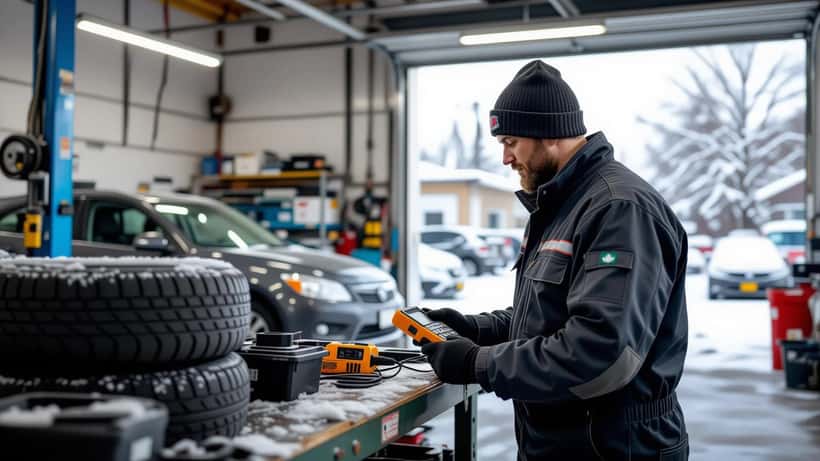
A licensed mechanic can run a proper cold-weather inspection in under an hour, and it is far cheaper than a boosted battery, a tow, or a collision. Key items to cover before the first hard freeze:
- Battery test. Have the charge and cold-cranking amps measured. A battery over four or five years old that tests weak should be replaced before winter, not after it strands you.
- Winter tires. Fit four matched tires bearing the peaked-mountain-with-snowflake symbol. Transport Canada advises against relying on tires worn close to 4 mm (5/32 inch) of tread on snow-covered roads. Remember the rules: winter tires are mandatory in Quebec from December 1 to March 15, and required on many British Columbia highways from October 1 to April 30.
- Fluids. Switch to a winter-grade oil, top up the coolant with the correct antifreeze mix rated to at least -40°C, and fill the reservoir with -40 washer fluid.
- Brakes and belts. Ask for a brake inspection and have belts and hoses checked for cracking, since cold accelerates rubber failure.
- Block heater. In regions that regularly drop below -20°C, confirm the block heater and its cord work so the engine starts cleanly and warms faster.
When to see a professional — and when not to wait
Some winter symptoms are warnings you should not drive through. A battery or check-engine light on a cold morning, a grinding or spongy brake pedal, a burning smell from stiff belts, or a car that cranks slowly and hesitates all warrant a same-week visit to a shop. Steering that feels vague on cold pavement can signal underinflated or summer-compound tires that harden below 7°C.
The mistake mechanics see every winter is procrastination. Booking a seasonal inspection in September or October is routine; booking it during the first snowstorm means joining a queue behind everyone else who waited. Parts such as batteries and popular winter tire sizes also sell out after the first cold snap, so early preparation is as much about availability as it is about safety.
The bottom line
Treat the Old Farmer's Almanac forecast as a useful nudge rather than a mechanical schedule. It is a reminder, arriving conveniently in mid-summer, that winter is coming for your vehicle no matter what the ocean temperatures do. Transport Canada offers a full guide to preparing your vehicle for winter, and pairing that checklist with a professional inspection is the surest way to avoid a dead battery on the coldest morning of the year.
For related seasonal reading, see our coverage of what Canadian drivers and mechanics should watch this year and how to use a weather forecast to plan safely. If your car has not had a cold-weather check in the last year, a certified mechanic on Expert Zoom can inspect the battery, tires and fluids and tell you exactly what needs doing before the almanac's winter — mild or brutal — actually arrives.
